
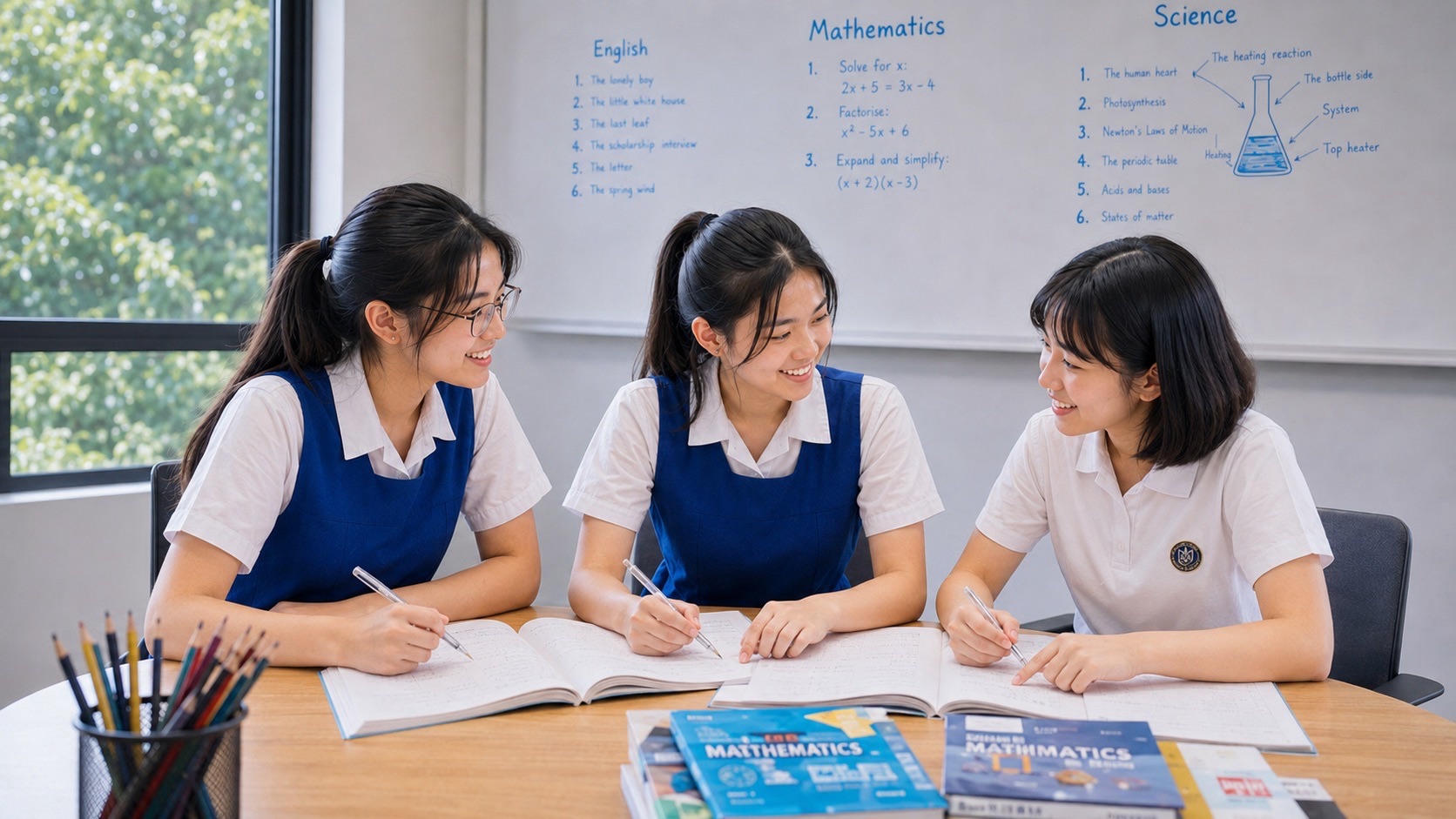
Primary 5 Science students often know how to read a result but are less sure how strong a conclusion the result actually supports. A small group can make this visible by giving three students the same investigation and asking each to decide whether the evidence is weak, adequate or strong enough for the claim being made.
This page has one job: show how Primary 5 Science small-group tuition can use One Investigation → Three Evidence Thresholds → Claim Revision → Independent Transfer to teach students not to overclaim from limited evidence.
For current programme information, continue to Punggol Primary Science Tuition P3–P6. eduKatePunggol’s current model is up to three students, typically for 1.5 hours.
The direct answer: the same result can support different strengths of claim
A graph may show a trend. A table may contain a difference. An experiment may produce one outcome. None of these automatically proves every explanation a student attaches to it.
- some evidence is too weak;
- some evidence is adequate for a narrow conclusion;
- some evidence becomes stronger after repeat measurements or better controls;
- some evidence can rule out one claim without proving another;
- some results remain ambiguous.
Primary 5 students should begin learning to match claim strength to evidence strength.
Threshold 1: weak evidence
Evidence is weak when the result does not distinguish clearly among competing explanations or when the method leaves important uncertainty.
- only one observation was made;
- measurements are inconsistent;
- several relevant conditions changed at once;
- the measured outcome does not directly test the claim;
- the conclusion is broader than the sample or setup;
- an obvious alternative explanation remains.
The correct response may be: “The result suggests ___, but it is not enough to conclude ___.”
Threshold 2: adequate evidence
Evidence can be adequate for a carefully bounded classroom conclusion when:
- the comparison is relevant;
- important competing conditions are controlled;
- the measurement answers the investigation question;
- the pattern is clear enough for the stated claim;
- the student does not generalise beyond the setup.
The key is scope. “In this investigation, setup A produced a higher temperature than setup B” is a stronger scientific statement than “A is always better”.
Threshold 3: stronger evidence
Evidence becomes stronger when uncertainty is reduced.
- measurements are repeated where useful;
- the same pattern appears consistently;
- relevant controls are maintained;
- the measurement method is appropriate;
- a changed example produces the expected relationship;
- alternative explanations are tested or narrowed.
Stronger evidence still does not justify unlimited claims. The student should state what was actually shown.
One investigation, three students
Imagine an investigation comparing how quickly equal amounts of water warm in two containers.
- Student A says: “Container A is the best container.”
- Student B says: “The water in A warmed faster in this setup.”
- Student C says: “A warmed faster, but we should check whether container material and starting conditions were controlled before explaining why.”
All three noticed the same result. Their evidence discipline differs.
The tutor’s question: what exactly has been proven?
After every conclusion, ask the student to identify the evidence boundary.
- What did we actually measure?
- What comparison did we actually make?
- What remained controlled?
- What did we not test?
- What alternative explanation remains possible?
- What additional evidence would strengthen the claim?
This turns “write the conclusion” into an evaluation task.
Use the claim ladder
- Observation: what happened?
- Pattern: what relationship appears?
- Claim: what conclusion is supported?
- Boundary: what does the evidence not show?
- Upgrade: what additional evidence would make the claim stronger?
Students should learn to move up the ladder without skipping the lower levels.
A correct concept can still produce an overclaim
A student may know the right Science but state the conclusion too broadly. For example, knowing that light affects plant processes does not mean one short classroom comparison proves that “more light always makes plants grow more”.
The tutor should separate:
- what the established scientific concept says;
- what this particular investigation observed;
- what conclusion this particular evidence supports.
Counterevidence belongs in the lesson
Once the class forms a conclusion, introduce one result that does not fit perfectly.
- Is it measurement noise?
- Is it an outlier?
- Did another condition change?
- Does the original claim need narrowing?
- Should the investigation be repeated?
Students learn that Science is not weakened by inconvenient evidence. The model becomes better when it accounts for it.
Peer comparison should improve claim precision
Three students can compare conclusions without ranking one another.
- Which claim is supported directly?
- Which one contains an unsupported leap?
- Which one is too cautious?
- Which extra evidence would change the ranking?
The aim is to calibrate scientific confidence.
Do not confuse “more detail” with “stronger evidence”
A long paragraph cannot compensate for a weak experiment. Students sometimes add scientific facts around a conclusion to make it sound more convincing. The tutor should bring them back to the actual evidence.
What in this investigation supports that sentence?
Why Primary 5 is an important evidence year
Primary 5 students increasingly coordinate systems, interactions, experiments, graphs, tables and causal explanations. They are also building the runway into P6, where application and inquiry must work across mixed conditions.
Learning to judge evidence strength now reduces two common later problems: overconfident conclusions and model-answer dependence.
How this aligns with current Primary Science
The current MOE Primary Science syllabus emphasises scientific knowledge, practices and values, including prediction, interpretation, evaluation, communication and evidence-based reasoning. It asks students to use Science rather than merely recall it.
Official reference: MOE Primary Science Teaching and Learning Syllabus.
How this works in a 3-pax P5 class
- all three examine the same investigation;
- each writes an individual conclusion;
- each rates the evidence as weak, adequate or strong for that claim;
- students defend the rating with method evidence;
- the class revises the claim;
- each learner completes a new evidence-strength task independently.
The group creates contrast. The final proof remains individual.
When small-group tuition may help
- the student writes conclusions stronger than the data;
- one result is treated as universal proof;
- controls are memorised but their purpose is unclear;
- graphs are described but not evaluated;
- counterexamples are ignored;
- the learner cannot say what additional evidence would help.
Progress receipts
- claims become more tightly scoped;
- students distinguish observation from conclusion;
- overclaiming decreases;
- controls are linked to competing explanations;
- counterevidence triggers revision;
- students can propose a stronger follow-up investigation.
One investigation should teach more than one answer
A useful P5 small-group lesson does not stop when the result is known. It asks how strong the result is, what it can justify, what remains uncertain and what evidence should come next.


