
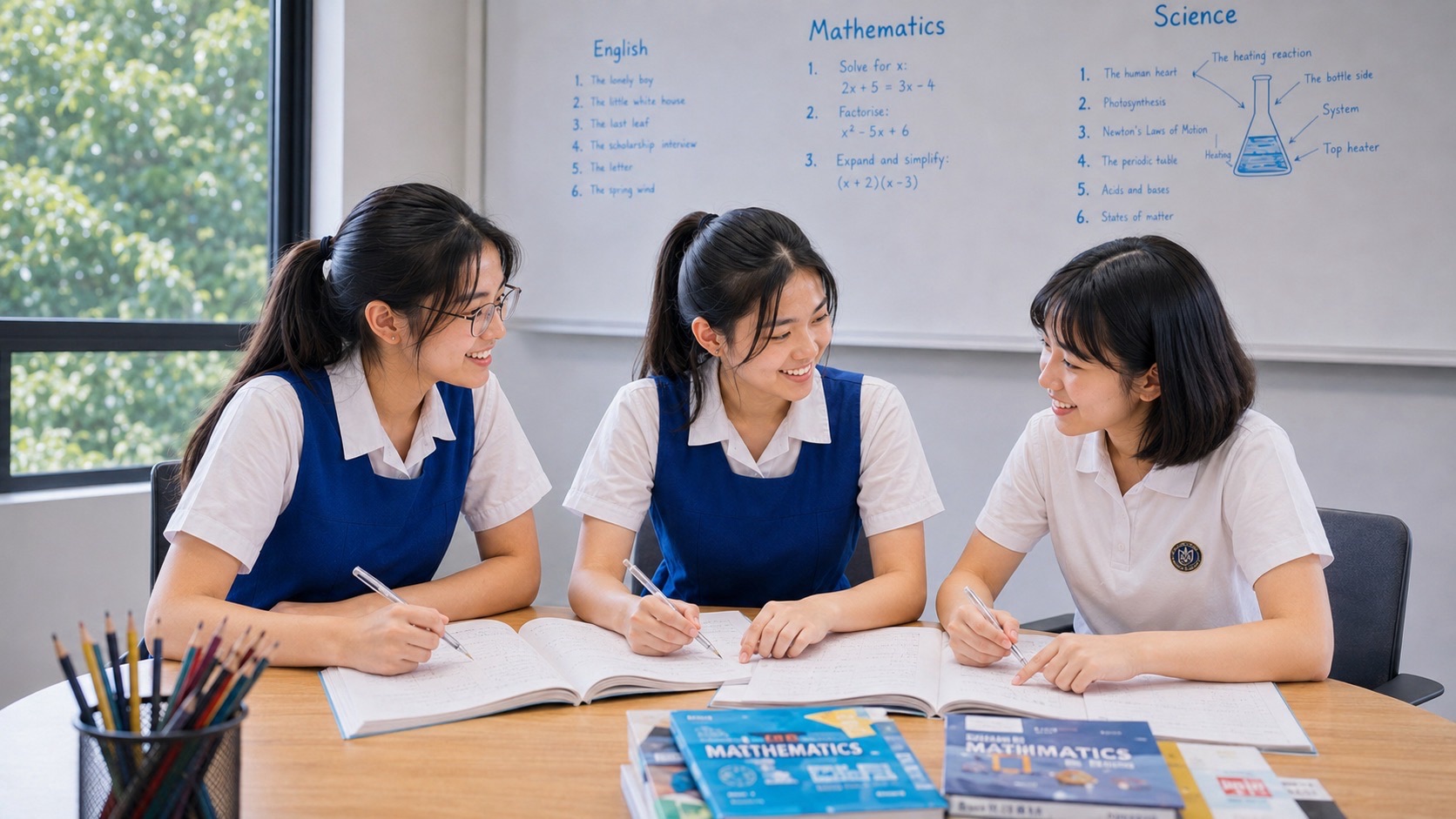
A small group becomes useful when students can learn from one another without simply copying the strongest voice. At Primary 3, three learners reading the same passage or writing from the same prompt can notice different clues, choose different words and organise ideas differently. The tutor’s job is to turn those differences into useful contrast, then return each student to an individual task.
This Yishun Primary 3 English small-group tuition page owns one specific job in the eduKate estate: peer contrast without copying. Our other Yishun P3 pages already cover connected English, the reading-to-learn transition, visible reasoning and the correction–retrieval–transfer loop. Here we focus on how a three-student environment can expose alternatives while still protecting individual ownership.
Why Peer Contrast Matters at Primary 3
Primary 3 English begins asking for more connected language. Students read longer passages, make simple inferences, build paragraphs, choose vocabulary in context and explain more of their thinking. At this stage, seeing another valid reasoning path can widen a child’s understanding.
| Shared task | Useful peer contrast | Risk to avoid |
|---|---|---|
| Vocabulary | Compare why two words differ in meaning or tone | Copying the word without understanding the distinction |
| Comprehension | Compare which clue supports each interpretation | Following the confident answer without checking text |
| Grammar | Compare which sentence condition each learner noticed | Memorising another student’s answer pattern |
| Writing | Compare paragraph jobs and development choices | Copying plot or phrases |
| Oral | Hear different examples supporting the same viewpoint | Repeating someone else’s experience mechanically |
The Three-Step Peer Routine
- Produce first. Each student attempts before hearing everyone else.
- Compare second. The tutor surfaces useful differences in evidence, language or structure.
- Retest alone. Each student receives a changed individual task so ownership can be checked.
The order matters. If the most confident learner answers first every time, the other students may never reveal their original reasoning.
Vocabulary: Compare the Reason, Not Just the Word
Suppose three students choose walked, strolled and dashed for a sentence. The tutor can ask what the scene requires. Is the character relaxed, ordinary or urgent? Which verb preserves the situation?
- meaning;
- intensity;
- tone;
- collocation;
- grammar form;
- context.
The learning is the selection logic. If Student B later uses Student A’s word in a new sentence correctly, that can be transfer. If Student B simply repeats the word because it was praised, that is imitation.
Comprehension: Evidence Decides Between Plausible Answers
Two P3 students can offer different interpretations that both sound sensible. The group should not decide by confidence or majority vote. The text is the authority.
- Which sentence supports your answer?
- What does that clue actually show?
- Does your conclusion add something the text never established?
- Which interpretation needs fewer unsupported assumptions?
This teaches a durable reasoning habit: disagreement is resolved by stronger evidence.
Grammar: Compare the Trigger Each Student Saw
A grammar answer is more useful when students can say what selected it. One student may notice the time marker. Another may notice the true subject. A third may have guessed from sound.
| Grammar relationship | Useful question |
|---|---|
| Agreement | Which noun controls the verb? |
| Tense | When does the action happen? |
| Pronoun | What noun does this replace? |
| Conjunction | How are the ideas related? |
| Punctuation | Where does one complete idea end? |
The tutor validates the reasoning, not the loudest answer.
Writing: Compare Architecture Without Creating Three Copies
Peer writing comparison can become harmful if children are encouraged to copy a “best” composition. A stronger approach compares function.
- Which opening establishes the situation clearly?
- Which paragraph has the clearest job?
- Which detail actually develops the event?
- Which transition makes the sequence easier to follow?
- Which ending follows naturally from what happened?
Students can learn a structural principle and still write different stories. The principle is shared; the expression remains individual.
Oral Work: Use Different Experiences as Evidence
In oral discussion, three students may answer the same question with different personal examples. The tutor can ask what makes each example relevant. This teaches development and listener awareness while keeping the child’s own voice.
Protect Quiet Thinkers
Small groups can still be dominated by the fastest speaker. The tutor can protect original thinking by using silent first attempts, written choices, rotating who answers first or asking everyone to identify evidence before discussion.
- everyone thinks before anyone speaks;
- each child produces an initial answer;
- discussion follows the attempts;
- the tutor verifies reasoning;
- the final retest is individual.
Retest Alone: The Essential Anti-Copying Step
After a productive discussion, students often feel they understand. The tutor still needs to know whether each child can generate the process alone.
- Change the sentence, passage or prompt.
- Remove the group answer.
- Do not announce which peer idea is relevant.
- Let each student begin independently.
- Observe the smallest prompt required.
- Return again after delay.
This step converts a social learning moment into individual evidence.
Three Students Is Useful Because Everyone Remains Visible
eduKate’s small-group model centres on three students, typically in 1.5-hour lessons. The number is not magic. Its value is the operating condition it creates: enough variation for contrast, small enough for individual reasoning and retesting to remain visible.
| Small-group advantage | What it should produce |
|---|---|
| Three answers | Useful comparison |
| Three explanations | Visible reasoning differences |
| Three writing plans | Architecture contrast |
| Individual retests | Ownership evidence |
| Different prompt levels | Personalised support fading |
Why This Fits Primary 3 English Development
MOE’s Primary English Language Syllabus 2020 emphasises interaction, oracy, reading, writing, meaning-making and increasingly independent language use. A well-run small group can support those goals when peer interaction is used to clarify language and reasoning rather than replace individual thought.
Parents can review the public English Language Syllabus 2020 (Primary).
What Parents Can Ask About a P3 Small Group
- Does every child attempt before hearing the strongest answer?
- Are students asked to explain evidence and language choices?
- Does peer comparison focus on reasoning rather than ranking?
- Are writing structures discussed without forcing one copied plot?
- Is every student retested individually?
- Are tutor prompts reduced over time?
For Yishun Families: Verify the Actual Class Arrangement
Families searching from Yishun should confirm the actual teaching location, timing and current availability before enrolment. eduKate publishes location-targeted tuition information, but a location keyword is not a claim that a physical eduKate centre operates in every named neighbourhood. Travel time and the child’s school-week energy remain part of programme fit.
The Goal Is Learning From Difference Without Losing Ownership
A good three-student class gives a Primary 3 learner something valuable: other minds to compare with. But comparison should widen reasoning, not replace it. The final test is always whether the child can use the learning when the group answer is gone.
Yishun P3 Peer Contrast: Almost-Code Summary
BEFORE_DISCUSSION:
    each_student_attempts()

COMPARE:
    evidence
    grammar_trigger
    vocabulary_precision
    paragraph_function
    oral_example_relevance

TUTOR:
    verify_reasoning()
    protect_quiet_thinkers()
    prevent_copying_as_substitute_for_understanding()

AFTER_DISCUSSION:
    change_task()
    remove_group_answer()
    retest_each_student_alone()

IF individual_transfer_succeeds:
    learning_is_more_portable()

OUTPUT:
    useful_peer_contrast
    preserved_student_voice
    stronger_independent_P3_English
About eduKate
eduKate uses very small groups to make differences in reasoning visible while preserving individual ownership. Our core values are Integrity, Empathy, Critical Thinking and Responsibility.
Properly Taught Kids Shine a Bright Light Into the Future.


