
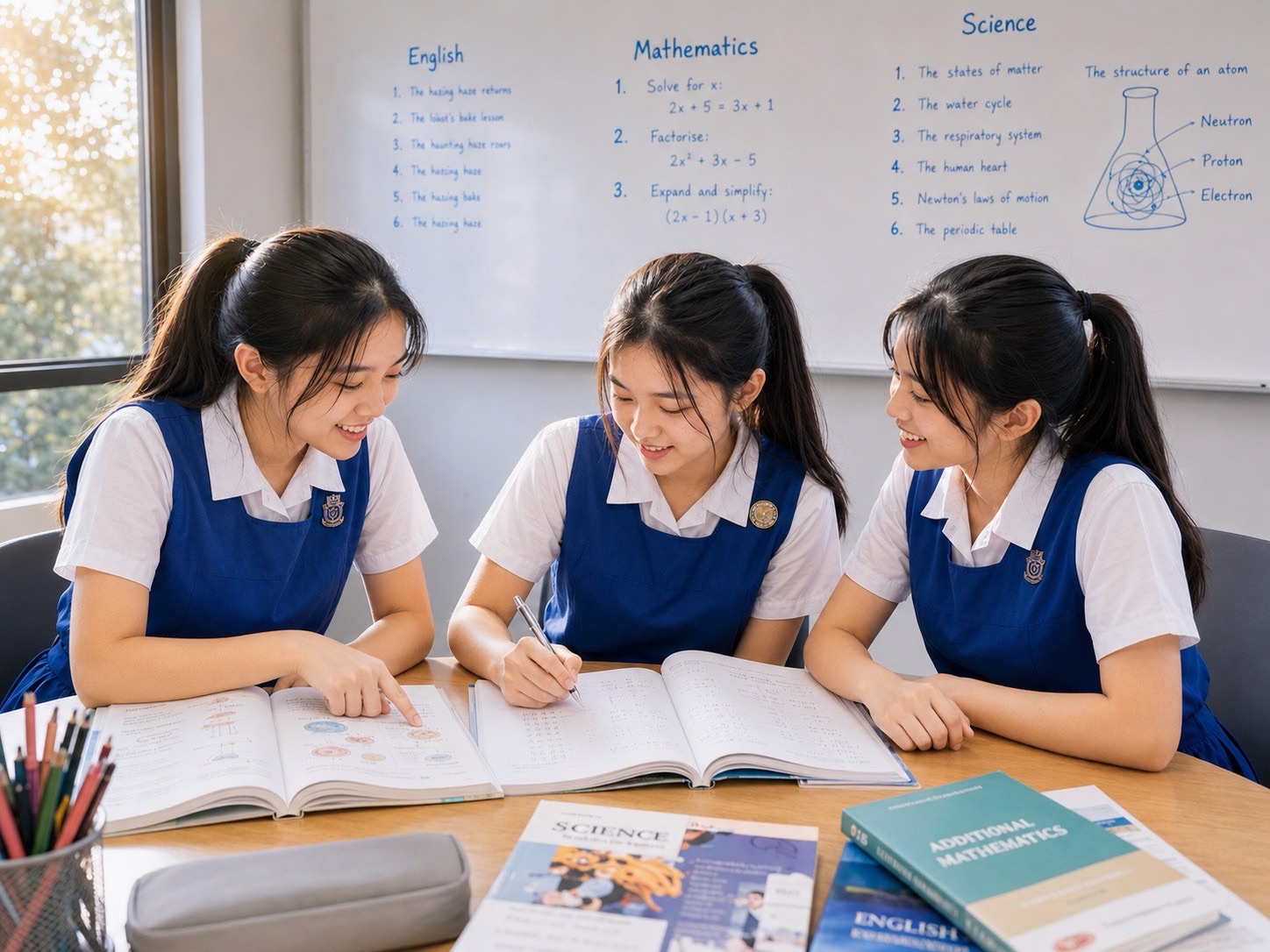
Primary 2 students often know how to make a simple sentence. The next challenge is making it richer without making it less accurate. Add a place, time, reason, description or second action and the sentence can improve—but working-memory load also rises. Grammar, spelling and meaning can begin to slip.
This Sengkang Primary 2 English tutorials page therefore owns one specific job: sentence expansion without loss of control. Our other Sengkang P2 pages cover broad tuition, reading for meaning and the Listen → Read → Retell → Write loop. Here we zoom in on how a young writer grows from one clear clause into richer written English while protecting grammar and meaning.
Start With a Sentence That Already Works
A useful expansion exercise begins with a complete core sentence. For example: The girl ran. The sentence is simple, but it already contains a clear subject and action.
| Add | Expanded sentence | New language job |
|---|---|---|
| Where? | The girl ran across the playground. | Place relationship |
| When? | The girl ran across the playground after recess. | Time relationship |
| How? | The girl ran quickly across the playground after recess. | Manner |
| Why? | The girl ran quickly across the playground after recess because she had forgotten her book. | Cause and clause connection |
Each addition gives the reader more meaning. Each also creates another place where grammar, punctuation or word choice can fail. Expansion therefore needs control, not simply length.
The Five Useful Expansion Questions
- Who or what? Make the subject precise.
- What happened? Choose an accurate verb.
- Where or when? Add context if it helps.
- How? Add useful manner or description.
- Why or what happened next? Connect cause, result or sequence.
Students do not need to answer all five every time. The aim is to choose the detail that helps the sentence do its job. A sentence can become worse when it is expanded with irrelevant information.
Expansion Should Preserve the Core Meaning
Young writers sometimes add so much that the original meaning changes or becomes unclear. We therefore teach a simple check: after expansion, reread the whole sentence and ask whether the main action is still easy to understand.
- Say the simple sentence.
- Add one useful detail.
- Reread the full sentence.
- Check whether the subject and action are still clear.
- Add another detail only if it improves meaning.
- Stop when the sentence has done enough work.
Grammar Load Increases as the Sentence Grows
A short sentence may contain one easy agreement decision. A longer sentence may introduce tense, pronouns, prepositions, conjunctions and clause boundaries. This is why a child can look accurate in isolated grammar exercises and become less accurate during writing.
| Expansion type | Grammar to protect |
|---|---|
| Add place | Prepositions and noun phrases |
| Add time | Tense consistency and time expressions |
| Add description | Adjective placement and meaning |
| Add reason | Conjunction and clause completeness |
| Add second action | Sequence, tense and punctuation |
The tutor can therefore use sentence expansion as a bridge between grammar knowledge and real writing control.
Verb Choice Gives More Value Than Adjective Piling
Young writers are often encouraged to “add adjectives”. Description can help, but precise verbs are frequently more efficient. Compare The dog went quickly towards the gate with The dog dashed towards the gate. One stronger verb can carry manner and action together.
P2 vocabulary work can therefore ask: What exact action happened? Did the character walk, stroll, creep, march, rush or dash? The word must still fit the context. Precision comes before impressive display.
Connect Two Sentences Before Building Long Ones
Sentence combining can begin with relationships the child understands: addition, contrast, cause and sequence.
- and — adds a related action or idea;
- but — shows contrast;
- because — gives a reason;
- so — gives a result;
- after/before — shows sequence.
The tutor asks what relationship exists before choosing the connector. This prevents conjunctions from becoming decorative words inserted at random.
Oral Rehearsal Reduces Writing Load
Primary 2 students can often handle a richer sentence in speech before they can write it independently. We use oral rehearsal to stabilise meaning before the child manages spelling and handwriting.
- Build the sentence orally.
- Repeat it once without changing the meaning.
- Identify the main subject and verb.
- Write the sentence.
- Reread aloud.
- Check whether any spoken word disappeared during writing.
This is a scaffold, not a permanent requirement. As written fluency grows, the amount of oral rehearsal can reduce.
Three Students Creates Three Useful Versions
In eduKate’s three-student format, one core sentence can produce three different expansions. The tutor can compare which details add useful meaning and which create confusion.
Student A may add place. Student B may add reason. Student C may choose a stronger verb. The comparison teaches that there is often more than one valid way to improve a sentence, while grammar and meaning still constrain the choices.
Do Not Turn Peer Examples Into One Model Sentence
The aim is not to merge all three versions into one overloaded “perfect sentence”. The tutor can ask what each version does well, then give every student a fresh core sentence to expand independently.
This keeps the learning transferable. Children learn a process—choose useful detail, preserve meaning, maintain grammar—not a sentence to copy.
Sentence Expansion Supports Reading Too
When a child learns how sentences are expanded, longer reading sentences become less mysterious. The student can find the core subject and action, then unpack where, when, how or why information around them.
This creates a useful bidirectional skill: writing teaches sentence structure; sentence structure helps reading comprehension.
Why This Fits MOE’s Primary English Direction
MOE’s Primary English Language Syllabus 2020 frames grammar and vocabulary as resources for language development and use, and stresses integrated listening, speaking, reading and writing for meaning and communication.
Sentence expansion puts those principles into a concrete P2 task. Grammar is used to hold meaning together; vocabulary is used to make meaning more precise; oral language supports writing. Parents can review the public syllabus at MOE English Language Syllabus 2020 (Primary).
A Typical P2 Sentence-Control Lesson
| Phase | Job |
|---|---|
| Core sentence | Secure a complete simple idea |
| Meaning expansion | Add one useful where/when/how/why detail |
| Grammar check | Protect subject, verb and sentence boundary |
| Vocabulary choice | Replace vague language with a more exact word |
| Peer comparison | Compare three valid expansions |
| Independent transfer | Expand a new sentence without the group model |
| Reading crossover | Find the core of a longer sentence in a short text |
What Parents Can Notice
- Can your child say a complete sentence before writing?
- Can they add one relevant detail without changing the core meaning?
- Do they use conjunctions according to relationship?
- Can they reread a longer sentence and find the main action?
- Are sentences becoming richer without a large increase in grammar errors?
- Can they write a fresh expanded sentence without copying a model?
For Sengkang Families
Families searching from Sengkang should confirm current class location, timing and availability directly. eduKate’s location-targeted pages organise tuition information but do not imply a branch in every named neighbourhood. For P2 students, a manageable travel and school-week routine matters to the quality of attention in class.
Questions Parents Often Ask
Should P2 students write long sentences?
Length is not the target. A longer sentence is useful only when the child can preserve clarity and grammar. Several short, controlled sentences can be stronger than one overloaded sentence.
Should we correct every error immediately?
Not necessarily. The tutor can prioritise errors that affect meaning or represent recurring patterns, while allowing the child to finish a thought before correcting smaller local slips. Correction timing should support both fluency and accuracy.
Can sentence expansion help composition later?
Yes. It builds the ability to add purposeful detail, choose stronger verbs, connect ideas and manage grammatical load—foundations that later support paragraph writing.
The Goal Is Richer Meaning With Stable Control
Primary 2 writing grows when children learn that detail has a job. We do not ask them to make sentences longer for appearance. We ask them to make meaning clearer, more specific or more connected.
As that control strengthens, the student gains a bridge from early sentence writing into the more sustained paragraph work that upper primary will require.
Sengkang P2 English Tutorials: Almost-Code Summary
CORE:
    subject + action

EXPAND:
    choose(where | when | how | why | next_action)

CHECK:
    main_meaning_still_clear()
    grammar_still_stable()
    detail_is_relevant()

VOCABULARY:
    prefer_precise_verb_or_noun()
    avoid_decoration_without_job()

TRANSFER:
    new_core_sentence()
    no_model_copying()
    read_longer_sentence_and_find_core()

OUTPUT:
    richer_sentences
    stable_grammar
    better_reading_of_sentence_structure
    readiness_for_paragraph_writing
About eduKate
eduKate uses very small groups to make language decisions visible and to increase challenge without losing the learner. Our core values are Integrity, Empathy, Critical Thinking and Responsibility.
Properly Taught Kids Shine a Bright Light Into the Future.


