
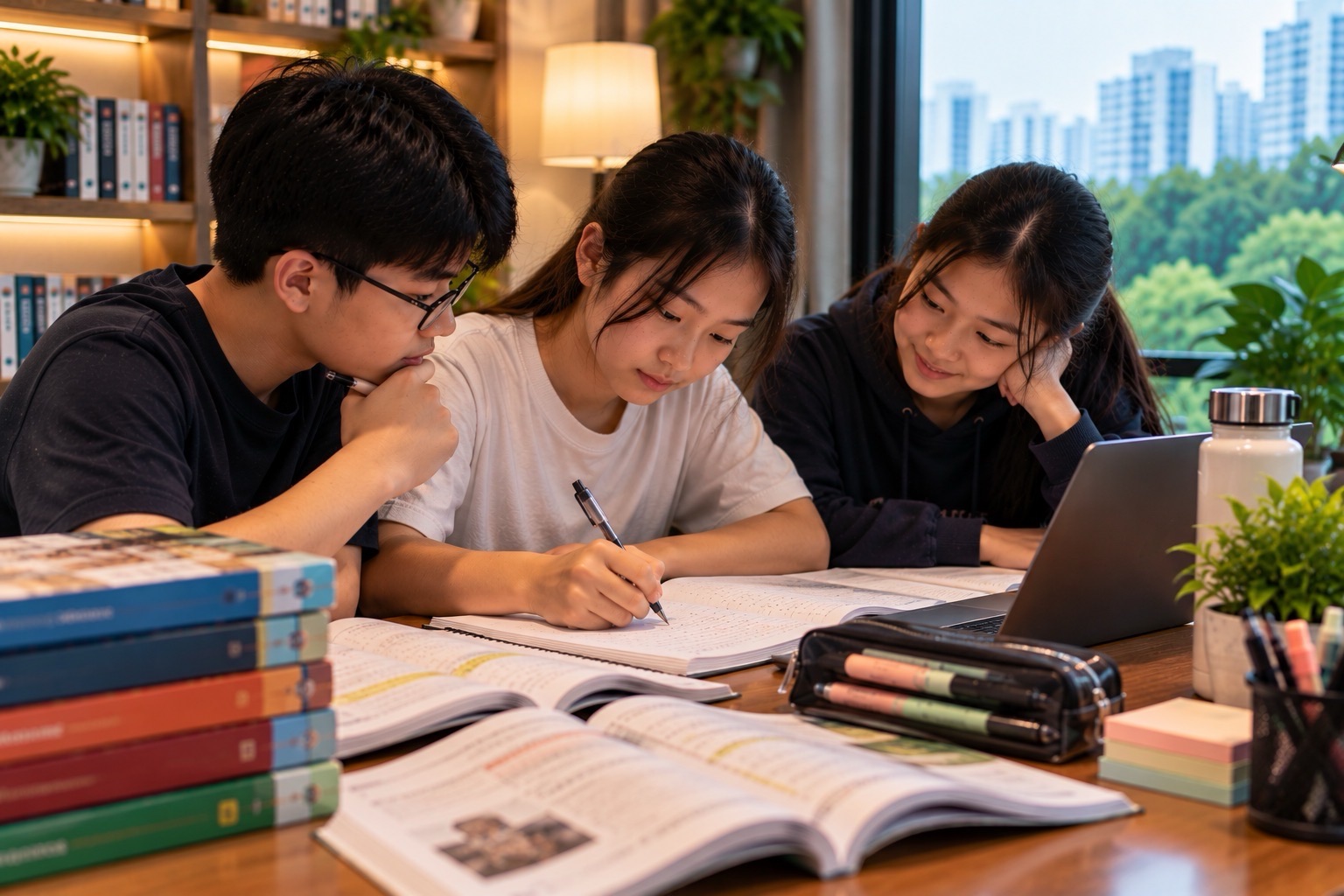
A small-group Science discussion is useful only if the learning survives after the group answer disappears. Students can learn a great deal from hearing another learner notice a variable, challenge a misconception or explain a causal chain. But the final question is individual: can each student reconstruct the Science independently in a changed task?
This Punggol Primary Science small-group tutorials page owns one specific job: Peer Reasoning → Individual Scientific Proof. The broader Punggol Science estate already explains the general value of small groups and the P3→P6 progression. This page focuses on the handoff from social learning into individual ownership.
Why Peer Reasoning Helps Science
Science contains many questions where two answers can initially sound plausible. Hearing another student explain what evidence they used can reveal a relationship the first learner missed. This is especially useful when the discussion stays anchored to evidence rather than confidence.
| Peer contribution | Possible learning value |
|---|---|
| Notices a controlled variable | Shows what makes a comparison fair |
| Rejects a tempting MCQ distractor | Exposes a misconception |
| Names the relevant concept | Connects setup to scientific model |
| Builds a clear causal explanation | Shows how evidence becomes a structured answer |
| Challenges unsupported inference | Strengthens evidence discipline |
The tutor’s job is to convert these peer contributions into principles the whole group can test, not sentences the whole group can copy.
Step 1: Every Student Commits Before Discussion
Before anyone hears the strongest voice, each learner should leave a trace of their own thinking.
- circle an MCQ choice;
- write one prediction;
- underline relevant evidence;
- label a diagram;
- write a one-sentence explanation;
- identify the variable that changed.
This baseline matters because the tutor can later see whether the learner revised for a scientific reason or merely followed the group.
Step 2: Compare the Reasoning, Not the Child
Small-group Science should avoid turning discussion into ranking. The object of comparison is the model, evidence or explanation.
- Which answer uses the relevant evidence?
- Which explanation makes the causal link explicit?
- Which prediction follows from the scientific model?
- Which distractor assumes something the question never establishes?
- Which method controls the comparison more effectively?
The group learns that scientific authority comes from evidence and a coherent model rather than who speaks first.
Step 3: Name the Principle
After comparing answers, the tutor extracts a general principle that can travel.
| Original discussion | Portable principle |
|---|---|
| One student notices that only one variable changed | For a fair comparison, isolate the factor being tested |
| One student explains why a keyword distractor is wrong | Scientific meaning outranks surface word matching |
| One student gives a stronger structured answer | Connect condition → concept → effect |
| One student reads a graph correctly | Read axes and trend before explaining cause |
The class should leave with the principle, not a memorised version of someone else’s answer.
Step 4: Change the Question
Individual proof requires a fresh surface. The tutor changes the diagram, variable, organism, material, graph or wording while preserving the underlying reasoning job.
- same concept, different setup;
- same inquiry skill, different topic;
- same data relationship, different representation;
- same answer architecture, different evidence;
- same misconception risk, different distractor.
If the student can only repeat the original discussion, the learning is still context-bound.
Step 5: Remove the Peer Cue
The tutor does not let the confident student answer first on the retest. Each learner begins independently.
- Present the fresh task.
- Use silent thinking time.
- Collect each student’s initial answer.
- Ask for the reasoning.
- Record the smallest tutor prompt needed.
- Return after delay if the skill is important.
Primary 3: Peer Observation Must Become Individual Classification
A P3 student can learn from a peer who notices the relevant property. The proof comes when the learner can classify a new object or organism using the same evidence rule without being told which property to inspect.
Primary 4: Peer Cause–Effect Must Become Individual System Reasoning
A P4 student may hear a peer explain how one part affects a larger system. The transfer task changes the part or condition and asks the learner to reconstruct the causal chain independently.
Primary 5: Peer Prediction Must Become Independent Model Use
A P5 student may revise a prediction after group discussion. The tutor asks what evidence changed the prediction, then gives a fresh setup. The student should be able to use the underlying model rather than wait for another peer’s forecast.
Primary 6: Peer Explanation Must Become PSLE Execution
At P6, the independence requirement is sharper. Booklet A and Booklet B will not contain peer discussion. A small group should therefore use social comparison earlier in the lesson and individual timed proof later.
| Group phase | Individual proof phase |
|---|---|
| Compare MCQ distractor logic | Fresh MCQ with no discussion first |
| Compare structured answer causal chains | Fresh Booklet B response independently |
| Discuss experimental method | Evaluate a new method alone |
| Interpret graph together | Read a new table or graph under time |
The Current Curriculum Rewards This Kind of Independence
MOE’s 2023 Primary Science syllabus combines core ideas with scientific practices, while the revised 2026 PSLE Science assessment explicitly tests knowledge with understanding and application/scientific inquiry. Students are expected to predict, interpret, analyse, evaluate and communicate explanations. Peer reasoning can support those capabilities, but the examination ultimately requires individual performance.
Parents can review the syllabus at MOE and the 2026 format at SEAB.
Three Students Gives Enough Contrast Without Hiding Individuals
eduKate’s three-student model is useful because the tutor can preserve three separate reasoning traces while still creating meaningful peer contrast.
| Student state | What discussion may do | What individual proof checks |
|---|---|---|
| Correct model | Helps articulate reasoning | Can model transfer? |
| Partial model | Fills missing link | Can student reconstruct link alone? |
| Misconception | Creates conflict with evidence | Has model actually changed? |
Do Not Confuse Better Group Talk With Better Science Yet
A student can sound much stronger during discussion because the room is carrying part of the reasoning. That is useful learning, but it is not the final evidence. The tutor should always ask what remains after the social cues are removed.
A Typical Small-Group Tutorial Loop
| Phase | Job |
|---|---|
| Independent first attempt | Capture original learner state |
| Peer comparison | Expose alternative reasoning |
| Tutor verification | Anchor discussion to Science and evidence |
| Principle extraction | Name what should travel |
| Changed individual task | Prove ownership |
| Delayed return | Test retention |
What Parents Can Ask
- Does every student attempt before discussion?
- Does the tutor ask why an answer changed?
- Are peer explanations converted into general principles?
- Does each child receive a fresh individual retest?
- Can the student reconstruct the reasoning after delay?
- Does the class protect quieter thinkers from simply following the fastest speaker?
Small-Group Science Works Only When the Group Does Not Own the Answer
A three-student Science class can be intellectually rich. One student notices a variable another missed. One explains a causal relationship in a clearer way. One challenges a claim by pointing back to the evidence. The group becomes a source of contrast.
But there is a danger. If the strongest or fastest student becomes the unofficial answer key, the other two can appear to improve while becoming more dependent. They recognise the group’s conclusion without being able to reconstruct the reasoning alone.
This page therefore focuses on one handoff: peer reasoning → individual scientific proof. Discussion is the middle of the lesson, not the final evidence of learning.

Why Peer Reasoning Helps
Science questions often allow several plausible starting points. Hearing another student explain a different route can reveal an assumption that was invisible in one’s own work. The benefit comes from comparison.
- One student may identify the correct concept but ignore the evidence.
- Another may read the evidence accurately but use the wrong model.
- A third may understand both but write an incomplete explanation.
Placed side by side, those responses show that “right” and “wrong” are not the only useful categories. The class can discuss why one reasoning path is more defensible, more complete or more transferable.
Peer Contrast Is More Useful Than Peer Consensus
The goal of group discussion is not to make everyone agree as quickly as possible. Fast consensus can hide weak reasoning. We want useful disagreement long enough to expose the evidence and model behind each claim.
A tutor may ask, “What made you choose that?” before revealing whether the answer is correct. Another student can then respond with evidence rather than preference. The group compares reasons first and conclusions second.
This changes the social dynamic. The student who speaks confidently does not automatically win. The explanation has to survive the Science.
Think Alone Before You Think Together
We usually protect an individual first attempt before discussion. This matters because otherwise the student may never discover what they actually think.
- Read the question alone.
- Record the answer or prediction.
- Write one piece of evidence or one reason.
- Only then compare with peers.
This first attempt gives the tutor a clean diagnostic. It also gives the student something to compare. Without it, the learner may simply inherit the first answer spoken in the room.
Reason Before Revealing the Option Letter
For multiple-choice questions, we can go further. Students explain the reasoning before saying A, B, C or D. This prevents the discussion from turning into voting.
One learner may say, “The changed condition reduces this process, so I expect the value to decrease.” Another may say, “The graph shows a different pattern because…” Only after the reasoning is on the table do the option letters matter.
This keeps attention on the scientific model rather than on who chose the most popular answer.
The Three Useful Roles in a Science Discussion
- Explainer: states the scientific relationship.
- Evidence checker: points to the observation, data or condition that supports it.
- Stress tester: asks what would happen if one condition changed or whether a counterexample breaks the claim.
Roles rotate. The purpose is not to make the lesson theatrical. It is to expose different dimensions of scientific reasoning. A student who is good at explanations may be weak at evidence checking. A quiet student may become excellent at stress testing because they notice contradictions carefully.
Why Explaining to a Peer Can Strengthen Understanding
When a student explains an idea to another learner, the explanation has to become explicit. Gaps that were hidden inside intuition become visible. The child may realise that a word is vague, a step is missing or the evidence does not actually support the conclusion.
Peer explanation is therefore useful not because students replace the tutor, but because speaking the reasoning exposes its structure.
The Risk of Fluent Copying
A student can repeat another student’s explanation fluently and still not own it. This is especially common when the group has discussed the question for several minutes. The language becomes familiar, and recognition feels like understanding.
We protect against this with a changed individual retest. The names, numbers, topic surface or diagram change. The underlying reasoning remains. If the student can reconstruct the model without the peer’s wording, the learning is more likely to be genuine.
The Fresh-Question Rule
After a useful group discussion, the most important question is often the one the group has never seen. This fresh item removes the shared answer and asks each learner to prove transfer.
- Same concept, different context.
- Same inquiry structure, different data.
- Same causal relationship, different diagram.
- Same misconception trap, different wording.
The fresh question is the bridge from social learning to individual proof.
Peer Reasoning in Primary 3
For younger students, peer reasoning can focus on observation and classification. One child notices a property another missed. The group compares which property is relevant and whether the same rule is being applied consistently.
The independent proof is simple: a new set of objects or pictures to classify without help. The child must state the rule and justify one difficult example.
Peer Reasoning in Primary 4
In Primary 4, discussion can focus on systems and cause–effect. Students compare diagrams, identify the changed condition and explain the missing middle between cause and outcome.
The independent proof changes one system condition and asks the student to predict and explain the consequence alone.
Peer Reasoning in Primary 5
Primary 5 groups can compare predictions and experimental designs. Each learner commits to a prediction before discussion. The group then examines which model each prediction assumes and what evidence would test it.
The independent proof uses a new system or representation so the student must transfer the predict–test–explain loop without relying on the earlier example.
Peer Reasoning in Primary 6
In Primary 6, group contrast can become sharper. Students compare why distractors are attractive, which evidence is sufficient, where a causal chain is incomplete and which answer is concise without losing meaning.
The independent proof should include changed questions and, when appropriate, time pressure. P6 success must survive not only a new surface but examination load.
How Peer Discussion Can Reveal Misconceptions
Misconceptions often become visible when two students make different predictions from the same evidence. Instead of correcting immediately, the tutor asks each learner to explain the model.
The group can then test the predictions against a simpler example or the data. The misconception is challenged by evidence, not by social pressure.
How Peer Discussion Can Improve Inquiry
Inquiry questions benefit from students comparing what they think changed, what was measured and what conclusion the evidence supports. Different readings of the same graph or setup make hidden assumptions visible.
The tutor keeps the conversation anchored to labels, values and conditions. “Where do you see that?” is often more useful than “Are you sure?”
How Peer Discussion Can Improve Explanation
Structured answers can be compared for completeness. One student may include the evidence but omit the mechanism. Another may write the mechanism but not connect it to the specific condition. A third may be complete but unnecessarily long.
The group identifies the essential relationships and then rewrites independently. The aim is not to create one class sentence everyone copies. It is to understand why a strong answer works.
How a Tutor Protects the Quiet Student
Small groups do not automatically give equal intellectual space. A quick student can dominate even with only three learners. The tutor must protect the first attempt, rotate speaking order and sometimes ask the quiet student to explain before hearing the others.
We may also use written thinking first. A child who needs more processing time can record a model or prediction before discussion begins. This keeps speed from being mistaken for depth.
How a Tutor Challenges the Fast Student
The fastest student also needs protection—from superficial success. If the child answers correctly before others finish, we do not automatically move on. We may ask for the evidence boundary, an alternative representation or a changed-condition prediction.
This turns speed into deeper reasoning rather than social dominance.
The Peer-Reasoning Ladder
- Private attempt: preserve original thinking.
- Explain: state the model or evidence.
- Compare: identify meaningful differences.
- Challenge: test claims against evidence or changed conditions.
- Revise: improve the reasoning.
- Fresh individual task: prove transfer alone.
- Delayed retest: prove the learning remains available later.
Why the Delayed Retest Matters
A student may succeed on the fresh question because the group discussion is still active in working memory. We therefore revisit important ideas later.
If the learner can reconstruct the reasoning after a delay, the skill is becoming more durable. If the group answer disappears from memory and the student has no independent route, we know more work is needed.
The Difference Between Collaborative Learning and Shared Dependence
Collaborative learning increases what each student can eventually do alone. Shared dependence increases what the group can do together while leaving individuals unchanged.
The difference is visible only when the group is removed. That is why independent proof is non-negotiable.
A 90-Minute Peer-to-Proof Lesson
- Retrieval: individual warm-up from previous learning.
- Private challenge: all students attempt the same Science task.
- Reasoning reveal: students explain models or evidence.
- Peer contrast: compare differences without voting.
- Tutor compression: name the scientific principle clearly.
- Changed task: each student applies the principle independently.
- Targeted repair: tutor branches if learner failures differ.
- Exit proof: one final independent item or explanation.
Common Small-Group Failure Modes
- Fast-student ownership: one learner supplies most answers.
- Consensus pressure: students switch because others agree.
- Model-answer convergence: everyone ends with identical wording.
- Discussion without retest: the class feels productive but individual ownership is unverified.
- Unequal difficulty: stronger students are not extended and weaker students are overloaded.
- Permanent roles: the same child always explains while another always checks.
How We Repair Group Dependence
If students begin waiting for one another, the tutor increases private thinking time, hides option choices, changes speaking order and uses more individual transfer questions.
The solution is not to remove discussion entirely. It is to restore the rhythm: think alone → compare → revise → prove alone.
Peer Teaching Is Useful Only When the Teacher Learns Too
When one student explains to another, the explaining student should also be challenged. The tutor can ask the peer teacher to justify the evidence, name a boundary or handle a counterexample.
This prevents peer teaching from becoming repetition of a memorised script and keeps both students intellectually active.
How Parents Can Ask About Small-Group Quality
- Does my child make an individual attempt before discussion?
- How does the tutor prevent copying?
- Does each student explain reasoning, not only answers?
- Are changed questions used after group discussion?
- How is a quiet or slower-processing student protected?
- How is a fast student extended?
- How do you know the learning survives after a delay?
A Small Group Should Produce Better Self-Questioning
One sign that peer reasoning is working is that students begin asking themselves the questions they have heard in class. “Where is the evidence?” “What changed?” “Does that conclusion go too far?” “What would happen if the condition changed?”
The social dialogue becomes an internal dialogue. That is a powerful form of transfer.
Frequently Asked Questions About Peer Reasoning in Science
Will students copy one another in a small group?
They can if the lesson is poorly structured. Protect private attempts, discuss reasons before answers and use changed individual retests to verify ownership.
Is a strong student held back by peers?
Not if the tutor extends the reasoning. Strong students can be asked for alternate models, evidence boundaries, counterexamples and more demanding transfer while sharing the same core topic.
Can a weaker student benefit without becoming dependent?
Yes, if peer explanation is followed by fading support and individual proof. The learner should receive the idea socially and then reconstruct it independently.
Why not teach privately instead?
Private teaching offers different advantages. A very small group adds contrast: students can see alternative reasoning and misconceptions. Its value depends on whether the tutor uses that contrast deliberately.
The Deeper Outcome: Social Learning That Becomes Individual Capability
A good Science discussion should leave each student stronger after the voices disappear. The learner has seen another route, tested an assumption, revised a model and then proved the principle independently.
That is the standard we use for Punggol Primary Science small-group tutorials. The group is not the destination. It is a high-visibility learning environment through which each student develops more reliable individual reasoning.
Peer reasoning can accelerate insight. Individual scientific proof tells us whether the insight has become the student’s own.
Peer Reasoning Should Expose the Decision, Not Just the Conclusion
When students compare only final answers, the most interesting part of Science remains hidden. Two children may both choose the correct option for entirely different reasons, and one of those reasons may be fragile or wrong. The tutor therefore asks for the decision path.
- What did you notice first?
- Which evidence mattered most?
- What model did you use?
- Which alternative did you reject, and why?
- What would make you change your mind?
These questions make peer comparison more valuable because students are comparing thinking, not merely letters or sentences.
The “Borrowed Reasoning” Test
After group discussion, a student may reproduce a good explanation so fluently that it looks owned. To test whether the reasoning is borrowed, we alter one condition and ask the child to predict what changes.
If the learner truly understood the model, the new case can be handled. If the explanation was memorised from a peer, the student often becomes stuck as soon as the surface changes.
This is one of the simplest and strongest reasons to include transfer in every small-group lesson.
Why Students Should Sometimes Defend the Wrong Answer
Occasionally, the tutor asks a student to explain why an incorrect option might attract someone. This is not to confuse the class. It teaches students to recognise misconception patterns.
If the learner can say, “This answer sounds plausible because it uses the right keyword, but it reverses the cause and effect,” the child has learned more than the correct answer. The student can now identify the trap.
That skill supports individual checking later because the learner knows what kinds of errors to watch for.
The Importance of Wait Time
A small group can still become too fast. If the tutor asks a question and accepts the first hand immediately, slower thinkers lose the chance to form an answer. We deliberately create short silent thinking periods.
Wait time is not wasted time. It protects independent reasoning and makes the later discussion richer because more than one student has a genuine position.
Written Before Spoken
Another useful technique is to require one written line before discussion. The line may be an option choice, prediction, classification rule or causal statement. This record preserves the student’s original thought and reduces social drift.
After discussion, the student can compare the revised answer with the first one and explain what changed. That metacognitive step makes learning visible.
Why Groups Need Productive Disagreement
If every question ends with instant agreement, the group is not using its full value. Science often benefits from two plausible models being compared against the same evidence.
The tutor keeps disagreement productive by returning to the question, data or mechanism. “Which answer is more popular?” becomes “Which claim does the evidence support?”
This teaches students that disagreement can be resolved through reasons rather than personalities.
Group Work and Scientific Vocabulary
Peer reasoning also helps vocabulary because students hear how the same scientific idea can be expressed in slightly different ways. The tutor can compare which wording is precise, which is vague and which changes the meaning.
This is especially useful for words that students recognise but do not yet use actively. Hearing a peer use the term inside a causal explanation can make the word more functional.
Group Work and Diagrams
Students can also compare representations. One child may draw a system with too many details, another may omit an important connection, and a third may use a simple diagram that captures the relationship clearly.
The comparison teaches that diagrams are models, not pictures. The best representation is the one that helps answer the scientific question.
Group Work and Experimental Design
Small groups are particularly useful for fair-test reasoning because students can critique one another’s designs. One may change two variables without noticing. Another may forget what is measured. A third may create a strong design but use an outcome that cannot be compared clearly.
Critique becomes more useful when students explain what the flaw prevents us from concluding. This ties design back to evidence.
The Tutor Should Compare Methods, Not Rank Children
Peer contrast is valuable when it is about the work. It becomes harmful if students are ranked as “the clever one”, “the slow one” or “the one who always gets Science”. Those identities can become self-fulfilling.
We therefore compare methods: this explanation uses stronger evidence; this model handles the changed condition better; this answer is more concise. The student remains separate from the current quality of the response.
The Group Should Make Errors Safer to Examine
A useful small group normalises revision. Students see that everyone produces incomplete first attempts, changes an answer, notices a missing condition or improves a diagram. Error becomes part of the learning process rather than evidence that someone does not belong.
This matters because students reason more openly when they are willing to expose uncertainty. Hidden uncertainty cannot be taught.
When Peer Reasoning Should Be Reduced
There are times when discussion should be reduced. Near an examination, students need longer independent runs. A learner who has become too dependent on peers needs more private work. A concept that is highly fragile may require direct teaching before discussion.
Small-group teaching is not a commitment to constant conversation. The amount of interaction should serve the learning goal.
When Peer Reasoning Should Be Increased
Discussion is especially useful when multiple plausible answers reveal different assumptions, when a misconception is common, when students need to compare experimental designs or when a strong student needs to justify rather than merely answer.
The tutor can increase interaction temporarily, then return to independent proof.
A Simple Peer-Reasoning Protocol Parents Can Understand
- Every student answers alone first.
- Every student gives a reason.
- The class compares evidence.
- The tutor clarifies the principle.
- The question changes.
- Every student answers alone again.
If a small-group programme consistently does these six things, peer learning is much less likely to become copying.
The Final Individual Proof Can Be Very Short
Independent proof does not always require another full worksheet. One changed question, one diagram or one explanation may be enough to test the principle. The value comes from removing the group answer and seeing whether the student can reconstruct the reasoning.
This makes transfer testing practical inside a 90-minute lesson.
The Delayed Proof Is Even Stronger
A later retest is stronger because the discussion is no longer fresh. The student must retrieve the model from longer-term memory and recognise when it applies.
We do not need to retest everything. Important concepts, recurring error families and recently repaired misconceptions deserve this extra proof.
What Progress Looks Like in a Small Group
- Students give reasons before asking who is correct.
- Quiet students contribute original thinking.
- Fast students explain rather than dominate.
- Peers challenge ideas with evidence.
- Wording becomes more precise without becoming identical.
- Changed individual questions are answered successfully.
- Delayed retests require fewer prompts.
The Small Group as a Temporary Scaffold
The group is a scaffold because it offers multiple models, language and perspectives while the student is learning. A scaffold is successful when it can eventually be reduced.
We want students to internalise the questions they have heard from peers and tutor: what is the evidence, what changed, what model explains this, what would happen if the condition changed, does my conclusion go too far?
When those questions become internal, the group has done more than help the child answer today’s worksheet. It has contributed to an independent scientific thinking routine.
The Final Standard for Peer Reasoning
The measure of peer reasoning is not how lively the discussion sounds. It is what each learner can do afterwards. A productive group leaves behind clearer models, stronger evidence habits and better self-checking.
The final proof belongs to the student: unfamiliar surface, no group answer, independent explanation. That is where social learning becomes individual capability.
A Peer Discussion Should Produce a Different Next Attempt
The simplest way to judge whether discussion was useful is to compare the student’s first attempt with the next one. Did the learner use a stronger piece of evidence? Did a missing causal step appear? Did an over-broad claim become more precise? Did the child recognise a misconception that had been invisible before?
If nothing changes except the wording becoming closer to a peer’s answer, the group has not yet produced meaningful learning. The next attempt should show a better decision, not merely a more polished sentence.
Why Individual Proof Matters Even for Correct First Answers
A student who was correct before the discussion still benefits from a fresh individual task. Correctness may have come from a strong model, lucky recognition or a familiar cue. The changed question reveals which.
For strong students, the proof can be harder: explain the boundary of the claim, compare an alternative model or predict a changed condition. This keeps the small group from becoming repetitive for the learner who already has the basic answer.
The Best Small Group Leaves Less Work for the Group Over Time
As students become more independent, they should need fewer prompts, less peer confirmation and less tutor routing. Discussion remains useful for difficult ideas, but ordinary questions should increasingly be handled alone.
This is the direction we want: social learning when contrast adds value, independent reasoning whenever the learner is ready, and a steady transfer of responsibility from the room to the student.
The Individual Exit Ticket
At the end of a small-group Science lesson, one short exit ticket can tell us whether the discussion became individual learning. Each student receives the same underlying reasoning job with a different surface and answers without consultation.
- One changed-condition prediction.
- One evidence-based conclusion.
- One classification rule with an awkward example.
- One short causal explanation.
The exit ticket is not another test for marks. It is evidence for the tutor. If one learner still needs the peer’s wording, the next lesson can target transfer. If another student succeeds easily, the tutor can increase complexity instead of repeating the same support.
This keeps the group responsive. The shared discussion may be identical, but the next move can differ because individual proof tells us who has actually internalised the idea.
The Final Small-Group Principle
Use peers to reveal thinking. Use the tutor to sharpen the principle. Then remove both supports and ask the student to show the Science alone. That sequence protects the best part of collaborative learning without sacrificing independence.
When repeated across Primary 3 to Primary 6, the classroom conversation gradually becomes an internal one. The student starts asking the evidence questions, changed-condition questions and checking questions without waiting for the group. That is the deeper proof that small-group learning has transferred.
The Group Should Improve the Next Independent Attempt
The cleanest measure of a useful discussion is not how animated the conversation sounded. It is whether the student’s next independent attempt is better. Did the learner choose stronger evidence? Did a missing causal link appear? Did a vague claim become more precise? Did the child recognise a misconception before the tutor pointed it out?
If the only change is that everyone now writes the same polished sentence, the group may have produced conformity rather than learning. We therefore vary the next task enough that copied wording is no longer useful.
Independent Proof Is Required Even When the First Answer Was Correct
A correct first answer can come from deep understanding, familiar cues or fortunate recognition. A changed question tells us which. Strong students therefore also receive transfer tests rather than being allowed to coast because the first response was correct.
For those learners, the changed task may require an alternative representation, a boundary condition, a counterexample or a more demanding explanation. This keeps the small group useful across different levels of readiness.
The Best Small Group Needs Less Group Support Over Time
As students become more capable, ordinary questions should require less discussion. The group remains available when contrast adds value, but students increasingly solve, check and explain alone. This is an important success signal.
The long-term direction is always toward independence: peer reasoning when it reveals something useful, tutor intervention when a misconception or gap needs repair, and individual proof whenever the learner is ready to carry the Science alone.
The final measure is therefore personal capability. A strong small group should leave each learner able to recreate the reasoning after the shared conversation ends. If a student needs the same peer explanation every time the surface changes, the handoff is incomplete. If the child can independently identify the evidence, choose the model and explain the relationship, the group has done its job.
This is the standard we want to preserve across Primary 3 to Primary 6: discussion can accelerate understanding, but ownership is proven alone.
A useful small group therefore creates two kinds of memory. Students remember the Science, and they remember the questions that good thinkers ask: what is the evidence, what changed, what model explains this, and can I prove it alone? Those internal questions matter because they remain after the discussion has ended.
That is why the individual retest is not an optional extra at the end of a lively lesson. It is the evidence that the social scaffold has started to become an individual capability.
When this transfer becomes routine, the class stops functioning as an answer-sharing environment and becomes what a small group should be: a place where different reasoning is exposed, tested and refined before every student proves the result independently.
For Punggol Families
Families should confirm current class timing and availability directly. The value of a small-group Science tutorial lies not in the word “small” but in what the tutor does with the visibility: preserve original reasoning, compare ideas and verify independent transfer.
The Final Proof Belongs to the Student
Peer reasoning can accelerate learning. The tutor can sharpen it. But the scientific proof is individual: a fresh question, a new surface, no group answer, and a learner who can still identify the concept, use the evidence and explain why.
About eduKate
eduKate uses three-student small groups to turn peer contrast into independently transferable scientific reasoning. Our core values are Integrity, Empathy, Critical Thinking and Responsibility.


