
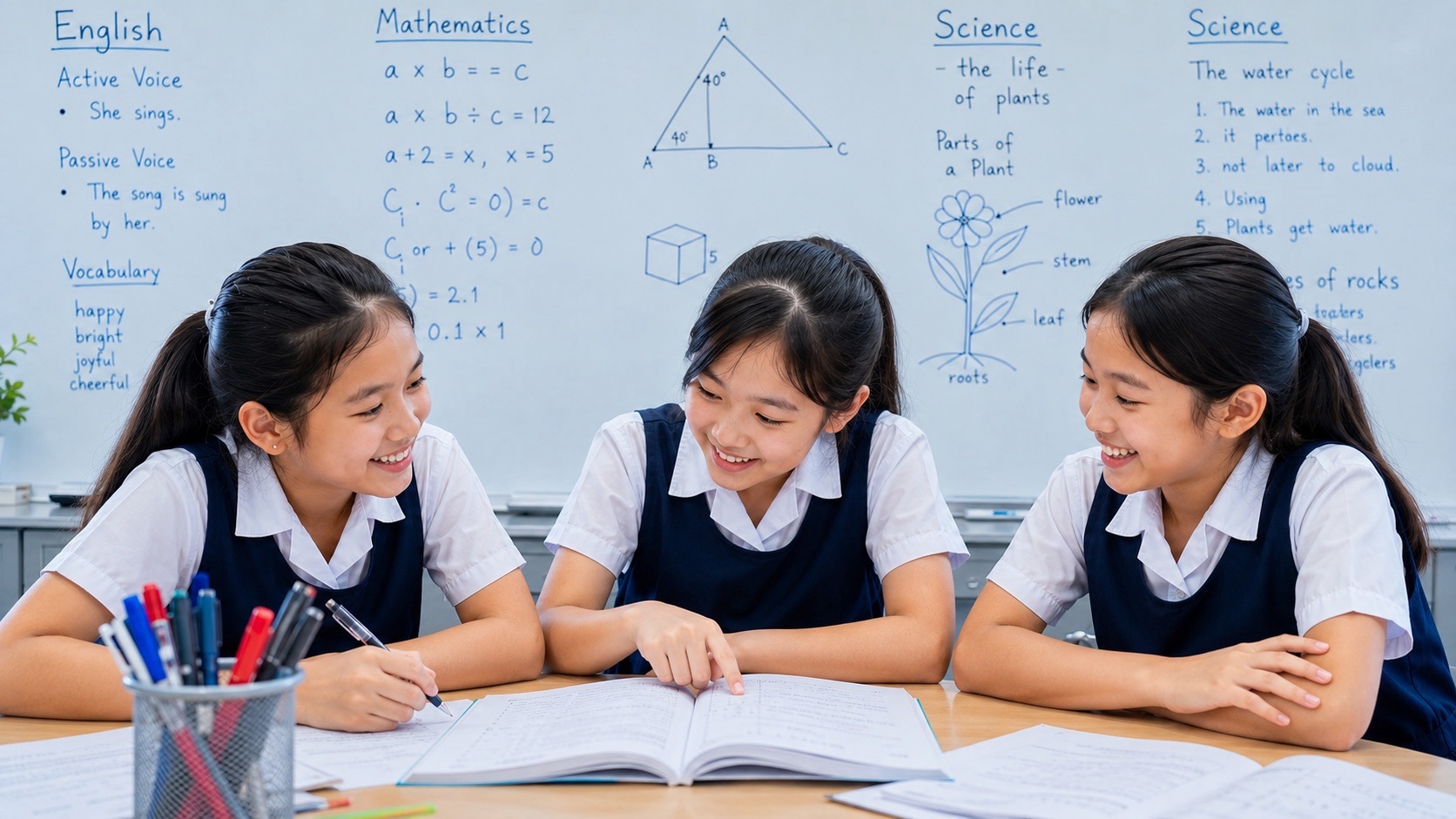
Primary Science should become more demanding because the student’s reasoning should become more demanding. P3 is not simply “easier Science” and P6 is not simply “more chapters”. Across the four years, the learner should move from noticing and naming towards comparing, modelling, applying, evaluating and explaining.
This Primary Science Tutors in Punggol page owns one distinct job: the P3→P6 scientific-reasoning progression. The current Punggol estate already has broad Primary Science tuition pages. This article instead helps parents see how the tutor’s instructional role should change as the syllabus and inquiry demands develop.
The 2023 Primary Science Syllabus Is Organised as a Progression
MOE’s 2023 Primary Science syllabus organises content across five connected themes: Diversity, Cycles, Systems, Energy and Interactions. Topics are distributed from Primary 3 to Primary 6 to support coherent concept development rather than isolated chapter memorisation.
| Level | Typical reasoning emphasis | Tutor role |
|---|---|---|
| P3 | Observe, compare, classify and describe | Turn everyday observations into scientific distinctions |
| P4 | Connect parts, cycles and cause-effect | Build systems and process explanations |
| P5 | Integrate several variables and representations | Strengthen application, data interpretation and transfer |
| P6 | Apply, evaluate and explain under exam conditions | Calibrate reasoning, structured answers and PSLE execution |
Primary 3: Observe Before You Explain
P3 Science introduces students to a more formal scientific way of seeing familiar things. Classification, materials, life cycles and magnets are not only content topics; they teach the student to observe relevant properties and compare systematically.
- What can you observe directly?
- Which property is relevant to the classification?
- What is similar?
- What is different?
- Which evidence supports the grouping?
A tutor should resist explaining too quickly. Let the learner notice, compare and state the evidence first.
Primary 4: Connect Processes and Systems
P4 adds systems and processes such as plant parts and functions, the digestive system, matter, light and heat. The student begins moving from “what is it?” towards “how do the parts or steps produce the outcome?”
- What part performs this function?
- What happens before and after?
- What changes when the condition changes?
- How does energy move through the situation?
- Which observation would show the process occurred?
The tutor’s role is to build connected models, not lists of disconnected facts.
Primary 5: Make the Student Use the Model
P5 brings reproduction, water, respiratory/circulatory systems and electrical systems. Questions increasingly require students to coordinate several ideas and interpret diagrams, setups, variables and data.
| P5 task | Reasoning move |
|---|---|
| Compare two setups | Identify what changed and what remained controlled |
| Interpret a diagram | Translate representation into system relationships |
| Explain an observation | Apply concept to evidence |
| Predict a result | Use the model under a changed condition |
| Evaluate a method | Judge whether evidence supports the intended conclusion |
This is the year when “I know the chapter” must begin turning into “I can use the chapter when the question looks unfamiliar”.
Primary 6: Apply, Evaluate and Communicate
P6 adds concepts such as photosynthesis, energy conversion, forces and interactions within the environment while preparing the learner for PSLE integration. The tutor must now test whether the student can select the relevant model, apply it to evidence and communicate the reasoning under time.
- choose the relevant concept without a chapter label;
- interpret tables, diagrams and graphs;
- explain causal relationships precisely;
- evaluate observations and methods;
- identify misconceptions in MCQ distractors;
- write structured answers that make reasoning visible.
The 2026 PSLE Science Destination
The revised 2026 Standard Science examination is a single 1 hour 45 minute paper comprising Booklet A with 30 multiple-choice questions worth 60 marks and Booklet B with 10–11 structured questions worth 40 marks. The assessment objectives explicitly include knowledge with understanding, application of knowledge and scientific inquiry.
That destination explains why the P3→P6 progression should steadily increase independent reasoning rather than jump straight from chapter notes into exam tricks. Parents can check the current PSLE format through SEAB and the syllabus through MOE’s 2023 Primary Science Syllabus.
A Tutor Should Change the Question They Ask
| Stage | Less useful tutor move | Stronger tutor move |
|---|---|---|
| P3 | Tell classification immediately | Ask which observable property distinguishes the groups |
| P4 | Give process steps to memorise | Ask what each step or part contributes |
| P5 | Show worked answer first | Ask student to interpret setup and predict before explanation |
| P6 | Give keywords | Ask student to construct the causal relationship from evidence |
Three Students Makes Progression Visible
eduKate’s three-student model allows one scientific phenomenon to generate multiple reasoning traces.
- Student A notices the key observation.
- Student B identifies the concept.
- Student C explains the causal relationship.
- The tutor then asks each student to complete the full reasoning independently.
As students mature, peer comparison can move from “what did you notice?” to “which explanation is better supported and why?”
Do Not Confuse More Difficult Vocabulary With More Difficult Science
Scientific language matters, but conceptual complexity is not the same as word complexity. A student should learn precise terms because they carry precise relationships—not because longer words sound more advanced.
- teach the phenomenon first;
- attach the scientific term;
- use the term in explanation;
- change the context;
- check whether the concept survives without memorised wording.
What Parents Can Ask Across the Four Years
- P3: can my child observe and classify using evidence?
- P4: can they explain how parts and processes work together?
- P5: can they use concepts in unfamiliar setups and data?
- P6: can they evaluate and explain under PSLE conditions?
For Punggol Families
When comparing Primary Science tutors in Punggol, ask whether the tutor is teaching the developmental stage the child is actually in. A P3 learner should not be treated like a miniature PSLE candidate, and a P6 learner should not remain dependent on fact recitation and tutor prompts.
The Goal Is a Growing Scientific Mind
From P3 to P6, the content expands, but the deeper progression is in reasoning: observe, compare, connect, model, apply, evaluate and communicate. A strong tutor helps those moves become increasingly independent.
About eduKate
eduKate uses very small groups to make scientific thinking visible and match the tutor’s role to the learner’s developmental stage. Our core values are Integrity, Empathy, Critical Thinking and Responsibility.


