
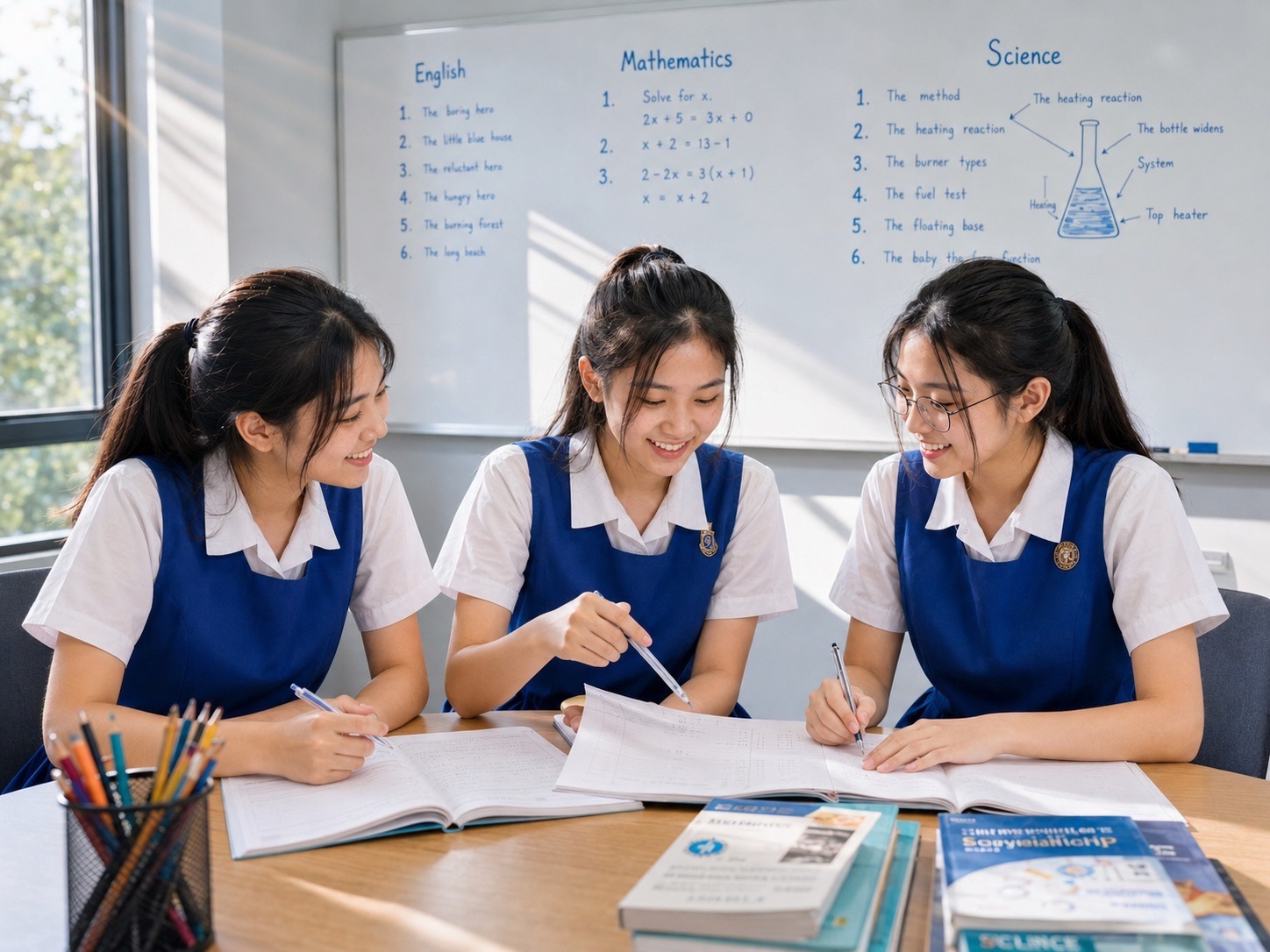
A three-student Primary English class does not need three completely different lessons to be differentiated. One shared text, image, topic or language object can generate three different response levels. The tutor’s craft is deciding how far each learner should be asked to go: recognise, explain, transfer or execute independently.
This Katong Primary English Tutor in Small Group Tutorials page owns one specific job: one shared text, three differentiated response levels. The existing Katong estate already contains broad tutor-selection pages, high-resolution 3-pax pages and level-specific P3–P6 tutor articles. This page therefore focuses on a reusable differentiation mechanism that can work from P1 to P6 without pretending every student needs a separate curriculum.
Why One Shared Text Can Be Enough
A good text contains multiple layers: vocabulary, sentence structure, literal meaning, inference, organisation, tone and ideas. The tutor can keep the shared material stable while changing the response demand.
| Shared text | Student A | Student B | Student C |
|---|---|---|---|
| Short narrative passage | Identify who, what and where | Explain why a character acted | Compare evidence and write a precise inference |
| Vocabulary-rich paragraph | Recognise meaning | Use word orally | Use word naturally in fresh writing |
| Model paragraph | Read fluently | Identify paragraph job | Recreate architecture with a changed topic |
The class stays socially connected, while the tutor still sees the individual learner state.
The Four Response Levels
- Recognise: can the student identify the meaning, feature, rule or evidence?
- Explain: can the student say why it works?
- Transfer: can the student use the same principle when the surface changes?
- Execute: can the student do it independently and, when age-appropriate, under realistic time?
Students do not move permanently into one box. A P5 learner may be at execution level for vocabulary and only explanation level for synthesis. The tutor differentiates by skill, not by fixed identity.
Primary 1: Same Story, Different Literacy Demands
At P1, a shared picture book or short passage can support listening, reading, speaking and writing without turning the lesson into worksheet rotation.
- Student A identifies a familiar word and says one sentence.
- Student B reads a short sentence and retells it.
- Student C uses a new vocabulary word and writes a related sentence.
The tutor can adjust support while keeping the shared meaning intact.
Primary 2: Same Sentence Pattern, Different Independence
One sentence can support several response levels.
- recognise the subject and action;
- expand the sentence with where or when;
- change the subject and preserve grammar;
- write a fresh sentence without the model visible.
The tutor can see whether the student needs language teaching, retrieval or simply more independence.
Primary 3: Same Passage, Different Reading-to-Learn Jobs
P3 is where shared reading becomes especially useful for differentiation.
| Response level | P3 example |
|---|---|
| Recognise | Find the paragraph where the problem begins |
| Explain | Explain what changed and why |
| Transfer | Use the same evidence process in a fresh passage |
| Execute | Read a longer text independently and answer without tutor location cues |
Primary 4: Same Text, Different Coordination Load
P4 students may understand individual skills but differ in how well they coordinate them. One shared text can be used for reading, evidence-based answers and paragraph writing.
- one learner may need help locating evidence;
- one may locate evidence but write too much;
- one may answer precisely and be ready to transfer the same idea into writing.
The tutor changes the next question rather than changing the whole lesson.
Primary 5: Same Material, Different Scaffold Level
At P5, differentiation often means changing the amount of support.
| Student state | Tutor support |
|---|---|
| Model still unstable | Explicit explanation and guided example |
| Knows after cue | Specific cue, then retrieval |
| Mostly independent | General reminder or silent wait |
| Stable | Changed context and delayed retest |
The same shared text can therefore generate different prompt levels without publicly labelling students as “strong”, “average” or “weak”.
Primary 6: Same PSLE Object, Different Repair Queue
P6 small-group differentiation becomes highly practical. Three students can work on the same comprehension passage or writing prompt but carry different personal priorities.
| Shared PSLE task | Student A | Student B | Student C |
|---|---|---|---|
| Comprehension | Question-job recognition | Evidence selection | Answer compression |
| Writing | Task fulfilment | Paragraph development | Tense stability |
| Grammar | Rule reteach | Retrieval | Timed mixed selection |
The tutor keeps the class coherent while preventing generic “same worksheet, same correction” teaching.
MOE 2020 Supports Integrated Language Use
MOE’s English Language Syllabus 2020 (Primary) treats listening, speaking, reading, viewing, writing and representing as connected language modes. Vocabulary and grammar support meaning across those modes. A shared-text small-group structure fits this naturally because one language object can travel through several representations.
Parents can review the public MOE English Language Syllabus 2020 (Primary).
One Text Can Travel Through Four Modes
- Listen: hear part of the text or a related prompt.
- Read: build the written meaning.
- Say: explain, retell or discuss.
- Write: represent the meaning independently.
Different students can need different support at each mode. One may read strongly but struggle to speak; another may explain orally but lose the idea in writing. The shared text makes those representation gaps visible.
Peer Difference Is Useful Only if Ownership Is Protected
Three students inevitably hear one another’s ideas. That can widen understanding, but the tutor should stop peer information from replacing original thought.
- everyone attempts first;
- rotate who speaks first;
- ask students why an answer changed;
- compare evidence, not personalities;
- give a fresh individual retest after discussion.
Differentiation Should Be Quiet
A good small group does not need constant public ranking. The tutor can quietly vary question depth, prompt level, text length, writing demand and time constraint.
- same topic, different question depth;
- same passage, different evidence demand;
- same writing prompt, different personal check;
- same grammar relationship, different surface complexity;
- same vocabulary, different production requirement.
The students remain one class, but the learning state remains individual.
A 1.5-Hour Three-Student English Rhythm
| Phase | Shared object | Differentiation |
|---|---|---|
| Retrieval | Prior vocabulary/grammar | Different cue depth |
| Reading/oracy | One text | Different response levels |
| Tutor teaching | Shared distinction | Individual weak layer |
| Writing/application | Related prompt | Different scaffold level |
| Peer comparison | Three attempts | Different reasoning made visible |
| Individual retest | Changed task | Ownership checked separately |
Do Not Differentiate by Giving the “Weak” Student Permanent Easier Work
Differentiation should create access and then growth. If one learner always receives a simpler task, the gap can become structural. The tutor should use support to reach the shared idea, then increase independence.
- reduce text length temporarily if needed;
- make the relationship explicit;
- practise successfully;
- increase the surface complexity;
- remove the scaffold;
- return the learner to the shared standard.
What Parents Can Ask a Small-Group English Tutor
- How can three students work on the same material without receiving identical teaching?
- How do you vary prompt level?
- Can my child be strong in one mode and weak in another?
- How do you prevent the fastest speaker from dominating?
- Does every student receive a fresh individual retest?
- How do you move a student from recognition to independent execution?
For Katong Families
Families searching from Katong should confirm the actual teaching location, lesson timing and current availability directly. eduKate’s location-targeted pages organise tuition information but do not imply a physical branch in every named neighbourhood. Travel time and weekly energy are part of whether a small-group programme is sustainable.
One Class Can Still Contain Three Learning States
The strength of a three-student group is not that every learner does exactly the same thing. It is that one shared language object can keep the class coherent while the tutor changes the response depth, prompt level and transfer demand. The shared text becomes the meeting point; the next move remains individual.
Shared-Text Differentiation: Almost-Code Summary
SHARED_OBJECT:
    text_or_topic()

FOR each_student:
    assess_current_state(
        recognise,
        explain,
        transfer,
        execute
    )
    set_response_depth()
    set_prompt_level()

GROUP:
    compare_reasoning()
    protect_original_attempts()

THEN:
    changed_individual_retest()
    reduce_scaffold_when_stable()

OUTPUT:
    one_coherent_class
    three_visible_learning_states
    growing_independence
About eduKate
eduKate uses very small groups to keep shared learning coherent while differentiating response depth, feedback and independence for each student. Our core values are Integrity, Empathy, Critical Thinking and Responsibility.


