
Primary 6 English has two horizons. The near horizon is PSLE: the student must perform accurately across writing, language use, comprehension, listening and oral communication. The next horizon arrives almost immediately afterwards: Secondary 1, where English becomes more textually demanding, writing purposes broaden and students are expected to handle greater independence.
For Sengkang families considering P6 English small-group tutorials, this page therefore owns one clear job in the eduKate estate: PSLE precision without sacrificing the Secondary 1 runway. Final-year tuition should sharpen examination execution, but the methods we strengthen should remain useful after the primary-school examination is over.
Two Horizons, One Language System
| Primary 6 / PSLE need | Secondary 1 continuation | Shared capability |
|---|---|---|
| Comprehension answers must be precise and supported | Texts become denser and interpretation more demanding | Evidence-based reading and inference |
| Continuous and Situational Writing require control | Students encounter broader writing purposes and more developed responses | Planning, organisation, language control and audience awareness |
| Grammar and vocabulary are tested in context | Language choices become more nuanced across longer texts | Contextual grammar and vocabulary precision |
| Oral requires clear, relevant expansion | Class discussion and spoken explanation remain important | Idea development and communication |
| Listening requires main idea, detail and inference | Students must follow longer classroom explanations and discussions | Attention and spoken-text comprehension |
| PSLE requires independent execution | Secondary school increases self-management | Retrieval, checking and learner independence |
The point is not to teach Secondary 1 content prematurely. It is to choose P6 teaching methods whose value does not expire on the day PSLE ends.
The Current PSLE English Reference Point
For the 2026 PSLE, English Language follows the format implemented from the 2025 examination year: Paper 1 Writing carries 25%, Paper 2 Language Use and Comprehension 45%, Paper 3 Listening Comprehension 10%, and Paper 4 Oral Communication 20%.
The official assessment objectives emphasise effective communication for purpose, audience and context; relevant and coherent idea organisation; literal, inferential and evaluative comprehension; contextual vocabulary and grammar; spoken-text understanding; fluent reading aloud; and clear oral communication.
Parents can verify the current format at SEAB and review the broader primary curriculum in MOE’s English Language Syllabus 2020 (Primary).
PSLE Precision Means Reducing Avoidable Variation
A student can have enough English knowledge to do well and still produce unstable results. The final P6 stage should therefore reduce avoidable variation: repeated grammar slips, unsupported comprehension, inconsistent task fulfilment, weak timing, forgotten checking routines and overdependence on familiar question formats.
- Know what the question is asking before answering.
- Anchor comprehension in textual evidence.
- Use vocabulary that is precise rather than merely impressive.
- Control recurring grammar triggers under mixed conditions.
- Plan writing quickly enough to protect execution time.
- Use a short personal checking routine.
- Recover from a difficult item without allowing it to consume the paper.
These behaviours also help in Secondary 1. Precision is not an examination trick; it is a form of language and task control.
Reading: Move From Finding Answers to Building a Text Model
PSLE comprehension rewards accurate reading, but the deeper capability is constructing a coherent model of the text. Who is doing what? What changed? What caused it? What does a reference word point to? What attitude is implied? Which evidence supports the conclusion?
This approach prepares the student for denser secondary texts because it is not dependent on one question format. The student learns to track relationships before hunting for an answer phrase.
- Literal layer: what does the text directly establish?
- Relationship layer: how are events, ideas and references connected?
- Inference layer: what follows from the evidence?
- Evaluation layer: what judgement can be defended?
- Expression layer: how can the answer be stated precisely?
Writing: Build a Process That Survives New Prompts
A P6 student can become vulnerable when writing depends on memorised model plots or fixed phrases. Those resources may help with exposure, but the stronger asset is a process that adapts.
- Read the task and identify the real communication job.
- Select a manageable central idea or event.
- Give paragraphs distinct functions.
- Develop relevant moments and relationships.
- Choose vocabulary that fits meaning and tone.
- Maintain sentence and tense control.
- Edit recurrent personal errors.
This process supports PSLE Writing now and provides a better base for the broader writing demands students meet later. The surface form can change; the architecture remains useful.
Vocabulary: Build Precision That Travels
The Secondary 1 runway benefits from vocabulary depth more than a final burst of decorative words. Students should know how meaning changes across nearby words, how collocations constrain choice and how register affects whether a word fits a situation.
A word becomes more durable when it is encountered in reading, discussed aloud, retrieved after delay and used in writing. This makes the vocabulary available across different modes rather than trapped inside a list.
Grammar: Turn Rules Into Checks
By P6, most students have encountered the major grammar structures repeatedly. The final-year job is often to make rule selection and checking more reliable under mixed conditions.
| Weak instruction | More useful operational check |
|---|---|
| “Be careful with tense.” | Mark the timeline and identify whether the event is current, completed, ongoing or earlier than another past event. |
| “Check subject–verb agreement.” | Locate the true subject before choosing the verb, especially when extra phrases intervene. |
| “Watch pronouns.” | Ask exactly what noun each pronoun refers to and whether the reference is unambiguous. |
| “Improve sentence structure.” | Identify clause boundaries and check whether each relationship is clearly signalled. |
Operational checks survive the transition to secondary school because the student can carry them into new texts and writing tasks.
Oral: Keep the Student’s Own Voice
Oral preparation should help the student organise and expand thought without making every response sound manufactured. A useful response can be structured while still being personal and responsive.
- Answer the actual question first.
- State a clear reason or perspective.
- Add an example, experience or observation that is genuinely relevant.
- Explain why the example matters.
- Respond naturally to follow-up rather than forcing every answer into one template.
This matters beyond Paper 4. Secondary classrooms expect students to discuss, explain and justify. Clear spoken thought is part of the runway.
Listening: Train Attention That Secondary School Will Need Too
Listening Comprehension is not merely a ten-percent examination component. Students also need to follow instructions, classroom explanations, discussions and oral presentations after Primary 6.
- Track the main idea.
- Distinguish examples from conclusions.
- Notice contrast and revision.
- Retain key details without losing the larger structure.
- Infer from what was actually said.
- Avoid choosing an answer only because it repeats an audible keyword.
Three Students Lets the Tutor Protect Both Horizons
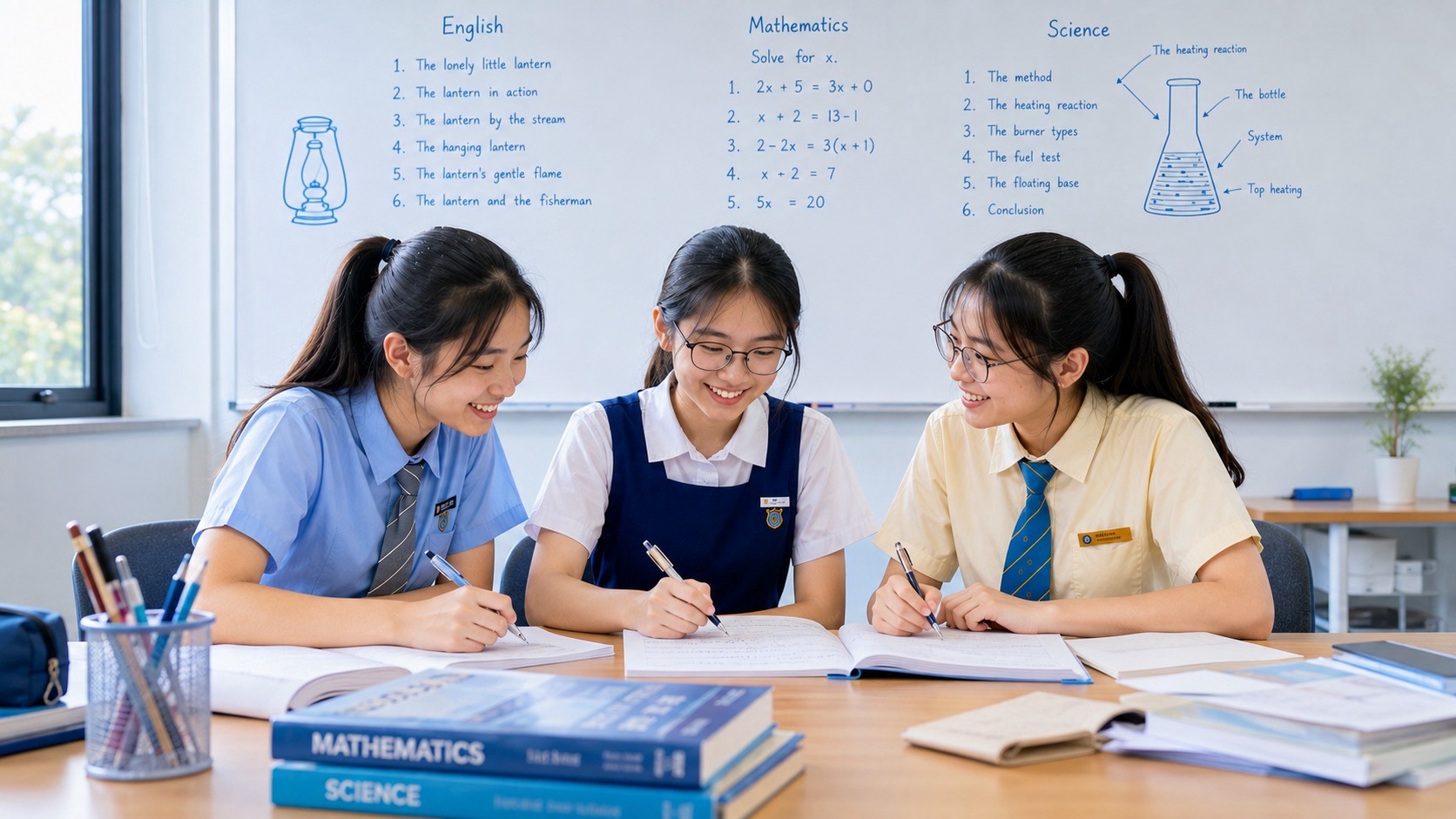
eduKate’s small-group model centres on three students in typical 1.5-hour lessons. During P6, that closeness lets us work at exam precision while still observing the transferable language underneath.
- A comprehension answer can be checked for PSLE scoring precision and then discussed for deeper text reasoning.
- A grammar error can be corrected in Paper 2 and then tested inside writing.
- An oral idea can be reformulated as a concise written paragraph.
- Vocabulary can move between reading, speech and composition.
- Prompts can be faded individually so independence becomes measurable.
- Strong students can be extended without forcing weaker students to skip prerequisite repair.
Do Not Let “Exam Technique” Replace English
Exam technique is real. Students benefit from understanding task requirements, timing, checking, answer form and how marks are typically lost. Technique becomes dangerous only when it is used as a substitute for comprehension and language competence.
A memorised comprehension formula cannot rescue a misunderstanding of the passage. A composition template cannot guarantee relevance when the prompt changes. A vocabulary trick cannot replace knowledge of meaning. We use technique to help ability reach the paper, not to simulate ability.
The Final Months: Narrow the Noise
As preliminary examinations and PSLE approach, students often receive more advice from school, tuition, books, friends and online resources. Too many late frameworks can interfere with routines that already work.
- Prioritise recurring mark leaks.
- Keep useful writing and checking routines stable.
- Increase realistic timed practice appropriately.
- Use full papers to test coordination and pacing.
- Zoom back into weak links when full-paper evidence reveals them.
- Avoid changing successful systems merely because a new trick looks attractive.
The final stage should feel increasingly executable. The child needs to know what to do when the paper begins.
After PSLE: Do Not Throw Away the Learning System
When the examination ends, some exam-specific routines can be retired. The deeper capabilities should remain: evidence-based reading, vocabulary retrieval, contextual grammar, paragraph architecture, oral explanation, attentive listening and independent checking.
The post-PSLE period can be used to widen reading, explore more complex nonfiction and literary texts, write for purposes beyond examination prompts, and practise summarising and explaining ideas. The pressure can fall while the language system continues growing.
Signs a Student Is Ready for the Secondary 1 Runway
- Can read a longer text without losing the main thread.
- Can support an interpretation with evidence.
- Can distinguish fact, inference and personal judgement.
- Can organise a multi-paragraph response.
- Can retrieve useful vocabulary without a prepared list in front of them.
- Can notice several recurring grammar errors independently.
- Can explain a viewpoint orally with a reason and evidence.
- Can begin unfamiliar work without waiting for a tutor to supply the first move.
These are not entrance requirements. They are useful indicators of a learner becoming more able to handle the larger secondary-school language environment.
What Parents Can Monitor During P6
- Are school-paper errors becoming less repetitive?
- Can the child explain corrections rather than only copy them?
- Does writing remain controlled when the prompt changes?
- Can the student retrieve vocabulary across different topics?
- Is comprehension evidence becoming more precise?
- Is oral response becoming more natural and developed?
- Are tutor prompts decreasing?
- Does the child’s learning look more portable, not only more exam-specific?
For Sengkang Families
A P6 tuition decision should fit the student’s real school week. Confirm current Sengkang class location, timing and availability directly. Consider travel, CCA, school homework, meals and sleep alongside the instructional model. Final-year tuition should sharpen the learner, not exhaust the learner.
Questions Parents Often Ask
Should P6 tuition teach Secondary 1 English early?
Not as a default race through next year’s content. The better goal is to strengthen transferable capabilities now so the student enters Secondary 1 with stronger reading, writing, vocabulary, grammar and independence. Specific preview work can be useful after PSLE when the timing is appropriate.
Can preparing for Secondary 1 distract from PSLE?
It can if the programme starts teaching unrelated future content while current PSLE gaps remain. The runway approach is different: we choose PSLE repairs that also have lasting value. Evidence-based reading and language control help both horizons.
Should we use more model answers near PSLE?
Models are useful for seeing quality and noticing choices. The student should still practise adaptation and independent production. Overdependence on a fixed model becomes fragile when the task changes.
What should happen after prelims?
Use the prelim papers as a high-value diagnostic. Prioritise recurring weaknesses, increase realistic exam integration, protect stable routines and avoid low-value last-minute complexity.
Finish Primary School Stronger Than the Examination Alone Requires
PSLE deserves serious preparation because it is the student’s current assessment boundary. But the best final-year learning does not have to expire there.
A child who learns to read evidence carefully, organise ideas, choose words precisely, control grammar, speak clearly, listen attentively and work with less prompting is preparing for PSLE and also becoming more ready for the next learning environment.
That is the dual purpose of this Sengkang P6 English small-group tutorial pathway: precise enough for the examination in front of the student, durable enough for the runway beyond it.
Sengkang P6 English: Almost-Code Summary
HORIZON_1 = PSLE
HORIZON_2 = Secondary_1

FOR each_P6_skill:
    diagnose_current_exam_need()
    repair_precisely()
    test_independent_execution()

    IF repair_is_transferable:
        preserve_for_next_stage()

SHARED_CAPABILITIES:
    evidence_based_reading
    coherent_writing
    contextual_vocabulary
    grammar_control
    clear_speaking
    attentive_listening
    retrieval
    self_checking
    independence

AS PSLE approaches:
    reduce_noise()
    protect_stable_routines()
    increase_realistic_timing()

AFTER PSLE:
    retire_exam_only_routines()
    widen_reading()
    widen_writing_purposes()
    strengthen_secondary_runway()

OUTPUT:
    precise_PSLE_execution
    durable_English_capability
    stronger_Secondary_1_readiness
About eduKate
eduKate teaches in very small groups with a focus on reasoning, precise correction, transfer and independence. Our core values are Integrity, Empathy, Critical Thinking and Responsibility. Examination preparation matters, and so does the learner who continues after the examination.
Properly Taught Kids Shine a Bright Light Into the Future.


