
Primary 2 English should not be treated like a small version of PSLE preparation.
The educational job is earlier and more fundamental: make reading more fluent, vocabulary more accessible, sentences more automatic, comprehension more reliable, writing more independent and school routines easier to manage before the child enters Primary 3.
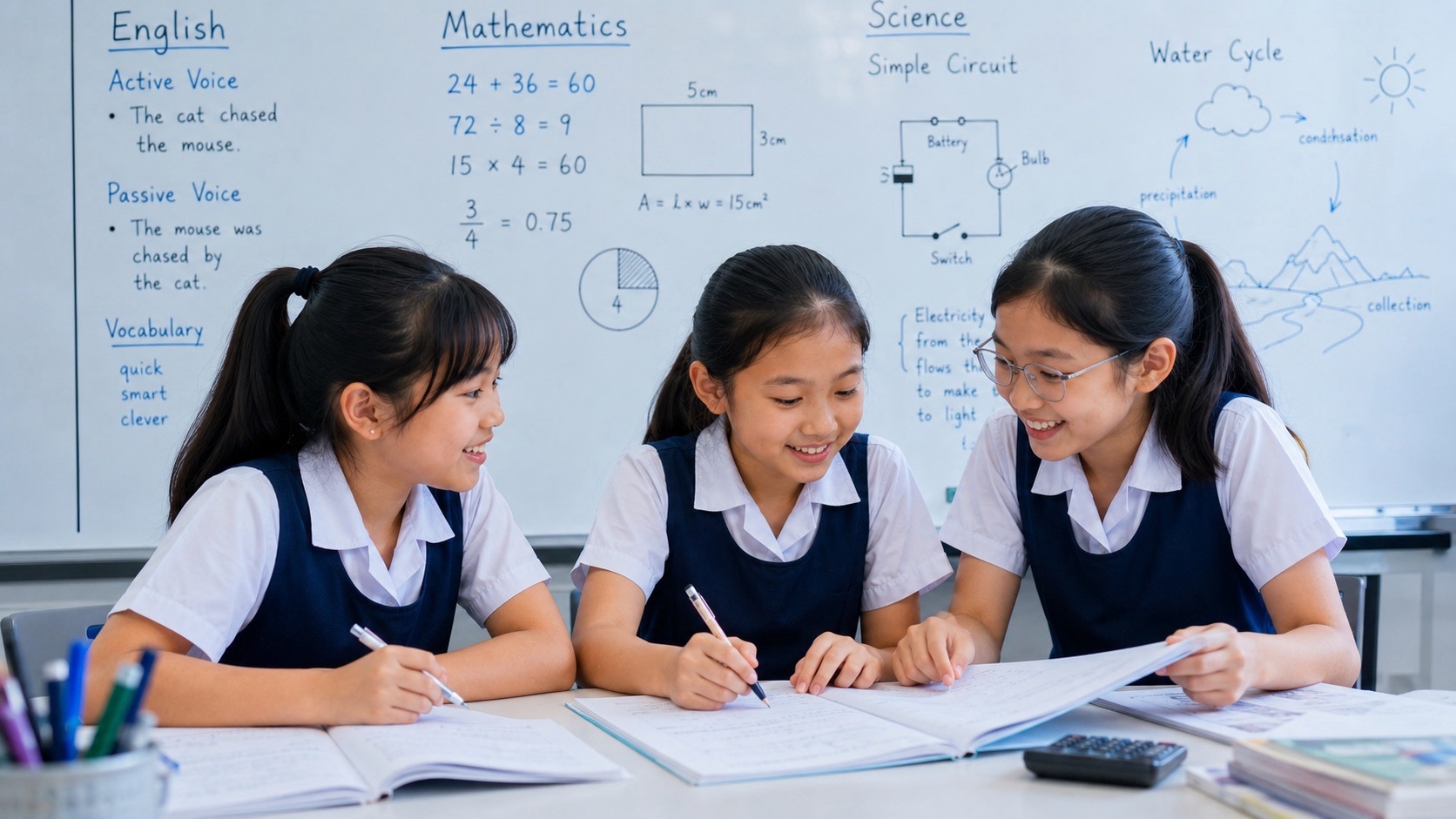
This guide is for Marine Parade families comparing Primary 2 English tutors who teach in small groups. Its purpose is not generic lower-primary tuition marketing. It focuses on what a 3-pax P2 class should actually change: every child is heard reading, every child produces language, repeated errors are tracked, peer comparison is kept gentle and useful, and tutor support is gradually reduced so the learner enters P3 with more automatic control.
This page does not claim that eduKate currently operates a Marine Parade classroom. eduKate’s verified current small-group teaching is based at 83 Punggol Central, Singapore 828761, with 3-pax classes and 1.5-hour weekly lessons. Marine Parade families considering eduKate should contact us for current arrangements and decide whether the teaching model and travel are appropriate for the child.
Singapore schools have no weighted assessments or examinations for Primary 1 and Primary 2. That matters. Lower-primary English tuition should build language foundations and school independence without creating artificial high-stakes pressure where the school system itself has deliberately reduced it.
The P2 Goal: Make Core English More Automatic
Automaticity means a basic skill takes less mental effort.
When common words are recognised quickly, the child has more attention available for meaning. When simple sentence patterns are familiar, the child can think more about the message. When spelling patterns are better established, writing becomes less exhausting.
P2 tuition should therefore reduce unnecessary cognitive load before P3 asks the child to use English more independently across school.
Why a 3-Pax Class Can Work Well at P2
At Primary 2, children still benefit from frequent direct observation.
- the tutor hears every child read;
- the tutor notices word guessing and hesitation;
- each child says complete sentences aloud;
- spelling patterns can be checked closely;
- writing can be reviewed line by line;
- the tutor can see who needs prompting to begin.
Three students also gives the child peers to listen to and respond to, which is useful for oracy and language confidence.
The P2 Diagnostic: Reading, Language and Independence
A useful P2 diagnostic does not need to feel like an examination. The tutor can observe ordinary language tasks.
Reading
- Can the child recognise common words quickly?
- How are unfamiliar words approached?
- Does the child read word by word or in phrases?
- Does meaning survive after the sentence is read?
Language
- Can the child explain familiar vocabulary?
- Can simple sentences be constructed?
- Are basic grammar relationships reasonably stable?
- Can a short text be retold?
Independence
- Can the child listen to an instruction and begin?
- Can simple work be completed without constant reassurance?
- Does the child know what to do after an error?
- Can materials be managed with age-appropriate support?
The tutor then knows whether the primary need is literacy, language, task routine or some combination.
Reading Accuracy Before Reading Speed
Fluency is not simply reading faster.
A P2 tutor should protect accuracy and meaning while reading gradually becomes smoother.
- recognise high-frequency words;
- use phonics and spelling patterns where appropriate;
- look through the whole word rather than guess from the first letter;
- pause at punctuation;
- reread when meaning is lost.
Reading speed should emerge from better automaticity, not pressure to race.
Phonics Is a Tool, Not the Whole English Programme
Phonics can help children connect sounds and print, decode unfamiliar words and notice spelling patterns.
But English also requires:
- meaning;
- vocabulary;
- sentence structure;
- reading comprehension;
- oracy;
- writing;
- background knowledge.
A strong P2 tutor uses phonics where it solves a real reading or spelling problem rather than treating it as the whole curriculum.
High-Frequency Words: Reduce Reading Friction
Common words should become increasingly automatic because they appear so often.
A tutor can use:
- short retrieval;
- sentence reading;
- word sorting;
- spelling patterns;
- short writing applications.
The goal is not to memorise a list once. It is to make common words increasingly effortless inside real reading and writing.
Phrasing: Read Meaningful Groups, Not Isolated Words
A child who reads every word separately can lose the sentence structure.
The tutor can model meaningful chunks, then ask the child to reread.
For example:
After the rain / the children hurried outside / to look for puddles.
Phrasing supports both fluency and comprehension.
Retelling: Check Whether Reading Became Meaning
After a short passage, ask the child to explain what happened.
- Who was involved?
- What happened first?
- What changed?
- Why did it happen?
- What happened at the end?
A child can sound fluent while retaining little meaning. Retelling helps the tutor detect that gap.
Vocabulary: Move Beyond “What Does This Word Mean?”
P2 vocabulary can become richer through simple connections.
- meaning;
- picture or situation;
- opposite;
- similar word;
- word family;
- sentence use;
- retrieval later.
Three students can contribute different examples. The tutor can then ask each learner to use the word independently.
Word Families: Useful for Vocabulary and Spelling
Word families help children see patterns.
- help, helpful, helpless;
- care, careful, careless;
- play, playful, player;
- hope, hopeful, hopeless.
The tutor can discuss how the ending changes meaning and word class.
This creates connections instead of isolated memorisation.
Spelling: Look for Patterns Before Calling It Careless
A repeated spelling error may have a pattern.
- sound-letter mapping;
- vowel patterns;
- double consonants;
- word endings;
- high-frequency irregular words;
- confusion between similar word forms.
The tutor should identify the recurring pattern rather than simply mark every word wrong.
Grammar: Build the Sentence Engine
Primary 2 grammar should support complete, meaningful sentences.
- subject and verb;
- simple tense relationships;
- articles;
- pronouns;
- prepositions;
- conjunctions;
- capital letters and punctuation.
The tutor can ask children to explain simple choices and then make a new sentence using the same relationship.
Complete Before Complex
At P2, a clear complete sentence is more valuable than a long sentence the child cannot control.
- Who or what?
- What happened?
- Where?
- When?
- Why?
- How?
The child can begin with one complete idea and then add useful detail.
Three students can produce different versions and compare which is clearest.
Comprehension: Start With Literal Meaning and Simple Evidence
P2 comprehension should build careful reading habits without turning every passage into an exam drill.
- read the question;
- find the relevant part;
- state the answer;
- check that the answer makes sense.
Students can begin learning to point to the sentence that supports their answer.
This early evidence habit becomes useful later in upper-primary comprehension.
Simple Inference: Build From Visible Behaviour
Even P2 students can begin making simple inferences when clues are concrete.
If a character is shivering, rubbing their hands and wearing a coat, the child can infer that the character is cold.
The tutor keeps the reasoning visible:
What did you notice? What does that tell you?
Writing: From Sentence to Short Paragraph
Primary 2 writing can move through a controlled ladder.
- one complete sentence;
- two related sentences;
- a short paragraph about one idea;
- a simple beginning-middle-end sequence.
The tutor should make sure sentence completeness and meaning remain stable as length increases.
Picture to Sentence to Story
Pictures can help children generate language without requiring a large memory load.
- name what is happening;
- say one complete sentence;
- add where or when;
- add a feeling or reason;
- connect several sentences;
- retell the short story aloud.
A 3-pax group gives children several valid language models without requiring everyone to copy the same sentence.
Oracy: P2 Students Should Speak During English Tuition
- retell a short text;
- describe a picture;
- explain a word;
- give a reason;
- answer in a complete sentence;
- respond to another child.
Speaking helps the tutor see whether the child has the idea before asking the child to write it.
Listening and Following Instructions
School independence depends partly on language used for instructions.
The tutor can gradually increase instruction complexity:
- underline the word;
- circle the verb and write one sentence;
- read the paragraph, underline the clue and explain your answer.
If the child repeatedly loses the second step, the tutor now has useful evidence about working memory, language comprehension or task routine.
Independent First, Group Second—Gently
At P2, independent retrieval should be brief and developmentally appropriate.
- write one word before hearing peers;
- choose one grammar answer first;
- say one sentence before comparing;
- underline one clue independently.
Then the tutor can invite peer comparison. The goal is not competition. It is to make each child’s thinking visible.
The Quiet Child and the Fast Child
A small group lets the tutor manage different response styles carefully.
- A quiet child can prepare a short sentence before speaking.
- A fast child can be asked to wait and explain.
- A child who guesses can be asked to point to evidence.
- A child who hesitates can receive a small cue rather than the answer.
The tutor should not turn personality into a label about ability.
Prompt Fading: Build School Independence Before P3
- model: show the process;
- guide: ask the child through it;
- cue: give one small reminder;
- wait: allow independent attempt;
- reflect: ask what the child did.
P2 tuition should make the child increasingly able to begin familiar tasks without waiting for adult permission at every step.
What “I Don’t Know” Can Mean
When a P2 child says “I don’t know”, the tutor should not assume one cause.
- the word is unknown;
- the instruction was not understood;
- the child cannot retrieve the answer;
- the child is afraid to be wrong;
- the task feels too large;
- the child is waiting for a hint.
A good tutor responds to the cause, not only the phrase.
Correction: Specific and Safe
Lower-primary correction should be clear without making language use feel dangerous.
Instead of “wrong”, the tutor can identify the repair:
- “This sentence needs a verb.”
- “Read the whole word again.”
- “The story happened yesterday, so check the tense.”
- “Find the sentence that tells us the answer.”
The correction should end with a new student attempt.
The P2 Error Map
- word-reading: decoding or recognition breaks;
- fluency: words are read but meaning is fragmented;
- vocabulary: the word meaning is unknown or inaccessible;
- sentence: the idea cannot be constructed clearly;
- comprehension: the text is read but the question is not answered accurately;
- spelling: repeated patterns are unstable;
- independence: the child waits for adult prompting.
These categories are more useful than simply saying the child is weak in English.
Retrieval and Spacing
P2 learning should return after time has passed.
- retrieve last week’s vocabulary;
- read a spelling pattern in a new word;
- rebuild a sentence pattern;
- retell a story read earlier.
The child should try before notes or peers provide the answer.
A 90-Minute P2 Small-Group Lesson
- short retrieval: familiar words, vocabulary or sentence patterns;
- reading: every student is heard;
- focused teaching: one literacy or language job;
- guided practice: support varies by learner;
- oracy: students explain or retell;
- independent application: each child produces without copying peers;
- error review: repeated patterns are named;
- continuation: a manageable home task reinforces the learning.
The lesson should remain active without becoming a high-pressure test.
Homework: Purpose Before Volume
Primary 2 homework should be focused enough that the child can do most of the thinking.
- read a short passage;
- retrieve a few words;
- write several sentences;
- practise one spelling pattern;
- retell a short text;
- complete a small comprehension task.
If parents must sit beside the child for the entire task, the tutor should know. The goal is increasing independence, not transferring the lesson home.
Parent Communication: Report Behaviours, Not Exam Predictions
Useful P2 updates might say:
- “Reading is more accurate and less word-by-word.”
- “High-frequency words are becoming automatic.”
- “Vocabulary is understood; sentence use is the next step.”
- “The child can retell the main event without prompts.”
- “Homework is beginning with less adult help.”
These are more appropriate lower-primary indicators than trying to predict future PSLE results.
Marine Parade Travel and the P2 Week
For a Marine Parade family considering tuition outside the east, the travel-and-study block must fit a young child’s week.
- travel;
- lesson time;
- homework;
- sleep;
- play;
- family reading;
- unstructured recovery.
Primary 2 does not benefit from replacing every free hour with structured instruction. The programme should earn its place.
P2-to-P3 Readiness
- common word recognition is increasingly automatic;
- reading is more accurate and better phrased;
- short passages can be retold coherently;
- vocabulary can be explained and used;
- simple grammar relationships are increasingly stable;
- complete sentences can be written independently;
- short paragraphs stay on one idea;
- simple comprehension answers use the text;
- instructions can be followed with less repetition;
- the child begins familiar tasks with less adult prompting.
The aim is readiness for the reading-to-learn transition, not early examination pressure.
Red Flags in P2 Small-Group Tuition
- heavy exam-style drilling despite the lower-primary stage;
- large homework packets requiring parent supervision;
- one child answers while others copy;
- no individual reading;
- phonics treated as the whole English curriculum;
- spelling errors marked without pattern diagnosis;
- correction without a student reattempt;
- no plan to fade prompting;
- future grade guarantees;
- outdated Marine Parade location claims.
Questions to Ask a Marine Parade P2 Small-Group English Tutor
- How often does each child read aloud?
- How do you distinguish decoding, fluency and comprehension problems?
- How do you use phonics without reducing English to phonics?
- How do you teach spelling patterns?
- How do you build complete sentences?
- How do you use oracy?
- How do you reduce adult prompting?
- How much homework is expected?
- How do you judge P2-to-P3 readiness?
- What would make you say tuition is unnecessary?
How eduKate Handles Current Marine Parade Enquiries
This page does not claim a current Marine Parade classroom. eduKate’s verified current programme is based at 83 Punggol Central, Singapore 828761.
Format: 3-pax small-group English tutorials
Duration: 1.5 hours weekly
Contact: +65 8823 1234
Marine Parade families considering eduKate should contact us for current arrangements and decide whether the programme and travel are appropriate for a Primary 2 child.
Frequently Asked Questions
Does eduKate currently run this P2 class in Marine Parade?
This page does not claim one. Current verified eduKate small-group teaching is based at Punggol. Contact eduKate for current arrangements.
Should P2 English tuition be exam-focused?
No. Singapore has no weighted assessments or examinations for P1 and P2. The priority should be reading, vocabulary, sentence control, comprehension, oracy and independence.
Is phonics enough for P2 English?
No. Phonics is useful for decoding and spelling, but English also requires vocabulary, meaning, grammar, comprehension, speaking and writing.
What does P3 readiness look like?
More automatic reading, stronger sentence construction, better retelling and comprehension, usable vocabulary, and greater independence with instructions and homework.
Does a 3-pax class guarantee faster progress?
No. It gives the tutor more opportunity for close observation and interaction, but progress depends on teaching quality, learner needs and consistency.
Do you guarantee future grades?
No responsible tutor should guarantee future examination outcomes for a Primary 2 child. The focus should remain on observable language development.
The Marine Parade P2 Small-Group Test in One Sentence
A strong Primary 2 small-group English class should make reading and sentence use increasingly automatic while making the child less dependent on adult prompts before the P3 reading-to-learn transition.
That is P2 readiness.
Properly Taught Kids Shine a Bright Light Into the Future.


