
Primary 5 is one of the best years to strengthen English because the work is becoming genuinely upper-primary, but there is still time to repair without treating every lesson like PSLE emergency preparation.
For families searching for Yishun Primary 5 English tuition, the useful question is not simply whether a child needs “more practice”. It is whether the child is building the language control, retrieval strength and independent habits that Primary 6 will assume are already present.
This page therefore has a deliberately narrow job in the eduKate estate: building the P5-to-P6 readiness bridge. Our already-published Yishun P5 pages cover broader tuition and transfer. Here we concentrate on what must become stable before the final primary-school year begins, how to detect hidden fragility early, and how a three-student class can turn a busy P5 year into a controlled transition rather than premature PSLE drilling.
What Changes in Primary 5 English?
| Primary 5 pressure | What the student may experience | What should be built before P6 |
|---|---|---|
| Longer and denser texts | The child reads every word but loses the relationship between ideas | Main-idea tracking, inference and evidence selection |
| Greater vocabulary demand | Known words do not come to mind in writing or cloze | Contextual retrieval, word families, collocations and precision |
| More complex grammar | Rules look familiar but errors return in authentic sentences | Trigger recognition and contextual grammar control |
| Longer writing | Ideas are present but organisation or accuracy collapses over time | Planning, paragraph purpose, sentence control and editing routines |
| Higher independence | The child can do work with a parent or tutor but not alone | Scaffold fading and transfer testing |
| Assessment begins to feel consequential | Every low score creates panic and random extra work | A diagnostic system that converts marks into useful next actions |
P5 Is a Construction Year, Not a Waiting Room
It is tempting to think of Primary 5 as the year before the important year. That wastes its greatest advantage. P5 is the point at which a student is mature enough to understand more explicit language reasoning while still having enough calendar space to rebuild weak foundations carefully.
A child who enters P6 with unstable grammar, thin vocabulary retrieval, weak inference and dependent writing habits must repair those systems while simultaneously managing the final-year assessment cycle. A child who enters P6 with those foundations already stable can use the year for integration, timing, transfer and refinement.
That difference is why good P5 tuition should be forward-looking without racing ahead. We are not trying to make an eleven-year-old sit endless full PSLE papers months too early. We are trying to make the underlying English system strong enough that future PSLE work has something reliable to stand on.
The P5-to-P6 Readiness Test
A useful readiness check asks whether knowledge survives three changes: time, context and support.
- Time: can the student still use the skill one or two weeks after learning it?
- Context: can the student use the same principle when the wording, topic or text changes?
- Support: can the student perform without the tutor giving the first step?
If a skill disappears when any one of these changes, the child may have achieved successful practice without achieving stable learning. P5 gives us time to detect that difference.
Readiness Area 1: Reading Must Become More Than Decoding
By P5, most students can read the words on the page. The harder task is building a coherent model of what the text means. A student has to track who or what a pronoun refers to, notice cause and consequence, distinguish a main claim from an example, infer attitude and select evidence that answers the specific question.
When comprehension is weak, we do not begin by demanding longer answers. We first identify whether the failure occurred during reading or during answer construction. If the child misunderstood the relationship in the passage, answer phrasing is downstream. If the child understood but cannot express the evidence precisely, we repair response formulation.
- Literal retrieval: find what the text directly establishes.
- Inference: connect clues without importing unsupported assumptions.
- Evaluation: form a judgement that remains anchored to the text.
- Reference tracking: know what words such as “this”, “they” and “it” point to.
- Question job: recognise whether the examiner wants a reason, comparison, feeling, evidence or effect.
Readiness Area 2: Vocabulary Must Become Available on Demand
A vocabulary notebook can be full while the student’s active vocabulary remains thin. P5 tuition should therefore connect meaning to use. The student needs to understand shades of meaning, common partners, register and the kinds of sentences in which a word naturally belongs.
We prefer a smaller set of words that can be retrieved and used accurately over a giant list that remains passive. Words should move through a cycle: encounter, explain, compare, use, retrieve after delay, use in a new context, then integrate into writing or speaking.
This is especially important before P6 because the current PSLE English assessment expects appropriate vocabulary use in context rather than ornamental word display. Precision is productive across writing, cloze, comprehension and oral communication.
Readiness Area 3: Grammar Must Move From Rule Recognition to Sentence Control
Students often say, “I know this rule,” immediately after making the error. They may be correct. Knowing the rule and controlling the rule during authentic language use are different stages.
P5 is the right time to find recurring grammar triggers. Does subject–verb agreement fail when extra phrases separate the subject and verb? Does tense shift when the narrative moves between earlier and later events? Do pronouns become ambiguous? Does punctuation fail when sentences grow longer?
Once the trigger is visible, the correction can be operational: identify the subject, mark the timeline, check the referent, read the clause boundary. The goal is not to chant a rule. It is to install a reliable decision.
Readiness Area 4: Writing Must Hold Together for Longer
Upper-primary writing is a coordination task. The student must decide what to say, organise it, choose words, build sentences, maintain coherence and monitor accuracy at the same time. When one part consumes too much working memory, another part often collapses.
That is why a child may write accurately in isolated grammar exercises but make many grammar errors in composition. The writing load changed. Tuition must therefore train grammar inside writing, not only beside it.
- Plan the central event or communicative purpose.
- Give every paragraph a job.
- Develop moments with relevant actions, observations, thoughts and consequences.
- Use vocabulary for precision before sophistication.
- Practise sentence variety without losing grammatical control.
- Edit the student’s own recurring error categories.
Readiness Area 5: Speaking and Listening Should Stay Alive
English is not only a written subject. MOE’s Primary English syllabus treats listening, viewing, speaking, representing, reading and writing as connected language areas. The current PSLE also retains Listening Comprehension and Oral Communication as substantial parts of the examination.
In P5, oral work should build comfortable, relevant expansion rather than rehearsed speeches. Students can learn to answer a question directly, give a reason, add a useful example and respond to follow-up naturally. Listening work can train attention to contrast, sequence, speaker intention, main idea and detail.
A P5 Diagnostic Matrix
| Observed problem | Do not assume | Test instead |
|---|---|---|
| Weak comprehension | “The child does not read enough” | Literal understanding, reference tracking, inference, evidence selection and answer form separately |
| Weak composition | “The child has no creativity” | Planning, paragraph purpose, development, sentence control and editing |
| Vocabulary errors | “Memorise more words” | Meaning precision, collocation, contextual clues and retrieval |
| Grammar errors | “Careless” | Whether the same error appears under the same trigger condition |
| Good homework, poor tests | “Exam nerves” | Prompt dependence, timing, mixed-question selection and delayed retrieval |
| Strong one week, weak next week | “Inconsistent effort” | Whether the learning was consolidated and revisited |
Why Marked School Work Is Valuable in P5
A school paper gives us more than a score. It shows what the student did when the tutor was not beside them. That makes it an excellent transfer test.
- Which errors repeat?
- Which sections are unfinished?
- Does the child misread command words?
- Are comprehension answers too broad, too narrow or unsupported?
- Does writing lose control near the end?
- Are corrected skills actually appearing in later assessments?
This is one reason we ask families to bring recent marked work when possible. The aim is not to criticise the child. It is to read the learning system from real evidence.
What “Preparing for P6” Should Mean
Preparing for P6 should not mean racing through every possible PSLE paper in P5. It should mean reducing the number of weak systems that P6 will have to carry.
- Grammar errors are becoming identifiable rather than mysterious.
- Vocabulary is being used, not merely collected.
- Comprehension answers can be justified with evidence.
- Writing has a repeatable planning and editing process.
- Oral responses can expand naturally.
- Earlier skills are retrieved after delay.
- The child can begin tasks without waiting for a prompt.
- School results are becoming more stable, even when questions change.
A child who can do these things enters P6 with spare cognitive capacity. Instead of using the final year to relearn everything, the student can integrate, refine and become more examination-ready.
Teaching Ahead Without Rushing Ahead
There is a useful distinction between being ahead in chapter sequence and being ahead in learning readiness. A student who has seen P6 material but cannot retain P5 language structures is not meaningfully ahead.
Where appropriate, tuition can preview upcoming demands. But the sequence should remain disciplined: repair prerequisite knowledge, introduce the next demand, practise it, retrieve it later, connect it to school work, then test whether it transfers. Familiarity is useful only when it rests on understanding.
How Three Students Changes the P5 Lesson
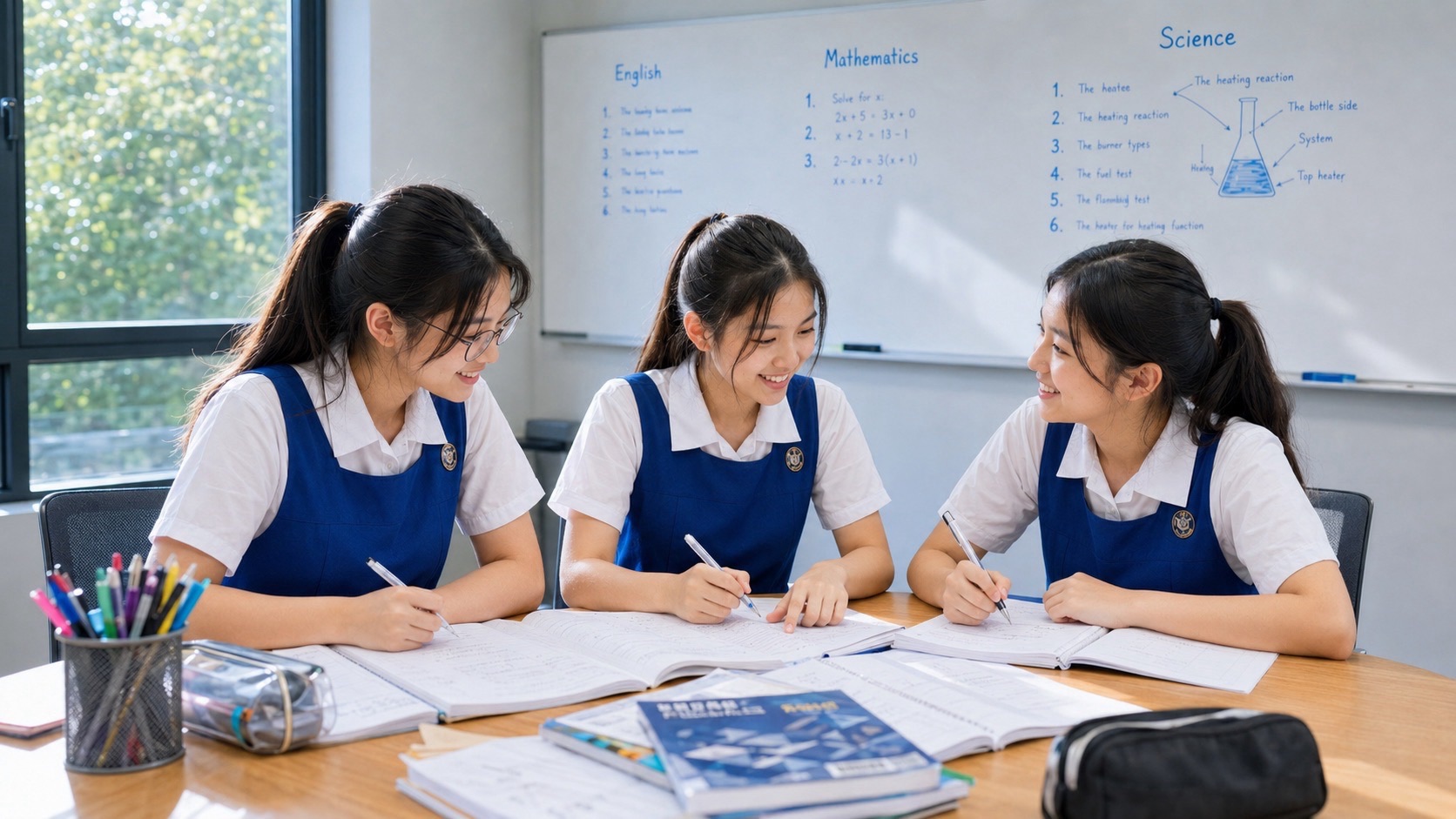
eduKate’s small-group model centres on three students, with typical lessons of 1.5 hours. In P5, this creates a useful balance between individual observation and peer comparison.
- A tutor can hear three different explanations for the same comprehension question.
- A student can see that two plausible answers may differ in evidence strength.
- Writing can be compared for paragraph function rather than ranked simply as “good” or “bad”.
- Grammar misconceptions can be corrected before they become group habits.
- Students can explain vocabulary choices and hear alternatives.
- The tutor can remove support at different speeds for different learners.
The small group becomes productive when it exposes thinking. It is not productive when three children simply sit beside each other doing identical worksheets silently for ninety minutes.
A Term-by-Term P5 Readiness Route
Early P5: Map the Foundation
Read school evidence, identify recurring P4-to-P5 gaps, establish vocabulary and grammar retrieval routines, and make writing/comprehension processes visible. The goal is to stop guessing where the child is weak.
Mid P5: Build Transfer
Vary text types, prompts and question forms. Reduce tutor prompting. Revisit earlier material inside new tasks. The child should begin to recognise language relationships rather than wait for a familiar worksheet layout.
Late P5: Protect the Transition
Use end-of-year evidence to identify what must be repaired before P6. Introduce stronger timing and independence without turning the holiday into an examination boot camp. The transition should feel organised.
What Parents Can Watch at Home
- Can your child explain a grammar correction rather than merely copy it?
- Can a new vocabulary word appear naturally in a later conversation or composition?
- Can your child identify the sentence in a passage that supports an answer?
- Does writing begin faster because planning is becoming habitual?
- Are repeated teacher comments decreasing?
- Can your child complete homework with less prompting?
- When a question looks unfamiliar, does the child have a way to begin?
These are useful readiness signals because they measure independence and transfer, not only the amount of completed work.
For Yishun Families: Choose the Whole Learning Arrangement
A family searching from Yishun should consider travel, school dismissal time, CCA commitments, homework load and the child’s energy at the lesson hour. eduKate does not treat a location keyword as a claim that every class is physically conducted in that neighbourhood. Please check current teaching locations and class availability before enrolment.
The best class on paper is not the best class if the weekly arrangement is unsustainable. P5 is already busy. Tuition should make the learning system clearer, not create a schedule that exhausts the student before the lesson begins.
Questions Parents Often Ask
Is P5 too early for PSLE preparation?
It is too early for unnecessary panic. It is not too early to build the language abilities that PSLE later tests. Strong reading, contextual grammar, vocabulary retrieval, controlled writing, speaking and listening are useful P5 skills in their own right and form the foundation for P6.
Should my child do full PSLE papers in P5?
Occasional exposure may be useful when carefully selected, but whole papers should not replace targeted learning. If a child has a specific inference or grammar gap, a full paper can bury the error among dozens of unrelated items. Repair first; integrate later.
What if my child is already scoring well?
Then the goal may be stability and transfer rather than remediation. Strong students benefit from changed contexts, deeper comprehension, more precise language choices and reduced prompt dependence. The question becomes whether the performance is robust, not whether more pages can be completed.
How fast should improvement appear?
Some visible mistakes can be corrected quickly. Reliable language development requires repeated retrieval and use over time. We do not promise a fixed mark increase within a fixed period; we look for evidence such as fewer repeated errors, stronger independence and more stable performance.
Ten Questions for Choosing P5 English Tuition
- Will the tutor read actual school evidence?
- Can the programme distinguish P5 learning from premature P6 drilling?
- Is vocabulary trained for retrieval and use?
- Are recurring grammar errors classified?
- Is comprehension taught as evidence-based reasoning?
- Does writing instruction cover planning, development and editing?
- Are students asked to explain choices?
- Is support deliberately reduced over time?
- Are earlier skills revisited after delay?
- Will the programme leave the student more independent entering P6?
The P5 Goal: Arrive at P6 With Fewer Emergencies
A productive Primary 5 year does not need to look dramatic. It may look like a child who now reads a question more carefully, catches a recurring tense error, plans before writing, retrieves useful vocabulary without prompting and can explain why a comprehension answer is supported.
Those small controls accumulate. By P6, they become spare capacity. The student has fewer foundational problems competing with examination preparation.
That is what this Yishun Primary 5 English tuition page is designed to protect: a calm, strong bridge from upper-primary learning into final-year readiness.
Yishun P5 English: Almost-Code Summary
STUDENT:
    level = Primary 5
    search_area = Yishun

READ:
    reading_depth
    vocabulary_retrieval
    contextual_grammar
    writing_stamina
    oral_expansion
    listening_attention
    independence
    school_evidence

FOR each_skill:
    teach()
    practise()
    remove_prompt()
    vary_context()
    wait()
    retrieve_again()

IF skill_breaks_after_delay:
    consolidate()

IF skill_breaks_when_question_changes:
    train_transfer()

IF skill_works_only_with_help:
    fade_scaffold()

BEFORE_P6:
    repair_high_value_gaps()
    stabilise_working_habits()
    protect_confidence()

OUTPUT:
    fewer_foundation_emergencies
    stronger_language_control
    greater_independence
    better_P6_readiness
About eduKate
eduKate’s teaching model uses very small groups so tutors can observe reasoning, correct precisely and test whether learning transfers. Our core values are Integrity, Empathy, Critical Thinking and Responsibility. We teach for results, but we do not reduce education to a score promise: the deeper destination is a student who can read, think and communicate with growing independence.
Properly Taught Kids Shine a Bright Light Into the Future.


