
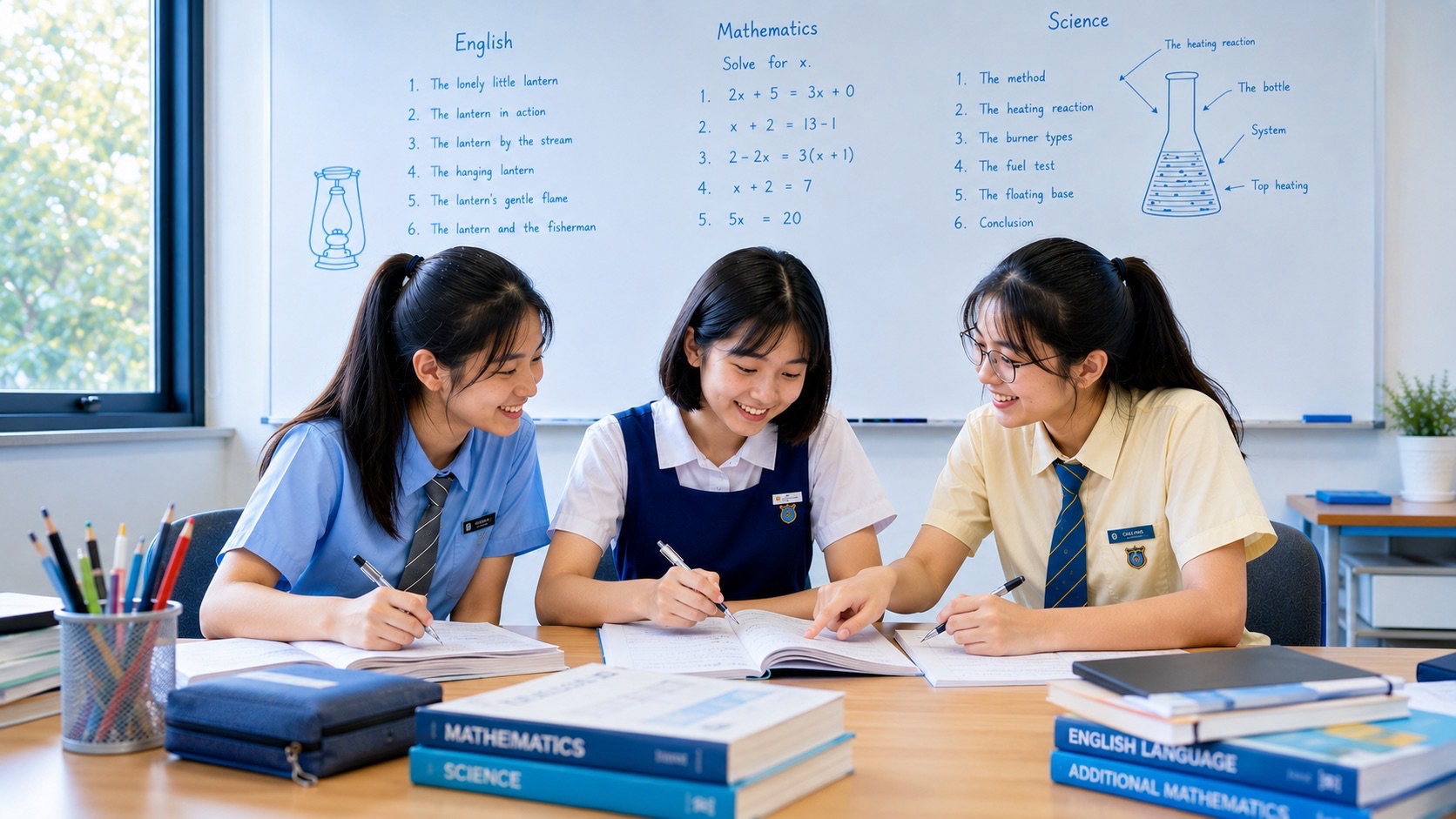
A quiet Primary 3 student is not necessarily lost. Sometimes the child is comparing, remembering, drawing a mental picture or finding the words to explain. At other times, silence means the learner has no useful entry point. A good Science tutor must distinguish productive thinking time from genuine confusion before stepping in.
This legacy page has one job: show how a Punggol Primary 3 Science tutor can use Wait → Observe → Ask → Hint so help arrives at the right moment without replacing the child’s reasoning.
For current programme information, continue to Punggol Primary Science Tuition P3–P6. eduKatePunggol’s current model is up to three students, typically for 1.5 hours.
Why immediate help can hide the real learner state
If the tutor names the concept as soon as the child hesitates, the answer may improve while diagnosis becomes weaker. The tutor no longer knows whether the student could have retrieved the idea independently with a little more time.
- quick rescue can create prompt dependence;
- facial expressions can become hidden hints;
- another student’s answer can contaminate the first learner’s reasoning;
- repeated help can make class performance look stronger than independent performance.
Waiting is therefore not passive. It is an observation window.
Step 1: Wait long enough to see a process
There is no universal number of seconds for every child or question. The useful question is whether the student is still producing new information.
- eyes move between the question and diagram;
- the child traces a label or comparison;
- the student quietly rehearses words;
- a sketch or note begins;
- the learner changes an initial answer after checking evidence.
These can be signs of productive thought. A tutor should not interrupt simply because the room is silent.
Signs the student may genuinely be lost
- the same sentence is reread with no change;
- the student scans the page without identifying what matters;
- the child starts copying a nearby answer;
- the response is unrelated to the question job;
- the learner cannot say what is confusing;
- frustration rises while no new representation appears.
At that point, more silence may not create useful struggle. The tutor should narrow the problem.
Step 2: Observe what the child is doing, not only the final answer
A wrong answer can begin in several places:
- the observation was inaccurate;
- the scientific word was not understood;
- the diagram was read incorrectly;
- the relevant evidence was ignored;
- the child knew the idea but could not express it;
- the question command was misunderstood.
Watching the route helps the tutor choose a smaller and more accurate intervention.
Step 3: Ask the smallest useful question
The first question should discriminate without giving away the whole route.
- “What do you notice?”
- “What changed?”
- “Which part of the diagram matters?”
- “What is the question asking you to do?”
- “Can you say your idea in ordinary words?”
- “What evidence made you think that?”
One well-chosen question is often more useful than a long explanation.
Step 4: Use a hint only when the question is not enough
A hint should restore productive movement while preserving as much learner ownership as possible.
- Attention cue: point the child back to the relevant evidence.
- Relationship cue: ask what changed and what effect followed.
- Concept cue: name the concept only if retrieval has failed.
- Partial model: demonstrate one link, then return the rest to the learner.
- Full teaching: rebuild the concept when the foundation is genuinely missing.
The tutor should start as low on the ladder as the learner can productively use.
The hint is not the end of the sequence
After a successful hinted answer, the student needs another attempt with less help.
- change the object, organism or material;
- change the diagram;
- remove the highlighted evidence;
- ask the same scientific job in different words;
- retest later without signalling the concept.
Otherwise the tutor has demonstrated assisted performance, not independent learning.
Productive struggle has boundaries
Waiting is useful only when the student has enough knowledge to make progress. A child cannot discover a missing scientific concept from persistence alone.
- wait when the learner is retrieving or comparing;
- ask when the route is unclear;
- hint when attention needs redirection;
- teach when the knowledge floor is absent;
- stop prolonged struggle when confidence and attention are deteriorating without new information.
The standard remains high. The intervention becomes better timed.
Primary 3 Science needs visible reasoning
Primary 3 is the first formal Science year. Students are learning to observe, compare, classify, communicate and begin explaining relationships. The tutor should therefore listen closely to how the child describes evidence, not rush directly to examination phrasing.
MOE’s 2023 Primary Science syllabus develops inquiry practices and scientific communication alongside core ideas. The Wait → Observe → Ask → Hint sequence supports those practices because it keeps the learner’s original reasoning visible.
Official reference: MOE Primary Science Teaching and Learning Syllabus.
How this works in a 3-pax lesson
Three students can receive the same stimulus while the tutor observes three different states.
- Student A is thinking productively and needs time.
- Student B has misread the diagram and needs one question.
- Student C lacks the concept and needs explicit teaching.
The class size makes those differences visible. It should not lead to three identical hints.
Parent questions
- Does the tutor let my child attempt before explaining?
- Can the tutor describe where my child first became stuck?
- Are hints becoming smaller over time?
- Does my child complete a fresh no-hint question?
- Is quiet thinking respected without allowing unproductive confusion to continue indefinitely?
Progress receipts
- students tolerate thinking time more calmly;
- the tutor uses fewer full explanations;
- children identify what is confusing more precisely;
- hints become shorter;
- fresh questions succeed without the original cue;
- independent Science explanations become more complete.
Continue with Current Primary Science Information
For current programme details and the wider Primary 3–6 learning route, see Punggol Primary Science Tuition P3–P6.


