
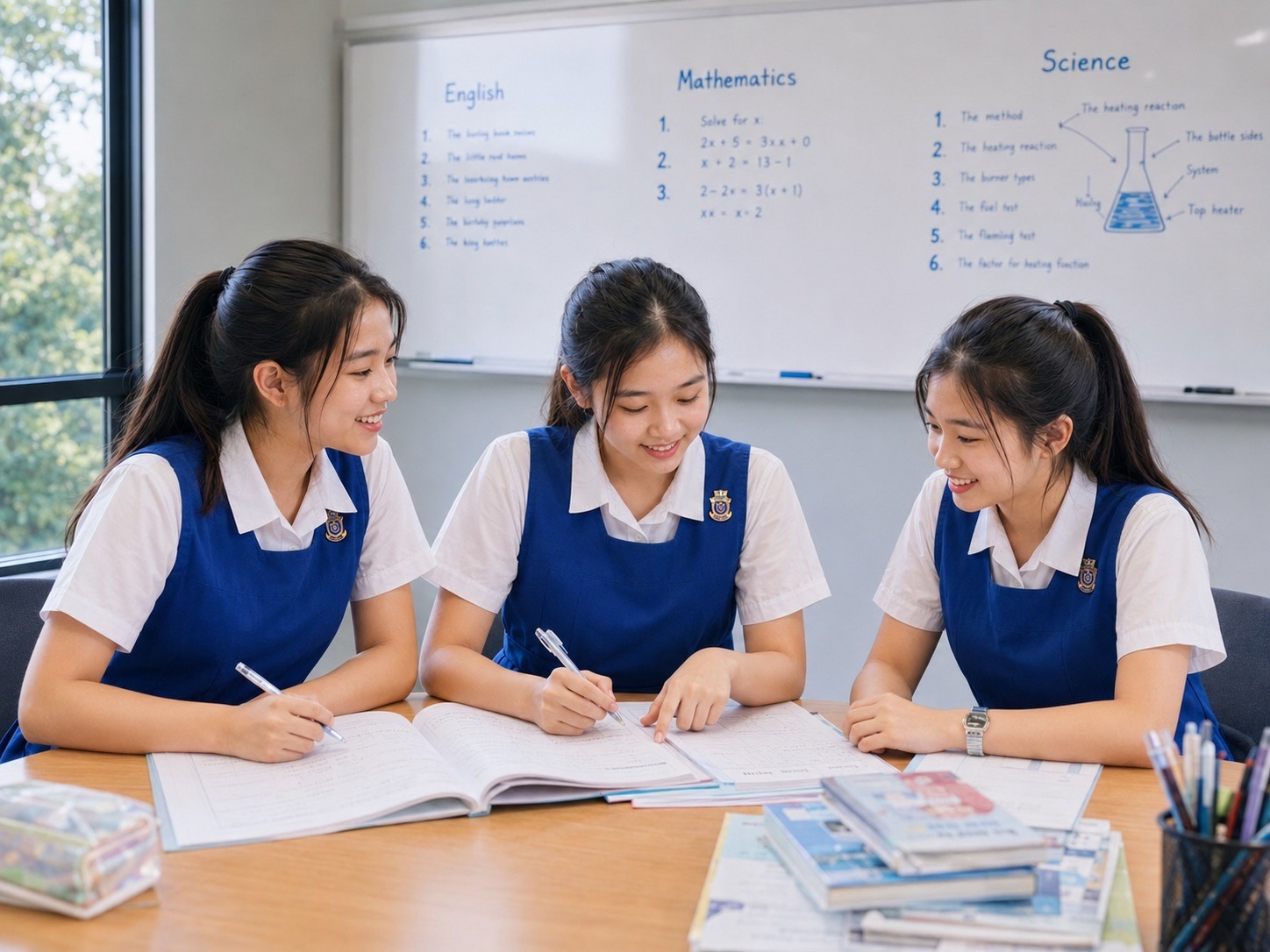
Good tuition should make itself less necessary over time. A Primary 3 student may need visible planning prompts, sentence frames and guided questioning. By Primary 6, those supports should have faded enough for the learner to interpret, plan, write, answer and check with far greater independence.
This page has one job: show how English scaffolds should progressively disappear from Primary 3 to Primary 6 instead of becoming permanent crutches.
For current programme information, continue through Primary English Tuition in Punggol and the current level pages.
What is a scaffold?
A scaffold is temporary support that helps the learner perform a process that is not yet stable.
- model answer;
- sentence starter;
- planning grid;
- question prompt;
- highlighted evidence;
- vocabulary bank;
- editing checklist;
- worked example;
- teacher think-aloud.
The support is successful only if it can eventually be reduced.
Primary 3: make the hidden process visible
P3 students are often learning how to handle longer texts, paragraph writing and more independent responses. Useful scaffolds may include:
- simple story-planning boxes;
- explicit question-type prompts;
- sentence-completion support;
- small vocabulary sets tied to context;
- teacher modelling of how to locate evidence;
- one or two editing targets.
The goal is not speed. The goal is to make the process understandable enough that the child can begin to run it.
Primary 4: reduce the amount of visible prompting
P4 should begin moving from “follow this structure” towards “choose the structure that fits”.
- planning boxes become shorter notes;
- sentence frames become question prompts;
- highlighted evidence becomes student-selected evidence;
- vocabulary lists become retrieval from reading and prior lessons;
- teacher corrections become student revisions.
The student should increasingly explain why a method is useful.
Primary 5: vary the task and remove familiar cues
P5 is a strong year for transfer testing. Students should encounter changed surfaces.
- different text types;
- less predictable comprehension questions;
- composition topics that do not match memorised stories;
- oral questions requiring fresh examples;
- grammar applied inside authentic writing;
- mixed tasks without labels announcing the skill.
If the child succeeds only when the worksheet tells them exactly what strategy to use, independence is not yet secure.
Primary 6: transfer control to the student
P6 tuition should increasingly test whether the student can operate without the tutor.
- interpret the task independently;
- choose a planning method;
- retrieve vocabulary without a supplied bank;
- locate and evaluate evidence;
- monitor time;
- run a personal checking routine;
- recover after a difficult question;
- decide when to move on.
Exam practice becomes more useful when these processes are already available.
The scaffold-fading ladder
- Model: tutor demonstrates.
- Guided: tutor asks the next question.
- Prompted: student receives a short cue.
- Independent similar task: no cue, familiar structure.
- Changed task: same process, unfamiliar surface.
- Delayed retest: skill is checked later.
- Self-triggered: student recognises when the process is needed.
Do not move up the ladder simply because the calendar changed. Move when performance supports it.
Model answers should become less central
A model answer can show quality. It becomes harmful when students believe every task has one ideal script.
- analyse what the model does;
- extract one transferable principle;
- close the model;
- change the prompt;
- produce independently.
The student should learn craft and reasoning, not the surface wording.
Vocabulary banks should shrink
At P3, a small bank can reduce retrieval load. By P5–P6, students should increasingly generate vocabulary from prior reading, discussion and their own active vocabulary store.
The useful question becomes: What word fits? not Which supplied word should I insert?
Editing checklists should become personal
A generic 20-item checklist is too large under time. Students should build a short list from their own recurring errors.
- tense drift;
- subject–verb agreement;
- unclear pronouns;
- sentence fragments;
- off-topic drift;
- rushed endings.
When one error stabilises, remove it and add the next priority.
Current 2026 PSLE English context
For 2026 PSLE English Language 0001, students must coordinate Writing, Language Use & Comprehension, Listening and Oral Communication. Final-year preparation therefore needs both paper familiarity and the ability to run language processes independently under changing tasks.
Official reference: SEAB 2026 PSLE formats.
What a 3-pax class can do
eduKatePunggol’s current model is up to three students, typically for 1.5 hours. The same task can be given at three support levels.
- Student A receives a planning grid.
- Student B receives only two prompts.
- Student C receives no prompt and must self-trigger the process.
The class standard can remain shared while scaffolds differ temporarily.
Warning sign: support is not fading
- the student waits for the tutor before every answer;
- writing cannot begin without a template;
- the child performs only on familiar worksheets;
- corrections disappear when the checklist is removed;
- the same prompts are required month after month;
- paper practice improves only when reviewed immediately with the tutor.
At that point, the programme should reduce assistance deliberately and measure what the learner can carry alone.
Progress receipts
- fewer prompts are needed;
- the student starts tasks faster;
- strategies are self-selected;
- changed tasks are handled better;
- personal checking becomes automatic;
- the learner recovers after mistakes without immediate rescue;
- school performance reflects the same independence.
Continue to current Primary English tuition
For current level-specific information, continue to Primary English Tuition in Punggol.
About this rebuilt legacy page
The previous page mixed Punggol, Marina Bay, school-name and P1–Sec4 keyword copy with old image blocks. This update removes the contamination and gives the URL one clear developmental job: what English support should progressively disappear from P3 to P6.


