
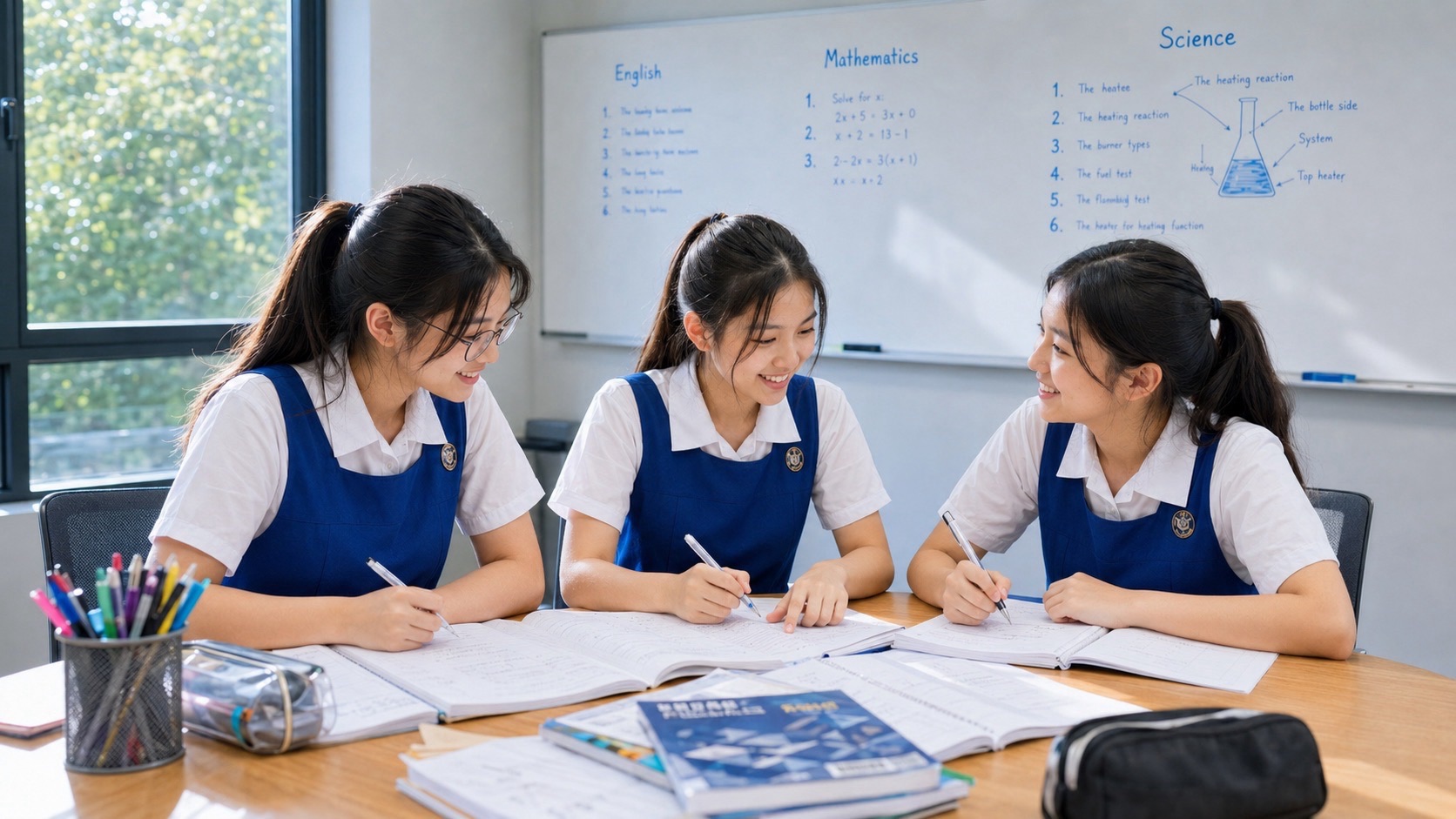
Science becomes transferable when the learner can move in both directions between the world, the scientific model and the question. A child sees water droplets on the outside of a cold bottle. A scientific model explains why they appear. An examination question then changes the surface: perhaps the diagram is different, the temperature condition is hidden in a table, or the student must explain what would happen if one variable changes.
This legacy Punggol Science Tuition page now owns one clear job: Phenomenon → Model → Question. It is not the general Punggol Science tuition landing page. Its purpose is to show how real observations, scientific explanations and assessment representations should remain connected so students do not learn Science as disconnected chapter vocabulary.
The Three-Layer Science Problem
Students often succeed at one layer and fail at another.
- A child can describe a phenomenon but cannot explain it scientifically.
- A learner can recite the textbook model but cannot recognise it in an unfamiliar diagram.
- A student understands the concept but writes an answer that does not connect the question evidence to the mechanism.
- A student memorises model answers but cannot predict what happens when one condition changes.
The tutor’s job is therefore not merely to “cover the topic”. It is to make the route between phenomenon, model and question usable in both directions.
Layer 1: Phenomenon — Start With What Is Actually Happening
A phenomenon is something observable: a shadow lengthens, a wet shirt dries, a plant bends toward light, a bulb changes brightness, an object slows on a rough surface, a seed germinates, or a metal spoon feels cooler than a wooden one in the same room.
Beginning with the phenomenon gives the scientific idea a job. The child is not memorising a definition in isolation. The model exists because there is something in the world that needs explaining.
Observation Before Explanation
A useful first move is to separate what can be directly observed from what is inferred.
- Observation: water droplets appear on the outside of the cold bottle.
- Inference: water vapour in the surrounding air condensed on the cooler surface.
If students jump straight to explanation, they may smuggle assumptions into what they claim to have seen. Science becomes stronger when the evidence layer remains distinct.
Layer 2: Model — What Relationship Explains the Phenomenon?
A scientific model is a simplified way of explaining and predicting. At Primary level, the model may be expressed through diagrams, causal chains, particle ideas, system relationships, life cycles, forces or energy changes.
The model should do more than name a keyword. It should explain what causes what.
- What condition changed?
- What process followed?
- Which part of the system was affected?
- What outcome should we observe?
- What would the model predict if the condition changed again?
A Keyword Is Not a Model
“Condensation”, “friction”, “photosynthesis”, “force” or “heat” can be correct words and still form a weak answer. The learner must connect the word to the question evidence through a relationship.
For example, “because of friction” is incomplete if the question asks why an object slows. A stronger explanation identifies the surfaces in contact, the frictional force opposing motion and the resulting reduction in speed.
Layer 3: Question — The Exam Changes the Surface
Assessment rarely presents the model exactly as the learner first met it. The same scientific idea can appear as a multiple-choice distractor, a labelled diagram, a table, a graph, an experiment setup or an open-ended explanation.
| Question surface | What it may be testing |
|---|---|
| MCQ | Whether a misconception looks more attractive than the correct model |
| Diagram | Whether the learner can read parts, arrows and relationships |
| Table or graph | Whether evidence can be interpreted before explanation |
| Experiment | Whether variables, fairness and evidence are understood |
| Structured response | Whether evidence can be connected to a scientific mechanism |
| Changed-condition question | Whether the model can be run forward under a new state |
The Return Route: Question → Model → Phenomenon
Students should also learn the reverse route. When a question looks unfamiliar, strip away the exam surface and ask:
- What is happening in the setup?
- Which scientific relationship could explain it?
- What evidence in the question supports that model?
- What does the command word require me to do with the model?
This prevents the student from searching memory for an identical worksheet. The learner instead retrieves the underlying Science.
Example: Condensation
Phenomenon: droplets appear outside a cold container.
Model: water vapour in the surrounding air loses heat near the cooler surface and changes from gas to liquid.
Question variation: compare a container filled with ice water and one filled with room-temperature water; explain why droplets form differently; predict the effect of changing the surrounding humidity.
If the learner only memorised “condensation is gas to liquid”, the changed question may still be difficult. If the learner understands the model, the new surface becomes manageable.
Example: Friction
Phenomenon: a toy car travels a shorter distance on a rough surface than on a smooth one.
Model: the interaction between surfaces produces friction that opposes the car’s motion; stronger opposing friction causes the car to lose speed more quickly.
Question variation: change the surface, change the mass, introduce a slope, or ask whether the test is fair. The learner must know which condition affects which part of the model.
Example: Plant Systems
Phenomenon: a wilted plant becomes firmer after being watered.
Model: water is absorbed through roots and transported through the plant; sufficient water supports cells and plant processes.
Question variation: ask what happens when roots are damaged, when water supply changes, or when a coloured-water experiment is used to trace transport. The student should recognise the same system beneath different surfaces.
From P3 to P6: The Same Route Gets Deeper
Primary Science begins formally in P3, but the Phenomenon → Model → Question route can grow across the four years.
- P3: observe accurately, classify, compare and use simple models.
- P4: connect variables, measurement, states and evidence more explicitly.
- P5: reason about systems, interactions and multi-step causal chains.
- P6: integrate prior concepts, interpret unfamiliar evidence and execute under PSLE conditions.
The content changes, but the intellectual movement remains: look at what is happening, identify the model, then use the model to answer the new question.
The 2023 MOE Primary Science Syllabus Supports This Connection
Singapore’s 2023 Primary Science syllabus is built around scientific knowledge, practices and values. It emphasises inquiry and the development of students who can observe, predict, interpret, evaluate and communicate rather than merely recall isolated facts. The official syllabus is available from MOE.
The Revised 2026 PSLE Science Paper Rewards Model Transfer
SEAB states that the 2026 PSLE Science paper assesses both Knowledge with Understanding and Application of Knowledge and Scientific Inquiry. The latter includes prediction, interpreting and analysing information, evaluating observations and methods, and communicating explanations and reasoning. Science is subject code 0009 for the 2026 PSLE and the format is revised for that year. See SEAB’s 2026 PSLE formats.
This is exactly why a student cannot rely only on chapter recall. The same model has to survive diagrams, tables, experiments and unfamiliar contexts.
The “Remove the Chapter Label” Test
One of the strongest transfer checks is to remove the topic heading. Give the student an unfamiliar setup without telling them whether it belongs to heat, forces, plants, electricity or another chapter.
Ask the learner to identify the phenomenon first. Then ask which model best explains it. This tests concept selection rather than chapter-conditioned recall.
The Changed-Condition Test
After a correct explanation, change one condition and ask the student to run the model forward. If light intensity decreases, what changes? If one component in a circuit is removed, what happens? If the surface becomes rougher, what should we expect?
A model that cannot make predictions is usually not yet fully owned.
The Diagram Translation Test
Ask the learner to translate between representations:
- phenomenon → labelled diagram;
- diagram → precise sentence;
- table → trend statement;
- trend → scientific explanation;
- explanation → prediction.
Transfer across representation exposes whether the student owns the model or only recognises one familiar format.
Three Students Can Reveal Three Models
In a three-student class, all learners should predict before anyone explains. One phenomenon can produce three different models. The tutor can compare the reasoning, use evidence to discriminate between them and then require each learner to answer a changed question independently.
The group is useful because different models become visible, not because three students can copy one correct explanation together.
What Parents Can Ask
- Can my child explain what is happening before naming the topic?
- Can they predict what changes if one condition changes?
- Can the same concept survive a diagram, graph or experiment?
- Can they distinguish observation from inference?
- Can they connect evidence to mechanism instead of listing keywords?
What This Page Does Not Own
This page owns Phenomenon → Model → Question. It deliberately does not duplicate the neighbouring legacy pages that focus on evaluating a Science tuition centre, tutor questioning or replacing misconceptions.
- For parent due diligence, see How to Evaluate a Punggol Science Tuition Centre | Concept, Inquiry, Explanation and Transfer.
- For tutor questioning and diagnostic observation, see Punggol Primary Science Tutor | Ask Observe → Predict → Evidence → Explain.
- For misconception replacement, see Punggol Primary Science Tuition | Replace the Misconception, Then Test the New Model.
For Punggol Families
A useful Science programme should help the child recognise the same scientific relationship whether it appears in the world, a diagram, a table, an experiment or an examination question. When phenomenon, model and question stay connected, unfamiliarity becomes less frightening because the student knows what to return to.


