
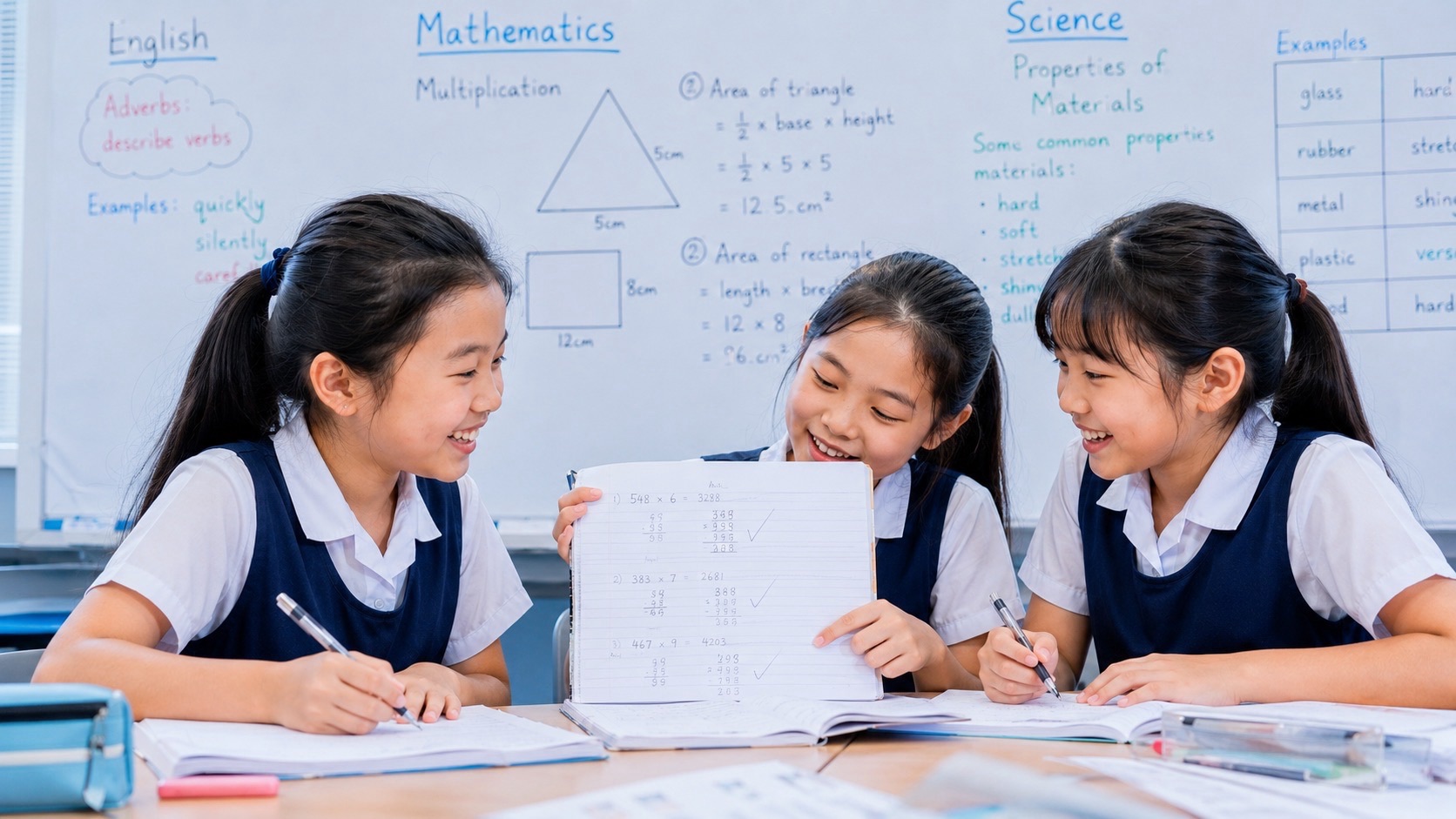
Primary Mathematics tuition in Punggol should change as the child changes. A Primary 1 student may need to build a quantity with objects. A Primary 3 student may need a diagram that reveals multiplication, fraction or measurement structure. A Primary 5 student may need to choose among several representations. By Primary 6, the learner should increasingly be able to read a problem, decide what matters, select a method, execute it and check the answer without waiting for an adult to announce the route.
That progression—Concrete → Visual → Symbolic → Independent—is the core of this rebuilt guide. It is not a rigid four-step programme, and students do not permanently “graduate” from one representation. Strong mathematicians return to diagrams, tables and models whenever a problem benefits from them. The difference is control. As children grow, they should rely less on representations because they have no alternative, and use them more because they know when each one is useful.
This article keeps the original 2017 title and URL while giving the page a clearer ownership role inside eduKatePunggol: the six-year representation progression from Primary 1 to Primary 6. It complements the narrower Primary 1 Maths Punggol page, which focuses on the earliest concrete-picture-symbol bridge, and the broader local Mathematics pages that focus on tuition decisions, exam preparation or specific levels.
The current Primary Mathematics context in Singapore
From 2026, the Ministry of Education’s 2021 Primary Mathematics syllabus applies across Primary 1 to Primary 6. The syllabus organises mathematical content through three strands—Number and Algebra, Measurement and Geometry, and Statistics—while the curriculum framework places mathematical problem solving at the centre.
That framework matters because Primary Mathematics is not intended to be a six-year collection of isolated procedures. Concepts, skills, processes, metacognition and attitudes interact. Students need to know facts and methods, but they also need to represent problems, reason, communicate, make decisions, monitor their own work and transfer knowledge into unfamiliar situations.
The current official syllabus is available here: MOE Primary Mathematics Syllabus. For parents, the practical implication is straightforward: teaching should progressively move the child from supported meaning-making toward independent problem solving.
Why representation is the spine of Primary Mathematics
Mathematics works by representing relationships efficiently. A child begins with the real world: three apples, two more apples, five altogether. The situation can then be represented with counters, a drawing, a number sentence, a bar model, a table, a graph or an equation. Each representation removes some detail and keeps the structure that matters.
This is why representation is more than a teaching technique. It is part of mathematical thinking itself. A good representation reduces unnecessary complexity, reveals relationships and makes reasoning easier to inspect.
The student becomes more mathematically independent when the child can decide how to represent the problem before deciding how to solve it.

Stage 1: Concrete — make quantity and relationship visible
Concrete materials are most useful when the child needs to experience quantity physically. Counters, cubes, sticks, coins, paper strips, measuring tools and real objects can make addition, subtraction, grouping, sharing, length, mass and fraction relationships visible.
The educational value is not the object itself. It is the relationship the object helps the child see. A pile of counters becomes useful only when the learner understands why the counters are being grouped, separated, compared or recombined.
A tutor should therefore ask questions while the child manipulates: What stayed the same? What changed? How many are in each group? What does this part represent? What would happen if one more were added?
Concrete learning is successful when the student can predict and explain, not merely move objects according to instructions.
Stage 2: Visual — preserve structure with less physical support
Visual representations include number lines, diagrams, bar models, arrays, fraction models, tables, sketches and simple graphs. They compress the physical world while keeping the important relationships visible.
The move from concrete to visual is a meaningful developmental step. The child no longer needs the full object but can still externalise thinking. A bar does not look like a bag of marbles, yet it can represent the same part-whole or comparison relationship.
Students who learn to draw useful models gain a way to offload working memory. They can place the structure on paper and reason from it instead of trying to hold every relationship mentally at once.
Stage 3: Symbolic — let notation carry the relationship
Symbols make Mathematics compact. Numerals, operation signs, fractions, decimals, percentages and simple algebraic forms allow students to represent ideas with great efficiency.
The danger is that symbols can be manipulated mechanically. A child may learn a procedure while forgetting what the numbers refer to. This is especially common when students are taught rules before relationships.
Good tuition keeps a return path. If the symbolic method becomes unstable, step back to a visual or concrete representation, rebuild the meaning, then move forward again.
Stage 4: Independent — choose the representation yourself
Independence does not mean “never draw”. It means the student can decide whether a drawing, table, equation, ratio unit, model, diagram or direct calculation is the most useful route.
This is the stage most closely connected to mature problem solving. The question does not tell the student which representation to use. The learner has to recognise the structure and choose.
By Primary 6, many examination questions depend on this capability. The child may know several possible methods. The challenge is selecting the one that fits the problem efficiently under time pressure.
The progression is not linear
Students move backward and forward. A P6 child may use symbolic methods fluently in routine questions and still need a bar model for a difficult ratio problem. A P3 child may understand multiplication symbolically but benefit from an array when a new concept appears.
Returning to a lighter or more concrete representation is not failure. It is mathematical strategy. The key is whether the student uses the representation to recover meaning and then moves forward.
This is why strong tuition avoids the simplistic rule that older students should never use models. Experts use diagrams all the time when diagrams reduce complexity.
P1–P2: build number relationships before workload grows
Lower Primary is where the child builds the basic architecture of number. Quantity, place value, addition, subtraction, multiplication foundations, division foundations, measurement and simple data ideas all depend on the student seeing relationships rather than memorising disconnected facts.
The most valuable work at this stage is often slower than parents expect. Make and break numbers. Compare. Estimate. Explain. Represent the same relationship in several ways. Let fluency grow after meaning begins to stabilise.
A child who learns early that 8 can be 5 + 3, 6 + 2, 10 – 2 or 4 + 4 has a more flexible mental number system than a child who treats each fact as a separate item.
Lower Primary priorities
- secure counting and quantity recognition;
- part-whole relationships and number bonds;
- place value and composing/decomposing numbers;
- addition and subtraction as relationships, not keyword rules;
- early multiplication as equal groups and repeated structure;
- early division as sharing and grouping;
- measurement linked to real quantities;
- simple data reading;
- language for comparison, sequence and quantity;
- confidence moving among objects, pictures and symbols.
Why P1–P2 should not become accelerated upper-Primary tuition
Families sometimes equate advancement with teaching future topics early. Acceleration can suit some children, but the early years are also the cheapest time to deepen number sense and representation.
A child who races ahead with fragile place value or weak part-whole understanding may later appear to “suddenly” struggle when fractions, ratio or algebra demand those earlier relationships.
Depth is often a better investment than premature coverage. Ask the child to explain, represent, compare methods and solve changed problems before assuming the current level is exhausted.
P3–P4: the representation bridge becomes more important
Primary 3 and 4 introduce greater multiplicative reasoning, more complex word problems, fractions, measurement and formal Science alongside Mathematics. The student has more content to coordinate and more language to interpret.
This is a common stage for hidden gaps to surface. A child who managed addition and subtraction procedurally may struggle when multiplication, division and fractions require stronger structural understanding.
Visual representations become especially powerful here because they bridge concrete intuition and symbolic methods.
Multiplication should become structure, not only times-table recall
Times-table fluency is important because it frees working memory. But multiplication is more than recall. Students should understand equal groups, arrays, scaling and the relationship between multiplication and division.
An array is a powerful visual representation because it makes commutativity and grouping visible. Three rows of four and four rows of three contain the same total, even though the orientation changes.
When students understand the structure, memorised facts have somewhere to attach. Fluency becomes a compression of meaning rather than isolated recitation.
Division has two meanings students should distinguish
Division can involve sharing a quantity into a known number of equal groups, or finding how many groups of a known size fit into a quantity. These two situations can look similar symbolically but feel different in a story.
Concrete and visual representations make the distinction visible. The tutor can then connect both meanings to the same division notation.
This flexibility becomes valuable later when students encounter fractions, rate and ratio.
Fractions expose weak representation quickly
Fractions are a major test of whether earlier number learning was relational. Students must understand a whole, equal parts, numerator, denominator, equivalence, comparison and later operations.
A child who sees the denominator only as “the bottom number” may apply rules without meaning. Fraction strips, area models, number lines and bar models can reveal what the notation represents.
The goal is not permanent dependence on fraction pictures. It is a mental fraction model strong enough to support later symbolic work.
The number line is underused and extremely powerful
Number lines connect counting, magnitude, addition, subtraction, multiplication, fractions and decimals. They show numbers as positions and distances rather than isolated symbols.
A student who can place 3/4, 0.8 and 1 on a number line is coordinating different representations of magnitude. That skill supports comparison and estimation.
Number lines also help students understand negative numbers later in Secondary school, making them a useful continuity tool across stages.
Bar models should reveal relationships, not become ritual drawings
Singapore Primary Mathematics is closely associated with bar modelling, and for good reason: bars can make part-whole, comparison, ratio and change relationships visible.
But a model becomes unhelpful when the child draws it mechanically without understanding what each segment represents. The tutor should ask the student to label meaning, not only dimensions.
A good bar model simplifies the problem. If the drawing is more confusing than the original text, the representation has failed its purpose.
P3–P4 is where method choice should begin to open up
Younger children often benefit from a single clear method. By middle Primary, students can begin comparing routes. Which representation is shorter? Which one makes the relationship obvious? Which one is easier to check?
This comparison develops judgement. The child stops seeing Mathematics as a sequence of teacher-approved procedures and starts seeing it as a space of valid methods with different efficiencies.
That is an important bridge to independent problem solving.
P5–P6: representation becomes strategic
Upper Primary Mathematics asks students to coordinate a larger body of knowledge while questions become more integrated. Ratio, percentage, fraction, rate, geometry, measurement, data and multi-step problems can interact.
The student can no longer rely on the tutor announcing the topic. In a mixed paper, the learner must identify the structure.
This is where representation shifts from “how the teacher explains” to “how the student decides”.
Ratio is a relationship, not a chapter
Ratio is often taught as a set of methods, but the underlying idea is comparative multiplicative structure. Students need to understand what the units represent and what remains constant when quantities scale.
Bar models, tables and unit-based reasoning can help students see ratio before symbolic manipulation becomes efficient.
Later, the student should be able to decide whether a ratio table, unitary method, fraction relationship or algebraic approach best fits the question.
Percentage is easier when the base quantity is visible
Many percentage errors come from losing track of what 100% represents. The student may remember a formula but apply it to the wrong base.
Visual models and explicit labelling help at first. Over time, the student should internalise the relationship and move more efficiently between percentage, fraction and decimal forms.
The important continuity is representation of proportion.
Rate introduces quantities that change together
Speed, rate and other compound quantities ask students to coordinate two measures. A student may know the formula and still misunderstand the relationship.
Tables, diagrams and units can make the structure visible. Good working keeps units attached long enough for the student to see what the calculation means.
This is another area where symbolic efficiency should grow after conceptual clarity rather than replacing it.
Geometry needs diagrams that are read, not merely looked at
Geometry questions often appear visual, but students can misread diagrams because they assume rather than infer from stated properties.
A useful habit is annotation. Mark known angles, equal lengths, parallel lines, right angles and relevant dimensions. Translate the visual information into a working representation.
The student is effectively creating a better diagram before calculating.
Statistics requires reading the representation itself
Tables, charts and graphs are not neutral decorations. Students need to read scales, labels, units, intervals and categories accurately before interpreting the data.
A surprising number of errors occur before any calculation because the representation was read incorrectly.
Upper Primary tuition should therefore separate “data-reading error” from “calculation error”. The correction is different.
The problem-solving chain from P1 to P6
- Read: understand the language and situation.
- Select: identify the relevant quantities and conditions.
- Represent: construct a model, diagram, table, equation or mental structure.
- Choose: decide which operation or method fits.
- Execute: calculate accurately and show working clearly.
- Check: verify reasonableness, units, signs and conditions.
- Explain: state the answer in the context of the problem when required.
The sophistication changes by age, but the chain remains recognisable across Primary school.
When a child is stuck, ask where the chain broke
“Cannot solve word problems” is too broad. The child may not understand the language. The student may understand the language but fail to represent the relationship. The representation may be correct while the calculation fails. Or the answer may be correct but checking is absent.
Good diagnosis locates the earliest broken step. That is usually the cheapest place to intervene.
This is the difference between adding more questions and repairing the system that answers them.
The nine gap types across Primary Mathematics
- Missing-node: a concept or fact is absent.
- Broken-edge: two ideas are known but not connected.
- Weak-link: the connection exists but is slow or unreliable.
- Wrong-edge: the student has built a misconception.
- Routing: the learner selects the wrong method despite knowing the right one.
- Translation: the student cannot move among words, diagrams and symbols.
- Transfer: the method works only in a familiar format.
- Calibration: the child cannot judge whether an answer is plausible.
- Regulation: attention, frustration or task management blocks performance.
A student may have several gaps at once, but naming them prevents the whole subject from being treated as one undifferentiated weakness.
Accuracy before speed—then speed without losing structure
Primary Mathematics eventually requires fluency and examination pacing. The order matters. Accurate deliberate practice establishes a reliable route. Retrieval and repetition make the route faster. Mixed practice tests method selection. Timed work tests execution under pressure.
If timing is introduced before the route is stable, the child can automate the wrong move. Fast mistakes are still mistakes.
The long-term goal is speed that rests on structure.
Fluency frees working memory
When basic number facts and procedures become automatic, the student has more mental capacity available for unfamiliar reasoning. This is why fluency and problem solving should not be treated as opponents.
A P6 student who still spends excessive attention on simple fraction arithmetic has less working memory available for the multi-step logic around it.
The right foundational practice can therefore make higher-order thinking easier.
Retrieval is stronger than rereading
Students often feel productive when they review notes or watch a solution. Recognition creates familiarity. Retrieval tests whether the knowledge can be produced.
For Mathematics, retrieval can include recalling a formula, reconstructing a method, explaining a concept, solving without the worked example or identifying the first step from memory.
The most useful cycle is attempt → feedback → correction → delayed reattempt.
Spacing matters because forgetting reveals what is stable
A student who can solve a question immediately after explanation may be relying on fresh memory. Returning after several days tests whether the idea has become accessible without the original context.
This is why homework should not be only same-day repetition. Selected ideas should return after gaps.
Learning continuity is demonstrated when the relationship survives time.
Interleaving makes students choose
Topical practice is efficient for learning a method because the student knows what chapter is being practised. Mixed practice is necessary because real papers do not always announce the method.
Interleaving ratio, fractions, geometry and data forces the student to identify structure before calculating.
The transition should be gradual. Mix too early and the learner may be overwhelmed; mix too late and the student may become dependent on topic cues.
Past papers are integration tests, not teaching substitutes
Full papers become most useful when enough of the underlying curriculum is stable. They test retrieval, method selection, pacing, endurance and checking across mixed topics.
A paper should generate an error map, not merely a score. If the same weakness reappears, return to targeted repair.
Doing another paper without changing the mechanism can produce another measurement of the same problem.
P5 is an important repair window
Primary 5 is often the first year when accumulated gaps become expensive. The content load increases, and earlier concepts are expected to support more complex applications.
This makes P5 a powerful diagnostic year. A fraction weakness, poor bar-model interpretation or unstable percentage base can still be repaired before the final PSLE year becomes heavily performance-focused.
Early repair reduces the number of layers that must be rebuilt later.
P6 should gradually shift toward independent execution
Primary 6 still involves learning, but the balance changes as PSLE approaches. The student should increasingly practise mixed retrieval, timed sections, full papers, strategic checking and recovery after difficult questions.
The tutor’s role changes too. Less solving beside the student. More observing, diagnosing and fading prompts.
A P6 learner should know not only how to solve but how to manage the paper.
What a small-group Mathematics class can do well
In a three-student class, students can compare representations without disappearing inside a large group. One learner may draw a bar model. Another may use units. A third may form an equation. The tutor can compare the routes and ask which is most transparent or efficient.
The tutor can also inspect working closely. Many Mathematics errors are visible only in the intermediate steps: sign loss, wrong unit, incorrect cancellation, miscopied value, invalid assumption or skipped reasoning.
The value of the small group is high-resolution feedback, not simply a smaller number of chairs.
Differentiation without three separate lessons
Students in the same class can work on one concept at different levels of support. One receives a partially completed diagram. Another creates the diagram independently. A third solves symbolically and must justify why the representation is valid.
The learning goal remains shared, which preserves discussion and efficiency. The scaffold changes.
This is especially useful in Primary Mathematics because representation provides a natural way to adjust support.
What parents should ask a Mathematics tutor
- What is the earliest weak relationship you see?
- Which representation does my child currently depend on?
- Can my child translate among words, diagrams and symbols?
- Are repeated errors conceptual, procedural or execution-related?
- When will the scaffold be reduced?
- How are corrected questions retested after a delay?
- When do you introduce mixed and timed practice?
- How will we know that the child has become more independent?
What Mathematics tuition should not do
It should not keep a child permanently dependent on the tutor’s first hint. It should not equate progress with chapter coverage alone. It should not force every learner into one representation regardless of need.
It should not make a struggling child rush before accuracy exists. It should not keep a capable child on repetitive routine work simply because the worksheet sequence says so.
The class should respond to evidence.
The home Mathematics environment matters
Parents do not need to become substitute tutors. They can support mathematical thinking by asking short questions that reveal structure.
- What do you know?
- What are you trying to find?
- Can you draw it?
- What does this number represent?
- Is there another way?
- Does your answer make sense?
- Which step are you least sure about?
These questions preserve the child’s ownership because they do not immediately supply the method.
Do not rescue too early
When a child hesitates, adults feel pressure to prevent frustration. A hint appears immediately. The child completes the question, but the adult may have removed the exact moment where method selection needed to develop.
Productive struggle is not prolonged confusion. Give the learner enough time to search. If the student remains stuck, offer the smallest useful cue, then return control.
The art is support that helps thinking continue without doing the thinking for the child.
Do not leave the child stuck too long either
Independence does not mean abandonment. Repeated failure without feedback can strengthen misconceptions and avoidance.
A tutor should recognise when the search has become unproductive, identify the missing link and teach it explicitly.
Strong learning alternates between guided clarity and independent attempt.
Mathematical confidence is built from successful control
Confidence grows when students see that effort changes capability. A child who can say “I used to need the bar model, but now I can form the relationship myself” has evidence of growth.
That is more durable than generic praise. It tells the learner what improved and why.
The child also learns that returning to a representation is a strategy, not a sign of being bad at Mathematics.
The representation ladder and learning continuity
A strong P1–P6 progression does more than add topics. It preserves connections across years. Place value supports whole numbers, decimals and later algebra. Part-whole reasoning supports fractions and ratio. Number lines support magnitude, fractions, decimals and negative numbers. Equality supports missing-number problems and later equations.
When these edges remain connected, later Mathematics feels like development. When they break, later work feels like a new subject every year.
Tuition should strengthen continuity, not merely patch the next test.
A P1–P6 parent checklist
Primary 1–2
- Can the child connect quantities to numerals?
- Are number bonds and place value meaningful?
- Can the child move between objects, pictures and symbols?
- Can simple word problems be represented before calculating?
Primary 3–4
- Can the child use multiplication and division structurally?
- Are fractions represented meaningfully?
- Can bar models, arrays, number lines and tables be used appropriately?
- Can the student explain why a chosen method fits?
Primary 5–6
- Can the child choose among representations independently?
- Do ratio, percentage and rate relationships remain clear?
- Can knowledge survive mixed and unfamiliar questions?
- Can the student manage timing, checking and full-paper execution?
A six-year progression in one sentence per stage
- P1: Make quantity real and connect it to symbols.
- P2: Strengthen place value, operation meaning and early fluency.
- P3: Build multiplicative structure and portable visual models.
- P4: Connect fractions, measurement and multi-step representation.
- P5: Repair weak links and increase independent method choice.
- P6: Integrate knowledge, execute under time and carry the system into Secondary school.
Frequently asked questions
Should Primary Mathematics tuition follow the school’s topic order?
Usually it should remain aware of the school sequence and upcoming assessments, but the tutor may need to repair an earlier prerequisite before the current topic can become stable.
Is bar modelling still useful in P6?
Yes, when it clarifies a difficult relationship. The goal is not to eliminate models by age. The goal is to make their use strategic and efficient.
Should strong students skip concrete and visual representations?
Not automatically. Strong students may move through them quickly, but representations can reveal deeper structure and provide alternative ways to reason. What should be avoided is unnecessary repetition after the relationship is secure.
How do I know whether my child has a concept problem or a calculation problem?
Ask the child to explain and represent the relationship before calculating. If the model is wrong, the issue is likely conceptual or interpretive. If the model is correct and the arithmetic fails, the repair is different.
How much should a Primary student practise?
Enough to achieve stable retrieval and transfer without creating overload. Practice quality, spacing and error correction matter more than raw worksheet volume.
When should timed practice begin?
When the underlying methods are accurate enough that timing measures fluency rather than panic. Timing should be added progressively.
Does a P6 student still need foundation work?
Sometimes. If a current weakness is caused by an earlier concept, targeted foundation repair can be the fastest route forward. The key is to repair only what is actually carrying the error.
What is the main goal of Primary Mathematics tuition?
To make the child increasingly capable of understanding, representing, solving, checking and learning Mathematics independently.
Related eduKatePunggol reading
- Primary 1 Maths Punggol Tuition Centre | Concrete → Picture → Symbol Without Losing Meaning
- Primary Mathematics Tuition in Punggol | Represent the Problem Before Choosing the Operation
- Accuracy Before Speed in Primary Mathematics
- How to Prepare for PSLE Mathematics: Concept → Method → Transfer → Exam Execution
- eduKate Punggol Contents & Learning Routes
The end of Primary school should look different from the beginning
At Primary 1, the child may need to touch the relationship. By Primary 2, the child should increasingly see it. Through Primary 3 and 4, visual models become more portable and symbols carry more of the load. In Primary 5 and 6, the student should increasingly decide which representation deserves to be used at all.
That progression is what makes Mathematics feel connected across six years. The learner is not abandoning earlier ways of thinking. The learner is gaining control over more representations and using them with greater independence.
The strongest Primary Mathematics tuition therefore does not ask only, “Did the student get the answer?” It asks, “What did the student represent, why was that representation useful, and can the student choose again when the next problem looks different?”
Concrete → Visual → Symbolic → Independent. That is not merely a sequence of teaching aids. It is a description of how mathematical control can grow.
Representation maturity is visible in the questions a student asks
A younger or less secure learner often asks, “Which method do I use?” A more mature learner may ask, “Would a table make this clearer?” or “Is the bar model shorter than forming an equation?” The difference is subtle but important. The student is no longer waiting for the teacher to classify the problem.
Representation maturity means the learner can inspect the problem before committing to a route. That pause becomes increasingly valuable in upper Primary Mathematics, where several valid methods may exist and the fastest method is not always the safest one for a particular student.
Parents can listen for this change at home. When a child begins talking about why a method fits rather than only asking whether the answer is correct, mathematical control is deepening.
A useful distinction: representation error versus arithmetic error
Two wrong answers can look identical on the page while coming from very different causes. If the student represents the situation incorrectly, perfect arithmetic will still produce the wrong answer. If the representation is correct but a multiplication fact is wrong, the conceptual structure may already be sound.
This distinction changes the correction. Representation errors need the child to reconstruct the relationship. Arithmetic errors may need fluency practice, checking habits or slower execution. Treating both as “careless mistakes” wastes the information inside the working.
That is why showing working matters. Working is not only for method marks. It is diagnostic telemetry for the learner and tutor.
What independence should look like at each Primary stage
By the end of lower Primary
The child should increasingly recognise basic number relationships, use simple representations with less prompting and explain straightforward operations in age-appropriate language. The learner may still rely on drawings or objects for unfamiliar ideas, but routine work should require less external support.
By the end of middle Primary
The student should be able to use arrays, bar models, fraction diagrams, number lines, tables and equations more deliberately. The child should begin comparing methods and should not need every problem classified in advance by topic or operation.
By the end of upper Primary
The learner should increasingly select representations strategically, translate between forms, recognise when an answer is unreasonable, and recover from a difficult problem without waiting for immediate rescue. Independence also includes knowing when a diagram or model is worth the time.
The transition to Secondary 1 begins inside Primary Mathematics
Secondary Mathematics introduces more formal algebra, negative numbers, equations, functions, geometry and symbolic manipulation. The transition becomes easier when Primary learning has already trained the student to see relationships beneath the surface.
A bar model that represents an unknown quantity is conceptually related to an algebraic equation. A number line used for fractions prepares the learner for directed numbers. Equality understood as balance prepares the student for equation solving. Ratio reasoning prepares the learner for proportional relationships.
This does not mean Primary school should teach Secondary content prematurely. It means Primary concepts should be taught deeply enough that Secondary abstraction has somewhere to attach.
Why the same child can look strong in one topic and weak in another
Mathematics ability is not one solid block. Students have skill graphs. A child may have excellent whole-number fluency and weak fraction magnitude. Another may reason well visually but make frequent arithmetic errors. Another may understand concepts but struggle to translate language into a model.
This jagged profile is normal. It is also why tuition should not use one global label such as “weak Math student”. The better question is where the graph is strong, where it is thin and which weak connection is carrying the most load right now.
Once the profile is visible, practice becomes more efficient because time can be allocated to the bottleneck instead of distributed equally across everything.
Why stronger students still need representation
High-performing students can sometimes become overdependent on mental speed. They calculate quickly and may resist drawing because drawing feels slower. That works until a problem contains enough relationships to overload mental tracking.
For these learners, representation is not remediation. It is a way to preserve complexity accurately. A quick table or diagram can expose a constraint that mental calculation misses.
Strong Mathematics is not the absence of external representations. It is the ability to use the lightest representation that still preserves the structure.
Why weaker students should not be trapped in permanent scaffolds
Students who struggle often receive more diagrams, more prompts and more guided steps. That support may be necessary initially. The risk is that nobody tests whether the student can now function without it.
Every scaffold should eventually face a removal test. Hide one prompt. Remove one labelled step. Ask the child to draw the model independently. Delay the question by several days. If performance survives, fade more. If it collapses, restore only the support that is still needed.
This is how repair becomes independence rather than long-term dependence.
A family does not need to choose between concepts and exam performance
Conceptual understanding and examination performance are sometimes discussed as competing philosophies. In reality, exams eventually demand accurate execution under time, while accurate execution is more reliable when the underlying relationships are understood.
The sequence is the important part. Build meaning. Stabilise the method. Retrieve it. Mix it. Time it. Review errors. Then repeat under increasingly realistic conditions.
This approach respects both the child’s long-term mathematical development and the practical reality that Primary 6 culminates in PSLE Mathematics.
The best sign that tuition is working
The clearest sign is not that the tutor can produce better-looking solutions beside the child. It is that the student increasingly produces good decisions when the tutor is silent.
The learner reads more carefully, represents more intelligently, chooses methods with less prompting, catches unreasonable answers, asks more precise questions and returns from mistakes faster. Marks may then improve because several systems are working together.
That is the real destination of the P1→P6 progression. A Primary Mathematics student begins by borrowing representations from adults and should finish Primary school increasingly able to construct, select and verify those representations independently.
When the child can move forward and backward across representations without losing the relationship, later topics stop feeling like unrelated tricks. The notation grows more compact, the problems become harder, but the learner keeps a stable way to recover meaning whenever the symbols become difficult.


