
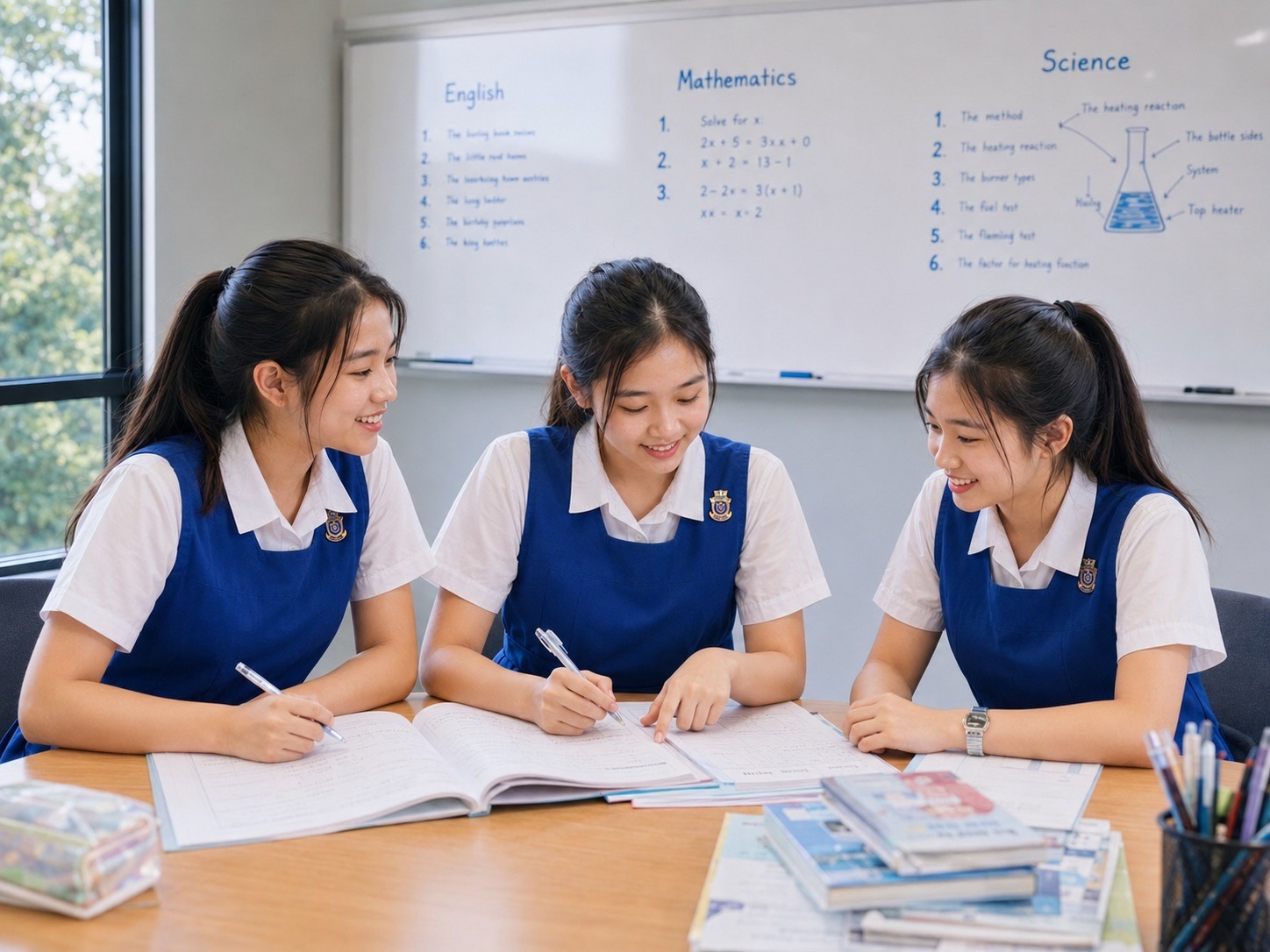
A Secondary English tutorial should be a learning cycle, not simply a smaller version of a school lecture. Students need to read closely, infer from evidence, discuss viewpoints, write with purpose and then revise what they produced. The cycle is useful across different school pathways, even though the exact syllabus and assessment requirements are not identical.
This legacy page has one job: show Punggol families what a high-value Secondary English tutorial cycle looks like, while keeping O-Level, IP and IGCSE requirements properly separate.
For current level-specific programme information, continue through The Secondary Pathway. This older URL now owns the tutorial-cycle method rather than broad programme search intent.
Step 1: Read
Reading is the input stage. The student should not race immediately to question techniques.
- identify the text type;
- understand the main idea;
- track references and paragraph movement;
- notice unfamiliar vocabulary;
- identify where the writer’s tone or viewpoint changes.
The first goal is an accurate mental model of the text.
Step 2: Infer
Secondary English increasingly asks students to go beyond what is directly stated. Inference should still be evidence-bound.
- Which words support the interpretation?
- What does the writer imply?
- What attitude is suggested?
- What relationship connects two paragraphs?
- What alternative interpretation is less well supported?
The tutor’s job is to make the evidence→inference chain visible, then reduce prompts.
Step 3: Argue or discuss
Discussion converts reading into active thought. Students should learn to state a position, support it, respond to another view and refine the claim.
- What do you think?
- What evidence supports that view?
- What might someone disagree with?
- Which example strengthens the claim?
- What would change your conclusion?
This is useful preparation for writing and oral communication because the student has already organised the idea before producing a polished response.
Step 4: Write
Writing should require the student to convert ideas into a form appropriate to purpose, audience and context.
- select relevant material;
- organise paragraphs;
- develop reasons or events;
- control tone;
- use vocabulary precisely;
- maintain grammatical control.
The tutorial should not supply every sentence. The student needs enough authorship for the tutor to diagnose the real writing system.
Step 5: Revise
Revision is where feedback becomes learning.
- Does the response answer the task?
- Is the central idea clear?
- Which paragraph is weakest?
- Is evidence sufficient?
- Where is language vague?
- Which grammar error is recurring?
The student should perform the revision. Watching the tutor improve the answer is not the same as learning to revise.
Then retrieve the cycle later
The next tutorial should not begin from zero. Return to one previous repair and see whether it survives.
- old vocabulary in a new text;
- same inference habit in a different genre;
- same paragraph issue in a new writing task;
- same grammar error inside a different sentence.
This creates continuity across tutorials.
How the cycle changes from Sec 1 to Sec 4
- Sec 1: more explicit support for reading structure, evidence and paragraph organisation.
- Sec 2: deeper inference, vocabulary nuance and more independent revision.
- Sec 3: sustained argument/viewpoint, denser texts and increasing time control.
- Sec 4: examination calibration, timed writing, summary/comprehension precision and prompt fading.
O-Level English: current 1184 context
For 2026 Singapore-Cambridge O-Level school candidates, English Language is syllabus 1184. The current assessment includes Writing, Comprehension, Listening and Oral Communication.
The Read → Infer → Argue → Write → Revise cycle supports these demands, but the exact examination practice still needs to follow the official 1184 format.
Official reference: SEAB 2026 O-Level syllabuses.
IP and IGCSE: use the same learning cycle, not the same syllabus
IP and IGCSE programmes can have different text demands, task types, examination boards and assessment structures. They should not be treated as interchangeable with O-Level English.
What can remain common is the learning process:
- read accurately;
- infer from evidence;
- develop and test ideas;
- write for the specific task;
- revise language and reasoning;
- use the exact syllabus for the student’s school or examination board.
The tutorial method can transfer. The syllabus details should not be collapsed.
Why small groups suit tutorial discussion
eduKatePunggol’s current model is up to three students, typically for 1.5 hours. Three students provide enough difference for discussion while keeping each student visible.
- three interpretations can be compared;
- one student can challenge another’s evidence;
- writing remains individual;
- the tutor can identify who is following and who is merely agreeing;
- oral discussion can include real follow-up.
The group should increase the amount of language each student processes and produces.
Tutorial versus lecture
A lecture can efficiently explain a concept. A tutorial should make the student use it.
- lecture: tutor explains inference;
- tutorial: student defends an inference from evidence;
- lecture: tutor explains paragraph structure;
- tutorial: student reorganises a weak paragraph;
- lecture: tutor discusses tone;
- tutorial: student compares word choices and explains the effect.
Both modes have a place. A 3-pax tuition class should not spend most of its time in lecture mode.
Tutorial failure mode: discussion without output
Students can have an interesting conversation and still fail to transfer it into writing or examination answers. Every discussion should eventually produce an individual output.
- a paragraph;
- a comprehension answer;
- a summary point;
- a revised sentence;
- an oral response;
- a delayed retrieval task.
Tutorial failure mode: model-answer dependence
Model answers are useful for comparison after the student has attempted. Showing the model too early removes the diagnostic and encourages copying.
A healthier sequence is attempt → discuss → revise → compare with model → extract one reusable principle.
When Secondary English tutorials may help
- the student understands texts but struggles to explain interpretations;
- writing ideas are stronger orally than on paper;
- feedback does not transfer into later work;
- the student needs more live discussion and revision than worksheets provide;
- exam practice is becoming fragmented from broader language learning.
A student who already reads deeply, writes independently and uses school feedback effectively may not need another tutorial.
Progress receipts
- students cite evidence more naturally;
- inference becomes more precise;
- discussion produces better writing;
- revision becomes student-led;
- model-answer dependence decreases;
- the same learning cycle works across new texts and tasks.
Continue through the current Secondary pathway
For current Secondary English programme information, continue through The Secondary Pathway.
About this rebuilt legacy page
The original page bundled O-Level, IGCSE and IP English under one generic tutorial description and used outdated Express/Normal labels. This 2026 update keeps the useful multi-pathway intent while separating syllabus ownership and defining the transferable tutorial cycle itself.


