
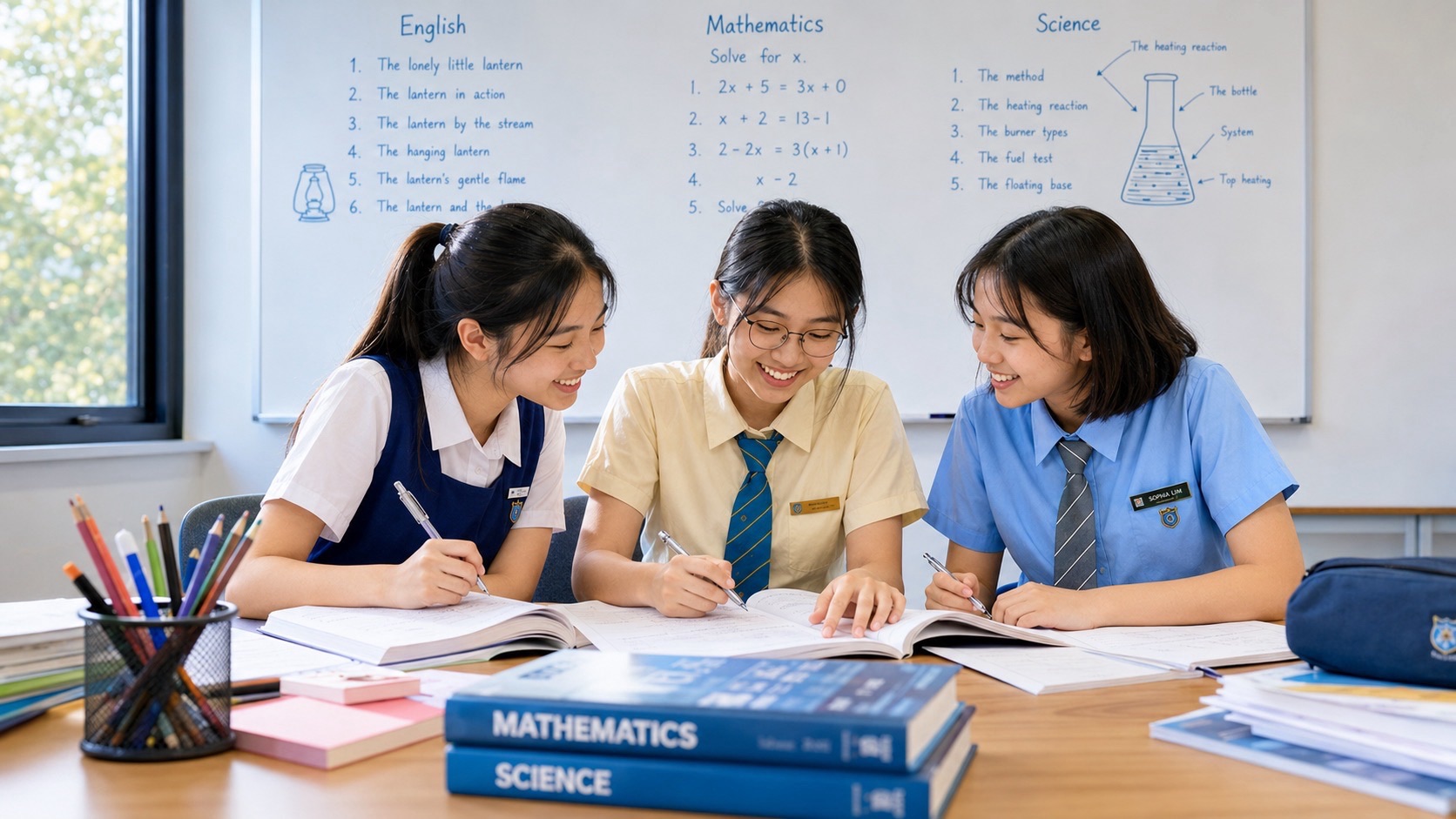
Reading and writing improve each other only when students learn to carry useful patterns from texts into their own language. Simply telling a child to “read more” may increase exposure, but the learning becomes stronger when the student notices how writers organise ideas, choose verbs, build sentences, control dialogue and create cause-and-effect.
This page has one job: help families around Punggol Green Primary understand how Primary English tuition can turn reading into usable writing knowledge without asking students to copy model compositions.
Independence note: eduKatePunggol is an independent tuition provider. This page serves families searching around Punggol Green Primary and does not imply affiliation with, endorsement by or representation of Punggol Green Primary School.
For broad current class information, continue to Primary English Tuition in Punggol. A separate legacy Punggol Green page now covers independent error checking; this page owns the different reading-to-writing transfer job.
Why reading does not automatically become writing
A student can read many books and still struggle to write. Reading recognition and writing production are different tasks. When reading, the language is already present. When writing, the student must retrieve vocabulary, generate ideas, select a structure and produce sentences independently.
Transfer improves when the child is taught to notice what is reusable.
- How does the writer open the scene?
- What detail makes a character believable?
- How is tension increased?
- Which verbs carry the action?
- How do short and long sentences change pace?
- How does one event cause the next?
- How does the writer end without suddenly stopping?
Transfer ideas, not whole sentences
Model language becomes dangerous when students memorise large phrases and insert them regardless of context. The better unit of transfer is usually a pattern or decision.
- Instead of memorising a dramatic opening, learn that an opening can begin with a change in the ordinary situation.
- Instead of copying a description, learn to choose one sensory detail that matters to the character.
- Instead of memorising an idiom, learn when figurative language adds precision or tone.
- Instead of copying dialogue, learn that dialogue should reveal information, conflict or character.
The student can then create a new sentence that performs the same job in a different story.
A six-step reading-to-writing loop
- Read: understand the text first.
- Notice: identify one useful writing move.
- Name: explain what the move is doing.
- Transform: create a different example using the same principle.
- Use: apply the move inside original writing.
- Retrieve: use it again later without the model beside the student.
The final step matters because transfer is not proven while the original text is still visible.
Vocabulary transfer from reading
Reading provides vocabulary in context, which helps students learn nuance and natural combinations. A useful vocabulary discussion asks:
- What does the word mean here?
- What simpler word could replace it?
- What meaning would be lost?
- What words commonly appear near it?
- Is it formal, informal, positive or negative?
- Can the student create a new sentence in a different situation?
A word that can survive these questions is more likely to become usable writing vocabulary.
Sentence transfer from reading
Students can examine sentence structure without copying the original content. For example, a sentence may combine an action with a reason, place an important detail at the end, or use a short sentence after a longer one to create emphasis.
The student can reconstruct the pattern with different nouns, verbs and context. This strengthens grammar and style together.
Paragraph transfer: understand the paragraph’s job
A strong paragraph usually has a job. It may establish a setting, develop a problem, explain a reason, show a consequence or shift the reader to a new stage.
Students can label paragraph jobs in reading, then check whether their own writing has paragraphs with clear functions. This is more useful than learning an arbitrary “five paragraphs always” rule.
Knowledge from reading improves idea quality
Reading also gives students knowledge about people, places, systems, events and relationships. That knowledge supports composition and situational writing because a child has more material to draw from.
A student who has read about community events, transport, nature, technology or everyday social situations may generate more plausible details when a writing task touches those themes.
The aim is not to force “general knowledge” into every composition. It is to enlarge the student’s available world.
Comprehension and writing share evidence discipline
In comprehension, students use evidence from a text to support an answer. In writing, students use details to make an idea believable or developed. Both require selection.
- Which evidence is relevant?
- Which detail is strong enough to include?
- What can be omitted?
- What relationship does the detail prove or show?
This connection can help students see English as one system rather than separate worksheet categories.
The Primary 3–6 progression
- Primary 3: retell, notice useful words, identify simple story movement and write clear sentences.
- Primary 4: compare author choices, infer character motivation, organise paragraphs and revise simple structure.
- Primary 5: read denser texts, compare tone and viewpoint, develop more complex writing and retrieve wider vocabulary.
- Primary 6: carry reading, vocabulary and writing capability into PSLE tasks under time without becoming dependent on memorised templates.
How this fits current Primary English
MOE’s Primary English syllabus develops reading and viewing alongside writing and representing, vocabulary and grammar. It also includes idea generation, selection, organisation, development, expression and revision. Reading-to-writing transfer sits naturally inside that connected framework.
For 2026 PSLE candidates, English Language 0001 assesses Writing, Language Use and Comprehension, Listening Comprehension and Oral Communication. Reading broadly remains useful because examination performance depends on language capability, not only familiarity with question formats.
Official references: MOE Primary English Language syllabus and SEAB 2026 PSLE formats.
What a 3-pax class can do
eduKatePunggol’s current model is up to three students, typically for 1.5 hours. A small group can turn reading into discussion and then into individual writing.
- Students can notice different features in the same text.
- The group can compare interpretations against evidence.
- Each student can create a different sentence using the same language pattern.
- A shared text can lead to separate original writing tasks.
- The tutor can detect whether a student is copying surface language or transferring the underlying principle.
Peer discussion provides contrast; independent writing proves transfer.
What not to do
- Do not ask the child to copy whole model essays.
- Do not reward impressive vocabulary used inaccurately.
- Do not assume more reading volume automatically produces better writing.
- Do not reduce every text to a list of phrases to memorise.
- Do not abandon reading once PSLE paper practice begins.
When tuition may help
- the child reads but cannot use new language in writing;
- composition depends heavily on memorised phrases;
- vocabulary remains passive;
- writing lacks believable detail or clear paragraph jobs;
- the student needs explicit help noticing craft in texts; or
- reading and writing are taught as disconnected activities.
A child who reads widely, writes willingly and is already transferring language naturally may not need tuition for this particular problem. Continued reading and independent writing can be enough.
Progress receipts
- new vocabulary appears naturally in later writing;
- students can explain what a useful sentence or paragraph is doing;
- writing contains more purposeful details;
- model phrases are copied less often;
- the student can create an original example from a studied pattern;
- reading discussions produce clearer writing decisions; and
- transfer survives when the original text is removed.
Continue to current Primary English tuition
For current class and level information, continue to Primary English Tuition in Punggol. For the self-correction route, see English Tuition Near Punggol Green Primary | Build Independent Error Checking.
About this rebuilt legacy page
This older Punggol Green page originally repeated a generic English tuition pitch. The 2026 update separates it from the other Punggol Green URL by giving it a distinct learning purpose: moving language, craft and knowledge from reading into original writing.


