
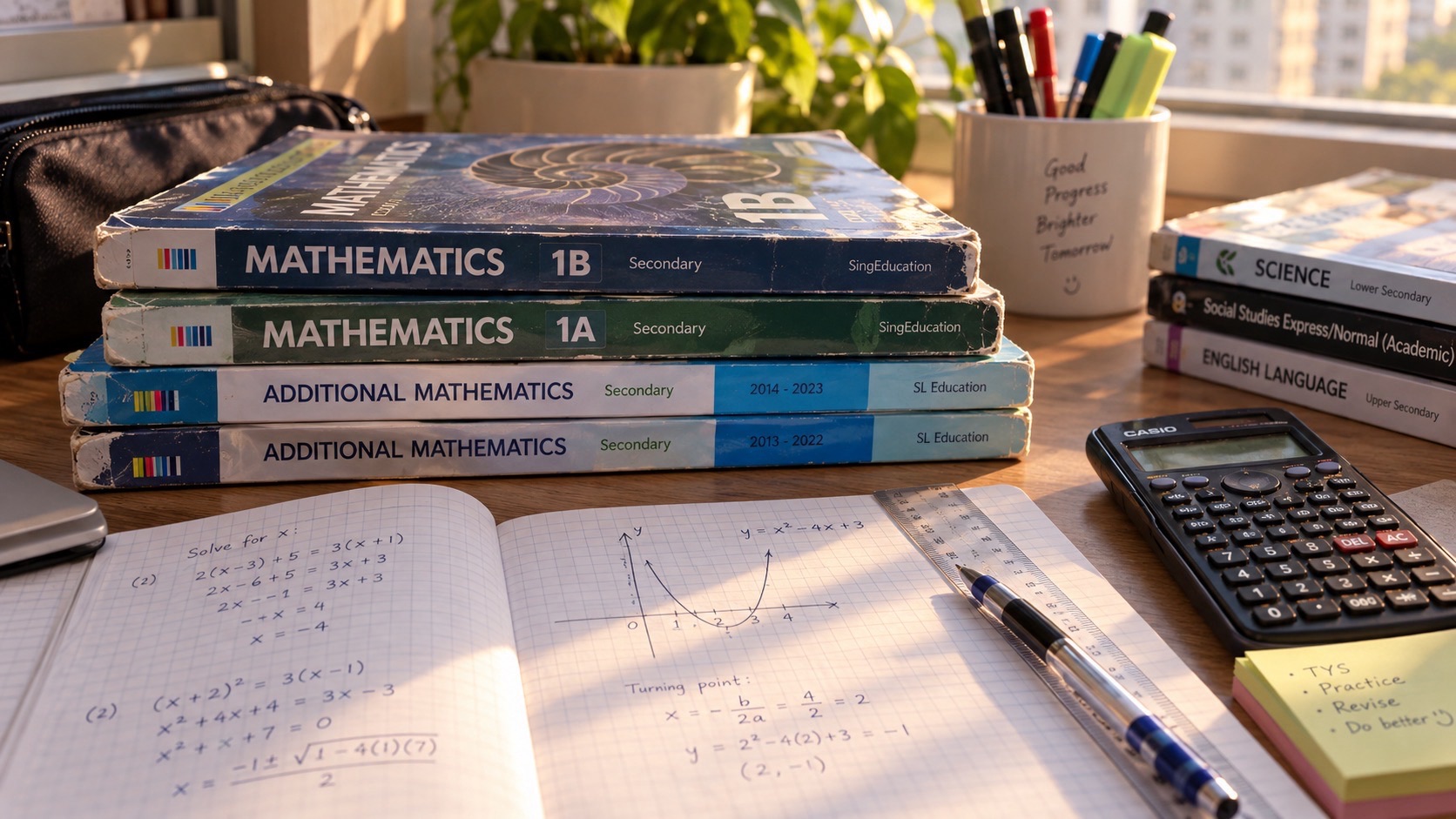
O-Level E-Math and A-Math should neither be revised as one subject nor treated as if they have nothing to do with each other. The useful structure is two separate revision lanes plus a shared bridge for algebra, graphs, notation, checking and other mechanisms that genuinely transfer.
This distinction matters because students often waste time at the extremes. One extreme is generic “Maths revision”, where A-Math and E-Math papers blur together and the student cannot tell which subject is actually leaking marks. The other extreme is duplicate repair, where the same algebraic weakness is practised twice in separate silos.
This rebuilt legacy page keeps its 2017 title and URL while giving it one clear job: decide when O-Level E-Math and A-Math should be revised together and when they should be revised separately. The answer depends on what the learner is trying to repair, retrieve, transfer or execute.
The core rule: revise together only when the mechanism is shared
A shared algebra sign error can be repaired once and retested in both subjects. An A-Math differentiation misconception cannot. A graph-scale habit may transfer. A G3 Mathematics statistics interpretation problem does not belong inside an A-Math calculus session simply because both are Mathematics.
Share the foundation when it is genuinely shared. Separate the subject when the mathematical demand is different.

Lane 1: E-Math revision
E-Math revision should preserve breadth. Students need to move among algebra, geometry, measurement, statistics, probability, graphs, number relationships and contextual problem solving without waiting for the worksheet to announce the topic.
A strong E-Math plan therefore uses a mix of topical repair and mixed retrieval. The student should know which broad topic family is unstable and whether the actual problem is interpretation, arithmetic, algebra, unit handling, graph reading or timing.
The revision lane should remain recognisably E-Math even when shared algebra is strengthened elsewhere.
Lane 2: A-Math revision
A-Math revision usually needs more symbolic continuity. Algebra is deeply embedded in functions, equations, trigonometry, coordinate geometry, polynomial work and calculus-related reasoning.
The subject can therefore appear conceptually difficult when the real weakness is algebraic execution. A student may understand differentiation and still lose the question after the derivative because equation solving collapses.
A-Math revision should preserve this subject-specific depth rather than reducing everything to generic algebra.
Lane 3: the shared bridge
The shared bridge is a temporary revision lane for mechanisms that damage both subjects. It may include sign handling, expansion, factorisation, substitution, rearrangement, graph interpretation, calculator discipline, exact-form awareness, notation or a personal checking routine.
The bridge is not a third permanent subject. It exists only while evidence shows a shared weakness.
When E-Math and A-Math should be revised together: algebraic sign control
If the student repeatedly loses signs in E-Math equations and A-Math symbolic manipulation, one shared repair is efficient. Use neutral algebra tasks first, then test transfer separately in each subject.
Do not complete two large worksheets containing the same error mechanism. Repair once, prove twice.
Together: expansion and factorisation
Expansion and factorisation are shared symbolic tools. A weakness here can damage quadratics, algebraic fractions, functions and later advanced work.
A shared drill can be useful, but the final application should return to the different subject contexts so the learner does not treat factorisation as an isolated exercise only.
Together: substitution
Substitution errors can appear across formulas, coordinate work, functions and calculus-related questions. Common problems include missing brackets, sign loss and calculator entry.
A shared substitution routine—write brackets, substitute visibly, simplify carefully—can transfer well.
Together: equation discipline
Both subjects depend on valid equation transformation. Equality should mean equality, not “and then I did this”. Students should preserve logical equivalence when rearranging, solving and substituting.
This is a cross-subject mathematical language habit.
Together: graph literacy
Axes, intercepts, gradient, scale, turning behaviour and the relationship between algebra and graphical form cross the two subjects. A student who misreads graphs in one subject is likely to carry some of that weakness into the other.
Shared graph-literacy work can therefore be high value before returning to subject-specific graph questions.
Together: checking discipline
A sign check, substitution check, calculator-entry check or reasonableness estimate can sometimes travel across both subjects. The personal check should be linked to recurring error history.
Keep the list short enough that the student can actually use it under examination conditions.
Together: timed decision habits
Both papers require decisions about when to continue, when to move on and when to return. The exact paper strategies may differ, but the general habit of protecting recoverable marks can be shared.
A student who spends too long proving one hard question at the expense of simpler marks may need a cross-subject move-on rule.
When E-Math and A-Math should be revised separately: subject-specific concepts
The subjects contain different topic networks and examination demands. E-Math statistics, data interpretation and practical contextual problems should not be diluted into A-Math revision. A-Math functions, identities, symbolic depth and calculus-related work require their own acquisition.
Shared foundations should support these topics, not replace them.
Separate: E-Math interpretation and contextual modelling
Many E-Math questions embed mathematics in contexts. Students must interpret rates, percentage, geometry, data or measurement before calculating.
A-Math strength does not automatically produce strong contextual interpretation. This lane needs its own practice.
Separate: E-Math breadth
A broad syllabus can decay unevenly. Probability may remain strong while geometry weakens. Statistics may be secure while ratio or rate becomes slow.
Mixed E-Math retrieval protects breadth in a way an A-Math paper cannot.
Separate: A-Math functions
Function notation, composition, inverse relationships and transformations require their own conceptual system. Ordinary graph fluency helps, but it does not replace function understanding.
Separate: A-Math trigonometric depth
A shared geometric intuition can help, but identities and symbolic transformations require A-Math-specific practice. The student should not treat every trigonometric error as a general Mathematics weakness.
Separate: A-Math calculus-related work
Differentiation and integration-related processes require subject-specific conceptual teaching. Shared algebra supports execution, but the central mathematical idea remains A-Math.
The tutor should mark the calculus step and algebra step separately when reviewing work.
Separate: paper strategy
The two papers may create different timing pressures, topic distributions and opportunities for checking. A student should have a specific risk map for each subject rather than one generic exam routine.
The revision decision tree
- Is the error present in both subjects?
- If yes, is the underlying mechanism actually the same?
- If yes, use a short shared bridge repair.
- Then retest once in E-Math and once in A-Math.
- If the error is subject-specific, keep it in that subject lane.
- If no active shared weakness remains, remove the bridge block.
This keeps revision connected without becoming blurred.
The student should maintain two error ledgers and one bridge list
The E-Math ledger records E-Math-specific problems. The A-Math ledger records A-Math-specific problems. The bridge list contains only recurring shared mechanisms.
This is enough structure to answer where the next hour belongs.
An E-Math error ledger might include
- Context interpretation.
- Number and arithmetic.
- Algebra.
- Graphs.
- Geometry and measurement.
- Statistics and probability.
- Units.
- Strategy selection.
- Timing.
- Checking.
An A-Math error ledger might include
- Algebraic manipulation.
- Functions.
- Equations and inequalities.
- Polynomial structure.
- Coordinate geometry.
- Trigonometry.
- Calculus-related process.
- Exact form and restrictions.
- Timing.
- Checking.
A bridge list might include
- Sign handling.
- Expansion and factorisation.
- Substitution.
- Rearrangement.
- Graph scale or intercept reading.
- Calculator-entry discipline.
- Notation.
- Personal move-on rule.
- Personal final-check rule.
The bridge list should be shorter than either subject ledger
If the bridge contains nearly every problem, the subjects have been merged too aggressively. Most errors belong primarily to one subject or one topic.
Connection should be selective.
How to allocate a two-hour revision block
Do not automatically spend one hour on each subject. Use the current evidence. A student with stable E-Math and fragile A-Math functions may spend ninety minutes on A-Math and thirty minutes on E-Math mixed maintenance. Another student approaching an E-Math school exam may reverse the ratio.
Equal time is not automatically strategic.
How to allocate a three-block week
- One E-Math block.
- One A-Math block.
- One flexible block that becomes bridge repair, extra work for the weaker subject or rest if both are stable.
The flexible block should respond to the current risk map rather than exist as mandatory extra volume.
When the flexible block should go to E-Math
Use it when breadth has decayed, contextual interpretation is weak, a school assessment is near or recoverable E-Math marks are being lost repeatedly.
When the flexible block should go to A-Math
Use it when a new high-density topic needs acquisition, symbolic execution remains unstable or a subject-specific misconception is carrying large mark cost.
When the flexible block should go to the bridge
Use it when the same algebra, graph or checking mechanism is demonstrably hurting both subjects.
The bridge should have an exit condition.
When the flexible block should disappear
If both subjects are stable and the learner’s week is overloaded, not every empty slot needs to become another Mathematics session. Recovery, reading or another subject may be higher value.
Revision allocation should consider the whole learner.
Topical practice and mixed practice have different jobs
Topical practice is useful while a method is being acquired or repaired. Mixed practice is useful when the student must select the method independently.
Both E-Math and A-Math need this progression, but the mix of topics and level of symbolic density differ.
The bridge should be topical only long enough to repair
A shared algebra drill is a controlled environment. Once accurate, it should move into mixed E-Math and A-Math questions so the student learns to retrieve the same discipline without being told.
Past papers should be reviewed separately before bridge analysis
Mark each paper according to its own subject demands. Identify the first broken step on each lost-mark question.
Only then compare the two papers for shared mechanisms.
This preserves subject identity and improves cross-subject diagnosis.
A low E-Math mark and low A-Math mark do not automatically have the same cause
One may come from breadth, interpretation and timing; the other from algebraic continuity or topic-specific understanding.
Generic “Maths is weak” language hides the difference.
A high E-Math mark and low A-Math mark is common and diagnostically useful
It often shows that ordinary Mathematics foundations are not the whole problem. A-Math may be introducing conceptual depth or symbolic load that requires its own repair.
Do not respond by increasing generic E-Math drills.
A low E-Math mark and high A-Math mark is also possible
A student may be comfortable with abstract algebra and still lose marks in contextual, statistical or broad mixed E-Math tasks.
The two-subject system should allow this profile without contradiction.
The tutor should protect subject confidence separately
A-Math difficulty should not erase the learner’s sense of competence in E-Math. Likewise, strong A-Math performance should not make the student dismiss E-Math weaknesses.
Specific subject language supports more accurate self-assessment.
The current 2026 cohort note
For 2026 school candidates, SEAB lists GCE O-Level Mathematics 4052 and Additional Mathematics 4049. Families should revise according to the syllabus and paper structure that applies to the student’s own cohort.
Official reference: SEAB 2026 O-Level syllabuses.
The 2027 transition note
From 2027, the Singapore-Cambridge Secondary Education Certificate framework replaces the N- and O-Level certificates for relevant graduating cohorts. SEAB lists G3 Mathematics K310 and Additional Mathematics K341 among the 2027 G3 syllabuses.
Official reference: SEAB 2027 SEC G3 syllabuses.
The page title remains O-Level because it is a legacy 2017 URL
Families should therefore read the revision logic as durable while verifying the current cohort’s examination label and syllabus. The underlying decision—shared foundations versus separate subject practice—remains useful across the transition.
A four-week revise-together-or-separately cycle
Week 1: separate review
Analyse one E-Math and one A-Math sample independently. Build two subject-specific error lists.
Week 2: bridge test
Identify one genuinely shared mechanism and repair it in neutral form.
Week 3: subject return
Retest the bridge inside fresh E-Math and A-Math questions. Continue subject-specific repair separately.
Week 4: timed integration
Use subject-specific timed sections. Decide whether the bridge remains active or can be retired.
A final-month revision model
Keep separate paper practice as the main work. Use the bridge only for recurring high-cost shared errors. Maintain stable topics lightly. Review personal checks and move-on rules.
The final month should become more subject-specific, not more generic.
What parents should ask after a month
- What is the main E-Math bottleneck?
- What is the main A-Math bottleneck?
- Which error genuinely appears in both?
- What shared repair has been attempted?
- Has it transferred back into both subjects?
- Which subject deserves the next extra hour?
- What can now move to maintenance?
Frequently asked questions
Should E-Math and A-Math always be revised together?
No. Share only foundations and processes that genuinely transfer. Subject-specific concepts and papers should remain separate.
Should they always be revised separately?
No. Duplicate algebra, graph or checking repair can waste time when the same mechanism is causing both errors.
Which subject should get more time?
The one with the higher-value current bottleneck, nearer assessment or greater recoverable mark loss. Reassess regularly.
Should a student have two error ledgers?
Yes, with a small bridge list for shared mechanisms. This preserves clarity while supporting transfer.
What if algebra is weak everywhere?
Use a focused shared algebra intervention, then retest separately in E-Math and A-Math contexts.
Does this page still apply after the SEC transition?
The examination labels change by cohort, but the revision principle remains useful. Families should confirm the applicable current syllabus through SEAB.
Related eduKatePunggol reading
- Math Tuition Near Compassvale Secondary | Keep G3 Mathematics and Additional Mathematics Separate but Connected
- Math Tuition Near Greendale Secondary | Build a Two-Year Error Ledger Across Sec 3–4
- eduKate Punggol Contents & Learning Routes
The deeper rule: together for foundations, separate for subject decisions
Students save time when shared mechanisms are repaired once and verified twice. They gain clarity when subject-specific concepts, papers and risk maps remain separate.
The strongest revision plan therefore has three lanes: E-Math, A-Math and a temporary bridge.
The bridge grows only when evidence justifies it and shrinks when the shared weakness is repaired.
Revise together where the learner mechanism is the same. Revise separately where the mathematical demand is different.
Use a shared error matrix before deciding the next revision block
A practical way to decide whether revision belongs in the E-Math lane, A-Math lane or shared bridge is to keep a small error matrix. Rows are learner mechanisms. Columns are the two subjects. Every recurring error is marked where it appears.
- Sign handling.
- Factorisation.
- Substitution.
- Graph reading.
- Exact form.
- Calculator entry.
- Question interpretation.
- Working clarity.
- Timing.
- Checking.
If an error appears only under one column, keep the repair subject-specific. If the same mechanism appears repeatedly in both columns, a shared bridge block becomes justified.
The matrix should record first cause, not only final loss
A wrong A-Math answer may end in an incorrect derivative value, but the first break may have been expansion. A wrong E-Math question may end with an impossible length, but the first break may have been misreading the diagram.
Record the earliest meaningful failure. This prevents the bridge from becoming too broad and keeps the next repair close to the actual cause.
The matrix should include frequency
One substitution slip is not automatically a bridge problem. If substitution errors appear in three E-Math questions and four A-Math questions across several weeks, the evidence becomes stronger.
Frequency tells the tutor whether the mechanism deserves dedicated revision or only ordinary correction.
The matrix should include mark cost
Some shared errors are low cost. Others contaminate long solutions. A sign error at the first line of a multi-part A-Math question can destroy several marks; the same algebraic habit may also damage an E-Math equation.
High-carry, high-frequency errors deserve the bridge first.
The matrix should include prompt depth
Two students may correct the same error after different amounts of help. One needs only “check the sign”. Another needs the whole manipulation modelled again.
Prompt depth reveals whether the shared weakness is close to independence or still conceptual.
Use separate subject baselines before building the bridge
At the start of a revision cycle, collect one E-Math and one A-Math sample. Mark each independently. Only after the subject profiles are clear should the tutor look for shared mechanisms.
This order matters. If the tutor starts by hunting for overlap, genuine subject-specific weaknesses can disappear inside a generic algebra label.
The bridge should have a narrow objective
“Improve algebra” is too broad. A stronger objective is “stop sign reversal when expanding negative brackets”, “use brackets consistently during substitution”, or “factorise before solving when the expression structure allows it”.
Narrow objectives make bridge work short enough to fit inside a busy Sec 4 week.
The bridge should end with two receipts
After repair, the student completes one fresh E-Math question and one fresh A-Math question where the same mechanism matters. Both need to succeed without the original tutor cue.
These are the receipts that prove the bridge repair travelled back into the subjects.
A six-week revision plan
Week 1: separate diagnosis
Review one recent paper or representative set from each subject. Build two error ledgers and one small list of possible shared mechanisms.
Week 2: repair the highest-value bridge or subject gap
If one shared weakness is genuinely expensive, repair it. If not, devote the extra time to the weaker subject.
Week 3: subject-specific return
Use changed questions in both subjects. Keep the bridge out of sight and see whether the learner recognises the repaired process independently.
Week 4: mixed retrieval
Use E-Math mixed-topic work and A-Math mixed-topic work separately. The purpose is method selection within each subject.
Week 5: timed sections
Add realistic timing and observe which errors return under pressure. Do not assume the same risk will appear in both subjects.
Week 6: reallocate
Compare both ledgers. Retire bridge errors that are now stable. Shift time toward the subject-specific bottleneck that remains.
An eight-week plan can separate acquisition and paper work more clearly
Weeks 1–2 can focus on diagnosis and foundation repair. Weeks 3–4 can return to subject topics. Weeks 5–6 can add mixed practice. Weeks 7–8 can use timed paper sections and full-paper review.
The important thing is not the exact calendar. It is the repeated movement from separate diagnosis → selective bridge → separate transfer → timed proof.
A 12-week final-year plan should reduce bridge time gradually
Early in the cycle, shared algebra repair may be substantial. By the final weeks, most time should be spent inside the actual E-Math and A-Math paper environments unless one unresolved bridge weakness remains.
A growing bridge near the examination is usually a warning that a foundation problem has not been retired.
E-Math paper review should begin with breadth
Ask which topic families lost marks, whether contextual interpretation failed, whether units or data handling created mistakes, whether graph questions were misread and whether time was distributed sensibly.
E-Math paper review should not be reduced to “algebra good, algebra bad” because breadth is one of the subject’s defining demands.
A-Math paper review should begin with the first symbolic divergence
Trace long solutions to the first line that becomes invalid. Was the concept wrong? Was the derivative correct but the algebra afterwards wrong? Was the function notation misunderstood? Was an exact form lost too early?
This protects correct conceptual work and prevents unnecessary reteaching.
One low score should not automatically increase both subjects
If A-Math drops sharply while E-Math remains stable, the family should not double all Mathematics time indiscriminately. Diagnose the A-Math-specific loss first.
Likewise, a weak E-Math paper does not prove A-Math needs more work if the A-Math error history is stable.
One strong score should not automatically reduce both subjects
A strong A-Math result may coexist with decaying E-Math breadth. A strong E-Math paper may coexist with fragile A-Math functions. The two lanes should be maintained from their own evidence.
Shared strengths can also travel
A disciplined algebra routine learned in A-Math can make E-Math equations cleaner. Strong E-Math graph reading can make A-Math function work easier. Good E-Math contextual estimation can improve plausibility checking in A-Math.
The bridge is not only for weakness. Tutors can deliberately leverage shared strengths.
The learner should know which subject is supplying the transfer
When a student says, “The way I learned to bracket substitution in A-Math helps me avoid errors in E-Math,” the learner is recognising transfer explicitly.
This metacognitive awareness makes future revision more efficient because the student can reuse strong processes deliberately.
Calculator habits should be reviewed across both subjects
Repeated calculator-entry mistakes, premature decimal conversion or failure to estimate can cross subject boundaries. One shared tool-use routine may be appropriate.
Tool use should remain subordinate to mathematical structure. The learner should understand what is being entered and whether the output is plausible.
Exact form should not become an A-Math-only habit if it helps elsewhere
A-Math often makes exact-form discipline more visible, but the broader habit—do not destroy useful structure too early—can help across Mathematics.
Students should know when a decimal is appropriate and when preserving symbolic form improves accuracy.
The two subjects should have separate personal checks
An E-Math checklist may include units, data interpretation, question demand and broad timing. An A-Math checklist may include signs, restrictions, exact form and substitution.
A few shared checks can sit above both lists, but the paper-specific risks should remain distinct.
The shared bridge should never become a comfort zone
Students may enjoy neutral algebra drills because they feel controllable. If the real difficulty is an A-Math function concept or an E-Math statistics interpretation problem, bridge practice can become avoidance.
The tutor should return the learner to the actual subject demand once the shared foundation is sufficiently repaired.
A small group can run all three lanes in one lesson
In a three-student class, the tutor may teach one shared algebra principle briefly, then assign E-Math and A-Math transfer tasks according to each student’s subject need. One student might return to E-Math breadth; another to A-Math functions.
The group remains coherent while the application becomes individual.
Parents should hear subject-specific updates
“Maths is improving” is too broad when the student takes two subjects. A stronger update names the state of each lane and the bridge.
For example: “E-Math is in mixed-paper maintenance. A-Math functions remain the main repair. Sign handling still appears in both, so one short bridge set stays active.”
The learner should eventually allocate revision without adult scheduling
By late Sec 4, the student should be able to look at recent papers and decide whether tonight’s Mathematics block belongs to E-Math, A-Math or a shared bridge repair.
This is a valuable independence outcome because tertiary learning will require the same kind of evidence-based allocation across subjects and deadlines.
The final pre-exam risk map should have three sections
- E-Math: two or three recurring subject-specific risks.
- A-Math: two or three recurring subject-specific risks.
- Shared: only the one or two bridge mechanisms that still genuinely recur.
If the shared list is long at this point, repair priority should be reconsidered urgently.
The final decision rule
Ask whether the next revision task is repairing a mechanism that exists in both subjects. If yes, revise together briefly and prove transfer twice. If not, revise separately and keep the subject identity clear.
This rule is simple enough for students to use themselves and strong enough to prevent duplication across an entire final-year programme.
The final Punggol E-Math/A-Math standard
The student should enter the examination period knowing exactly what belongs to E-Math, what belongs to A-Math and which few habits travel across both. Revision becomes more efficient because the learner stops treating all Mathematics time as interchangeable.
The result is not merely more organised notes. It is a more organised mathematical mind: separate subject maps, shared foundations where useful, and a clear decision about what the next hour should accomplish.
Use different revision questions for different purposes
A question should be chosen because it tests something specific. An E-Math mixed question may test whether the student can identify the method without a chapter cue. An A-Math question may test whether the concept survives a longer algebraic chain. A bridge question may test whether sign control or substitution is stable across both.
This prevents revision from becoming a page-count exercise. Two well-chosen questions can reveal more than twenty routine items when the purpose is clear.
Use retrieval differently in the two subjects
E-Math retrieval often benefits from broad switching. The student needs to recognise what kind of Mathematics is present. A-Math retrieval may need deeper reconstruction of one method, identity or function relationship before the topics are mixed.
Both subjects need retrieval; the shape of the retrieval can differ.
Use spacing to protect E-Math breadth
Once a topic is stable, bring it back after increasing intervals. The student should not wait until the final examination month to rediscover that probability, geometry or statistics has decayed.
A small mixed E-Math set can preserve breadth while A-Math receives the larger acquisition block.
Use spacing to protect A-Math algebraic fluency
A-Math topics can feel secure immediately after intensive practice and become fragile after a gap. Delayed retrieval exposes whether the student can reconstruct the method without recent familiarity.
Short spaced returns are especially useful for functions, identities, equations and calculus-related processes where symbolic fluency matters.
Use interleaving only after acquisition
Mixing too early can make students practise confusion. First establish the method. Then interleave so the learner has to identify when and why to use it.
This principle applies in both subjects, but the mixed pools should remain separate unless the lesson is deliberately testing a shared bridge habit.
Use timed practice as a diagnostic, not a punishment
When the student becomes slower or less accurate under time, inspect what changes. Does E-Math interpretation worsen? Does A-Math symbolic accuracy deteriorate? Does checking become excessive in both?
The timed result should identify the execution problem. It should not merely generate anxiety and another full paper.
Use one subject to reveal habits hidden in the other
A student may notice an overchecking habit in E-Math because the paper is broader, then discover the same habit consumes time in A-Math. Another may learn exact-form discipline in A-Math and realise premature decimal conversion has also caused E-Math mistakes.
Cross-subject awareness is valuable when it reveals a genuine process that was previously invisible.
Do not force a bridge where transfer is weak
Some apparent similarities are superficial. Two topics may both involve graphs but demand different reasoning. Two questions may both contain algebra while one is fundamentally contextual and the other symbolic.
Transfer should be demonstrated, not assumed from surface resemblance.
The student should know the cost of switching subjects
Constantly alternating every ten minutes between E-Math and A-Math can fragment attention. Use longer focused blocks unless the lesson is intentionally comparing a shared mechanism.
Deep work belongs inside subject lanes; bridge work belongs at deliberate transition points.
One weekend can include both without mixing them
For example, Saturday morning can hold an E-Math mixed-paper block, Saturday afternoon an A-Math topic repair, and Sunday a short shared algebra retrieval if the error matrix justifies it.
The subjects coexist in the week while remaining cognitively distinct.
The final revision notebook should stay compact
A final-year student does not need a giant combined file containing every worked solution. A compact system is more useful: one subject-specific error summary for E-Math, one for A-Math, and a tiny shared bridge list.
The notebook should point toward action, not preserve every historical page.
The learner should be able to retire a bridge item explicitly
Once sign handling has been stable across both subjects for several weeks, mark it retired. It can remain a light check, but it should stop consuming dedicated practice.
Retirement protects the timetable from permanent remedial work.
The learner should also know when a retired item has returned
Under stress, old habits can reappear. If a retired error returns repeatedly, reactivate it briefly and confirm whether the problem is again systemic or only one isolated slip.
The system remains responsive without becoming alarmist.
A final parent checklist before the examination runway
- Is E-Math breadth being maintained?
- Is A-Math depth being maintained?
- Are subject-specific error ledgers separate?
- Is the bridge list short?
- Are shared errors retested in both subjects?
- Are timed errors classified by subject?
- Are personal checks short enough to use?
- Has bridge time reduced as the exam approaches?
- Can the student allocate the next hour independently?
- Does the applicable SEAB syllabus match the learner’s cohort?
If these answers are clear, revision is likely to be better organised than a generic plan that simply says “do more Maths”.
The final learner test
Give the student one fresh E-Math question and one fresh A-Math question. After solving, ask which parts of the reasoning were subject-specific and which parts came from a shared foundation. Then ask what the next revision block should be if one answer is weak.
A mature learner should be able to answer without defaulting to “practise both”. The student should diagnose the failure and allocate revision accordingly.
That is the final benefit of deciding when to revise together and when to revise separately: Mathematics time becomes evidence-led instead of interchangeable.
The final allocation rule should be simple enough to use under pressure
By the last examination runway, students should not need a complicated planning meeting every time revision begins. Use three questions: Which subject lost the marks? Was the mechanism subject-specific or shared? What is the smallest practice block that would prove the repair?
If the loss belongs only to E-Math, stay in E-Math. If it belongs only to A-Math, stay in A-Math. If the same algebra or checking mechanism is recurring in both, use one short bridge block and then return to separate subject proof.
What good revision looks like by the final month
E-Math revision should feel broad but controlled. A-Math revision should feel deep but increasingly fluent. The shared bridge should feel small. The student should know the few personal checks that remain active and the subject in which each risk is most expensive.
At this stage, a large new bridge programme would usually indicate that a foundation weakness was allowed to persist too long. Most shared work should have moved into maintenance or disappeared.
What parents should hear from the tutor
A useful update is specific: “E-Math is stable in mixed practice, but timing remains tight in geometry and statistics. A-Math functions are improving; the main remaining leak is algebra after differentiation. The shared sign-handling issue has been retired.”
This gives the family three clear maps instead of one vague statement that Mathematics is improving.
The final independence standard
The student should be able to review a marked paper, classify the loss, decide whether the next task belongs to E-Math, A-Math or the bridge, and choose an appropriate check without waiting for an adult to prescribe the whole revision plan.
That self-allocation is the strongest reason to teach the subjects as separate but connected systems. It allows the learner to use shared foundations without losing the ability to diagnose subject-specific weakness.
Revise together only where one repair can genuinely travel. Revise separately everywhere else.
A compact weekly review prevents the two lanes from drifting together again
At the end of each week, the student can answer three lines in a revision notebook: what improved in E-Math, what improved in A-Math, and whether any shared bridge error is still active. This takes only a few minutes but preserves the separation that makes the system useful.
Over several weeks, the student should see the bridge list shrink. E-Math may move into maintenance while A-Math receives a larger block, or the balance may reverse near a school assessment. The timetable becomes dynamic without becoming chaotic because every shift has a reason.
The two-subject system should reduce duplication, not create more administration
There is no need for elaborate spreadsheets or dozens of categories. Two short ledgers, one bridge list and a few active checks are enough. The system should make revision faster to organise than the old habit of reopening every chapter and guessing what deserves attention.
When the student can tell the difference between an E-Math weakness, an A-Math weakness and a genuinely shared foundation problem, the revision problem has already become smaller. The learner is no longer treating every lost mark as one large subject failure.
That is the durable outcome: two Mathematics subjects that remain distinct enough for accurate diagnosis, connected enough to share useful foundations, and organised well enough that the student can decide where the next hour belongs without wasting effort on duplicated repair.
By the examination period, the student should be able to look at one lost mark and say exactly which lane owns the repair. That clarity prevents revision from expanding every time one paper goes badly and helps preserve time for the subject, topic or shared mechanism that is actually limiting performance. The aim is not more Mathematics work. It is better allocation of Mathematics work.
Separate the subjects clearly, connect only the shared mechanism, and let current evidence decide the next block.
Then retest independently.


