
Holistic Science Tuition Punggol | From Real-World Observation to Exam Answers
Science begins in the world before it appears in a worksheet.
A child notices condensation on a cold cup, feels resistance while cycling, watches a plant lean towards light, sees shadows change during the day or becomes breathless after physical activity.
Those experiences can create curiosity. They do not automatically create scientific understanding.
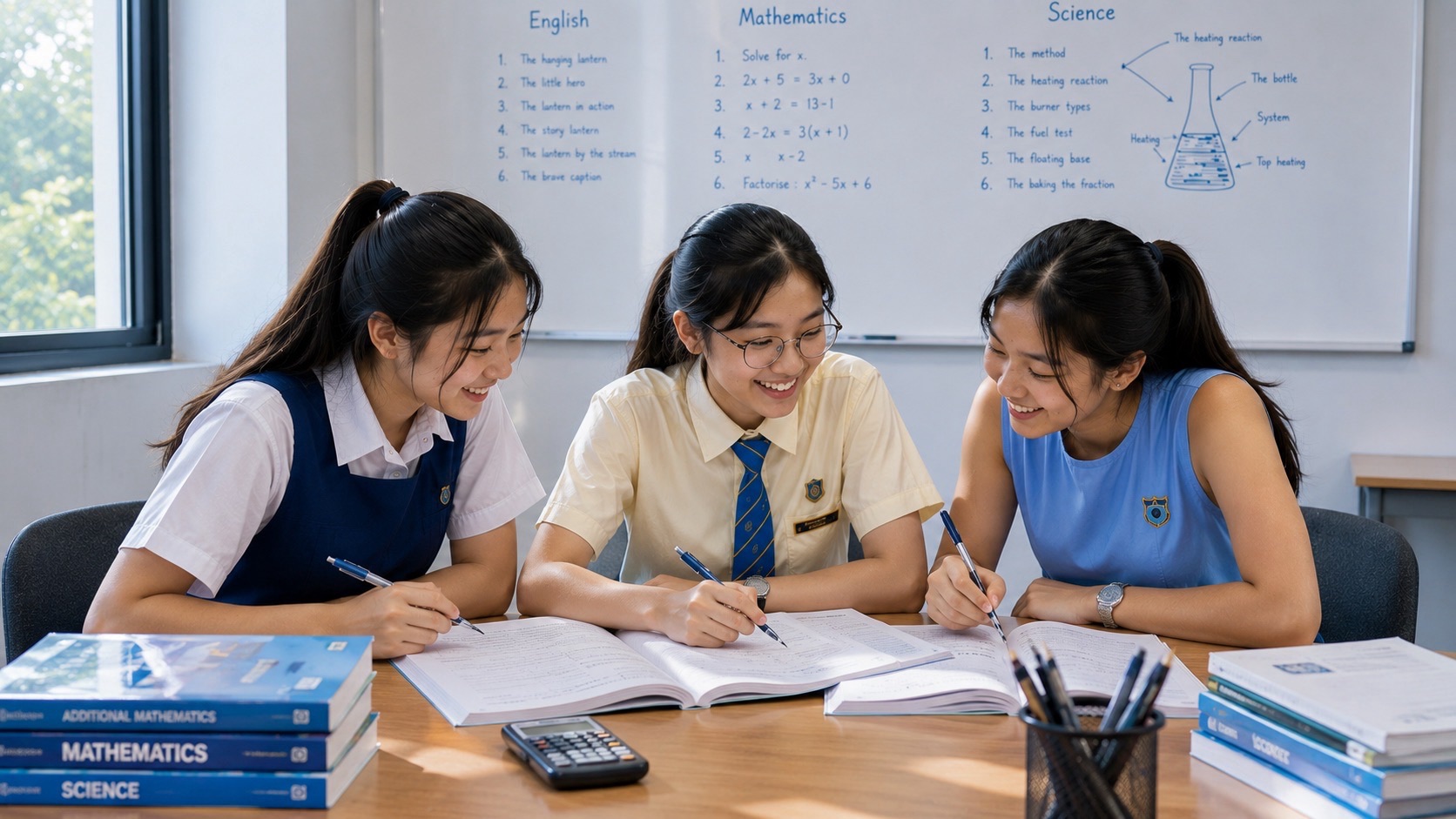
At eduKate Punggol, our current Science tuition is conducted in premium three-student small groups, typically 1.5 hours weekly. We use real-world contexts when they help the learner see a scientific relationship, but the experience must return to formal concepts, evidence, models, written answers and transfer.
This page grew from an older eduKate enrichment archive involving indoor rock climbing. The historical photographs remain useful evidence of how we once connected classroom ideas with lived experience. The updated lesson is broader: what makes experiential Science educational rather than merely memorable?
Holistic Does Not Mean “Add More Activities”
The word “holistic” becomes weak when it means everything and nothing.
For Science, a useful holistic approach should connect several layers without confusing their jobs:
- Experience: what the learner can observe in the world.
- Concept: the scientific idea used to organise the observation.
- Model: the simplified representation that helps explain the system.
- Evidence: what measurements, conditions or observations support the claim.
- Language: how the reasoning is communicated precisely.
- Examination: how the same thinking appears in school questions.
- Transfer: whether the learner can use the concept in a new context.
When these layers are connected, a real-world example can deepen Science. When they are not, the activity may be enjoyable without changing what the student can actually explain.
The Learning Route: Context → Model → Evidence → Answer → Transfer
1. Context
Begin with something the child can see or imagine clearly.
Forces might begin with walking, cycling, climbing or pushing a trolley. Heat may begin with melting ice or a hot drink cooling. Plant transport may begin with wilting leaves or coloured water moving through a stem.
2. Model
The tutor introduces the scientific representation that makes the context more intelligible: a force diagram, particle model, system diagram, circuit or causal chain.
3. Evidence
Students identify what is actually observed or measured and what conditions matter. This prevents them from answering only from memory.
4. Answer
The learner turns the relationship into examination-quality language: relevant evidence, correct concept, complete mechanism and direct outcome.
5. Transfer
The surface changes. A different object, diagram, apparatus or situation tests whether the concept has become portable.
If the child can explain friction only when the climbing photograph is shown, the experience has not yet become a transferable scientific idea.
Observation and Explanation Are Different Jobs
One of the most important habits in Science is separating what is directly observed from what is inferred.
- Observation: the water level decreased.
- Explanation: water left the exposed surface through evaporation.
- Observation: breathing became faster after exercise.
- Explanation: physical activity changed the body’s demand for energy and gas exchange.
- Observation: an object remained stationary.
- Explanation: the net force was zero at that moment.
Students should learn when they are reporting evidence and when they are using a model to explain it.
This distinction improves experimental questions, structured answers and later Secondary scientific reasoning.
Real-World Models Have Limits
School Science uses models because the real world is complicated.
A simple force diagram may ignore the detailed distribution of contact forces. A particle model helps explain states of matter but does not show every microscopic interaction. A circuit diagram represents electrical connections without resembling the physical layout of the wires.
Students do not need advanced university physics to understand one mature idea:
A model can be useful without being the whole reality.
Knowing the model’s job reduces overgeneralisation. It also prepares learners for Secondary Science, where familiar Primary explanations are often replaced by deeper models.
The Historical Climbing Example: What It Can Teach
The original eduKate climbing activity can be used to illustrate several school-level ideas.
Forces
Students can discuss weight, contact forces, friction and—where relevant to the situation—tension. They can draw simplified force diagrams and compare stationary and accelerating states.
Body systems
Students may notice changes in breathing and heart rate during physical activity and connect those observations to the respiratory and circulatory systems at an age-appropriate level.
Experimental thinking
Students can ask what could be measured, which variable would change, what should remain constant and what conclusions the evidence would actually support.
Model limits
A real climber is a complex system. Classroom discussion should simplify carefully and avoid pretending a basic school model explains every technical detail of climbing mechanics or physiology.
Safety Has Its Own Professional Boundary
Real-world learning does not give a tutor authority over safety-critical activities.
Where an external activity involves specialised equipment, height, physical risk or professional procedures, the venue and qualified instructors own those safety instructions and checks.
A tutor can help students understand school-level force concepts. That does not make the tutor a climbing-safety engineer. A student can observe changes in heart rate. That does not make the lesson a medical diagnosis.
Knowing the boundary between educational explanation and professional authority is part of responsible scientific thinking.
How Real-World Contexts Return to Examination Questions
Experiential Science earns its place when the student can return to formal work more effectively.
After a context has been discussed, students may be asked to:
- label a diagram;
- identify variables;
- construct a cause-and-effect chain;
- interpret a graph;
- write a structured answer;
- evaluate whether a conclusion is justified;
- compare two models; or
- apply the same concept to a new setting.
The aim is not to keep the student in the context. It is to use the context as a bridge back to disciplined scientific representation.
Why Three Students Help With Real-World Science
Real-world contexts produce different interpretations.
One student may focus on what they felt. Another may notice a visible pattern. A third may immediately reach for a memorised scientific term.
In a three-student class, the tutor can compare those interpretations and ask which ones are observations, which are hypotheses and which are explanations supported by the school model.
The discussion remains small enough for every student to contribute and for scientific language to be corrected immediately.
Our Science Teaching Cycle
- Retrieve: bring back relevant earlier knowledge.
- Observe: identify what is actually given.
- Model: select the scientific representation or concept.
- Explain: connect evidence to mechanism.
- Refine: improve vocabulary and answer completeness.
- Transfer: change the context.
- Retrieve again: revisit after a delay.
- Fade support: require increasingly independent reasoning.
This cycle works whether the starting point is a photograph, a practical setup, a graph, a textbook diagram or a PSLE question.
Repair, Stabilise or Extend
Repair
The student has a missing concept, scientific-language gap or earlier dependency. We repair it before adding more unfamiliar applications.
Stabilise
The learner understands much of the material but is inconsistent. We strengthen retrieval, evidence use, structured answers and mixed-topic control.
Extend
The learner is ready for less familiar contexts, stronger experimental reasoning, better model critique and more precise scientific communication.
What Progress Should Look Like
- Students describe observations more precisely.
- They identify the relevant concept without relying on chapter labels.
- They use evidence from the question.
- They acknowledge where a simple model has limits.
- Structured answers show clearer causal chains.
- They transfer concepts to new contexts.
- They retrieve old knowledge after a delay.
- They increasingly check and correct their own explanations.
We do not guarantee a particular grade or claim that enrichment experiences alone produce examination results. Progress depends on the learner’s starting point, attendance, practice, language access and the quality of transfer back into formal Science work.
Class Details
Format: premium 3-student Science tuition
Levels: Primary 3–6 and Secondary according to current class arrangements
Duration: typically 1.5 hours weekly
Location: eduKate Punggol, 83 Punggol Central, Singapore 828761
Contact: +65 8823 1234
Current programme: syllabus learning, inquiry, evidence, structured answers, transfer and examination preparation; historical external enrichment examples on this page are not presented as current weekly activities
Frequently Asked Questions
Does “holistic Science” mean students constantly go on outings?
No. Holistic Science means connecting concepts, evidence, language, models and transfer. A real-world context is useful only when it has a clear teaching job.
Is the climbing activity part of the current weekly programme?
This page preserves a historical enrichment example. Current Science tuition is centred on three-student classroom teaching and current academic requirements.
Why discuss model limits with Primary students?
Students can understand that models are useful simplifications. This prevents overgeneralisation and prepares them for deeper Secondary explanations.
How do we begin?
Bring recent Science work to a parent–student consultation. We identify whether the learner needs concept repair, answer-language support, application practice or extension and assess suitable three-student placement.
Use the World to Clarify Science, Then Return to Science
The world is full of Science examples.
The teaching job is to choose them carefully, represent them honestly and return the learner to formal reasoning.
Observe the world. Build the model. Check the evidence. State the limits. Write the answer. Change the context.
That is how experience becomes transferable Science.


