
Punggol 3-Student Small Group Tuition | How Close Feedback Actually Works
A small class is valuable only if the teaching changes because the class is small.
If three students receive the same lecture, the same worksheet and the same correction at the same time regardless of what they understand, the class may be physically small without being educationally precise.
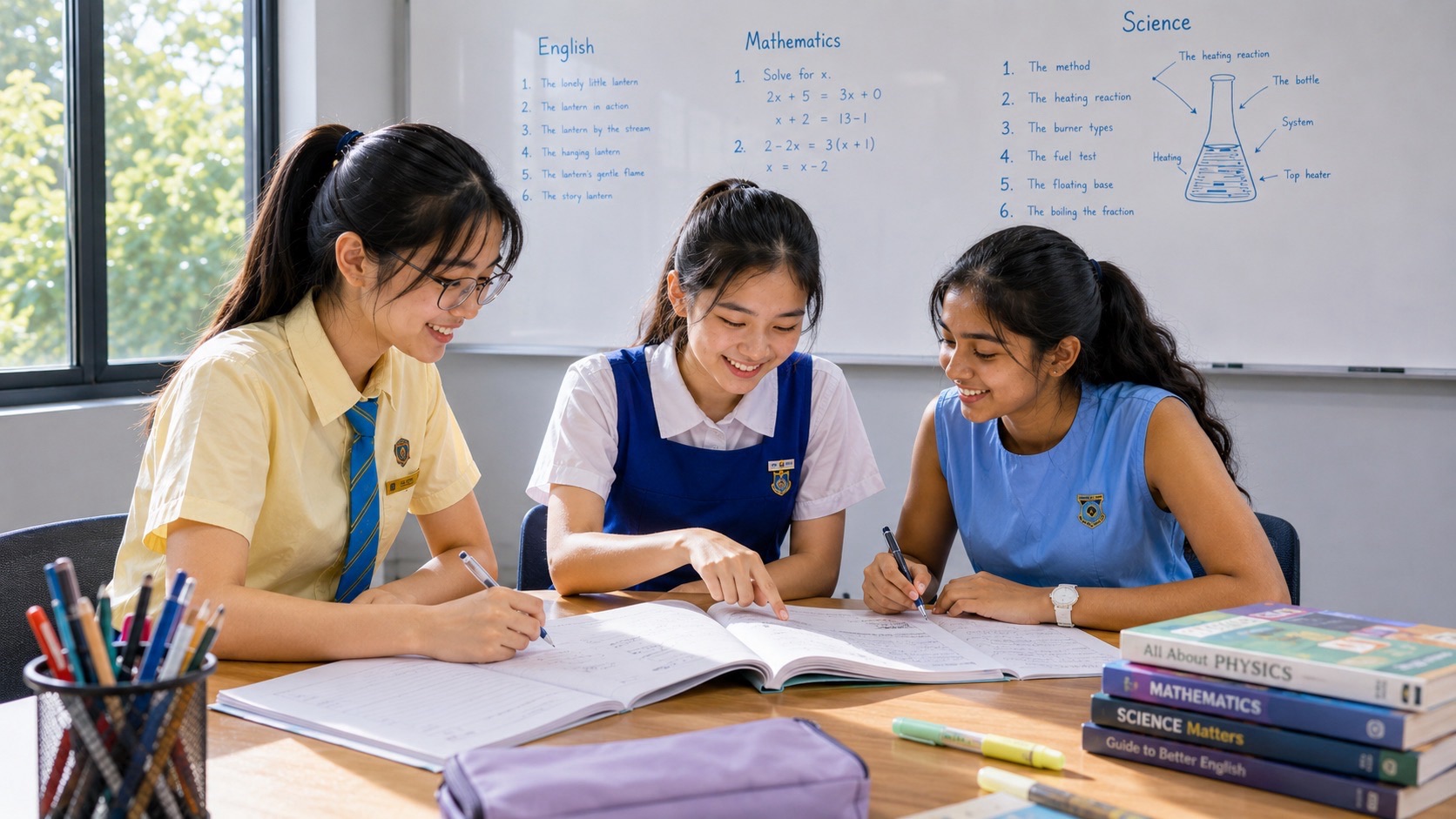
At eduKate Punggol, our premium tuition format is built around three students, with lessons typically lasting 1.5 hours weekly. Three students give the tutor enough time to see the reasoning behind the answer, while still preserving peer discussion, comparison and the momentum of learning with others.
The purpose is not constant tutor attention. The purpose is accurate attention at the moment it matters.
The Wrong Answer Is Only the End of the Story
Before a student writes a wrong answer, several things have already happened.
The learner read the task, decided what mattered, retrieved knowledge, chose a representation, selected a method, executed it and decided when the work was complete.
The tutor’s real job is to locate the first unreliable step.
- An English answer may fail because the passage was misunderstood, the question demand was misread or the evidence was not expressed precisely.
- A Mathematics answer may fail because the relationship was represented wrongly even though the arithmetic was correct.
- A Science answer may fail because the child knows the concept but does not connect it to the evidence in the question.
Three students give the tutor enough resolution to find that first wrong move instead of correcting only the final surface error.
Why Three Rather Than Five or Six?
Every additional student changes the tutor’s attention budget.
With three learners, it remains realistic to:
- inspect each student’s written work closely;
- hear each learner explain a method or answer;
- pause when an important misconception appears;
- adjust question difficulty within one shared topic;
- notice when a quiet student is confused;
- revisit one student’s prerequisite without stopping the entire class for long;
- reduce prompts at different rates; and
- respond quickly to school assessment evidence.
The number three is therefore a teaching constraint that protects visibility.
A 3-Student Class Is Not Three Private Lessons Running at Once
Individualisation does not mean every student spends the whole lesson on unrelated material while waiting for the tutor to rotate between them.
A productive small group has a shared spine.
Students may share the same concept explanation, then work at different levels of difficulty. They may compare two valid methods. One student’s misconception may become a useful contrast for everyone. The tutor can ask one learner to explain while the others evaluate the explanation.
Personalisation happens around a common intellectual job.
The First Ten Minutes: Retrieval and Readiness
A strong lesson often begins by returning briefly to earlier learning.
This might be:
- five vocabulary items from earlier English work;
- a short Mathematics mix involving fractions and ratio;
- several Science questions from previous topics; or
- a rapid review of errors from the last school paper.
The purpose is not a daily mini-examination. It is to see what remains available without the previous lesson sitting immediately beside it.
If a prerequisite has faded, the tutor knows before building new work on top of it.
The Teaching Phase: Make the Mechanism Visible
Instruction should explain why the method works, not simply demonstrate what to copy.
In English, this may mean showing how a pronoun relates to sentence role, how an inference depends on evidence or how a composition event must cause the next event.
In Mathematics, it may mean exposing the relationship behind a bar model, fraction operation or equation.
In Science, it may mean separating observation, concept, mechanism and outcome.
The student should leave the explanation with a structure that can be used again.
Guided Practice: Help Without Doing the Thinking
Close tuition can become counterproductive if the tutor rescues the student too quickly.
We use prompts carefully:
- “What is the question asking?”
- “Which information matters?”
- “Where did the relationship change?”
- “Which line supports your answer?”
- “What would happen if this condition changed?”
The prompt should move the learner’s attention, not supply the solution.
As the student improves, the prompt becomes smaller and eventually disappears.
Independent Application: The Moment of Truth
Performance with the tutor beside the student is not the final target.
At some point in the lesson, the learner must work without step-by-step help.
This reveals whether the student can:
- identify the relevant knowledge;
- choose a method;
- organise the response;
- notice uncertainty;
- recover from an error; and
- check the final work.
Three students make this phase practical because the tutor can let one learner struggle productively while checking the others, then return with a precise intervention if needed.
Error Review: Replace “Careless” With a Category
We do not want students to leave class with a red correction and no explanation for why the error happened.
Errors may be classified as:
- reading;
- knowledge;
- representation;
- method selection;
- arithmetic;
- language;
- copying;
- presentation;
- retrieval; or
- time pressure.
Once the category is visible, the correction becomes more specific.
A sign error in Mathematics needs a different repair from a misunderstood ratio relationship. A vague Science explanation needs a different repair from missing content. A weak English answer needs a different repair if the student misunderstood the passage rather than the question.
Transfer: Can the Student Use the Learning When the Surface Changes?
Immediate repetition can make a student look fluent.
Transfer is harder.
After correction, we change something:
- the numbers;
- the diagram;
- the wording;
- the context;
- the order of information; or
- the combination of topics.
If the skill survives, the learning is becoming portable. If it collapses, the student may still be attached to the original example.
Three Pathways Inside the Same Tuition Model
Repair
The student has an earlier weakness blocking current work. We trace the problem backwards, repair the dependency and reconnect it to school learning.
Stabilise
The student can perform but inconsistently. We strengthen retrieval, mixed practice, working routines, checking and independent execution.
Extend
The student is secure and ready for deeper applications, less familiar structures, stronger explanation and greater independence. Extension is depth before speed.
Placement Matters
A three-student class works best when the group has enough compatibility for a shared learning spine.
We consider level, pace, subject context, school assessment timing, support needs and the amount of independent work each learner can manage.
Students do not need identical marks. They need a combination in which the tutor can teach the group without one learner permanently waiting or another permanently drowning.
What Progress Should Look Like
- The learner starts with less prompting.
- Questions become more precise.
- Old error patterns repeat less often.
- Written work becomes easier to inspect.
- Corrections can be explained.
- Knowledge survives a delay.
- Skills transfer to changed questions.
- The tutor can reduce support.
- School performance becomes more stable.
We do not guarantee a particular grade. The rate of progress depends on the starting point, attendance, practice, school demands, learner readiness and time available.
Class Details
Format: premium 3-student small-group tuition
Levels: Primary and Secondary according to current class arrangements
Subjects: English, Mathematics and Science; upper-secondary support varies by subject and current arrangement
Duration: typically 1.5 hours weekly
Location: eduKate Punggol, 83 Punggol Central, Singapore 828761
Contact: +65 8823 1234
Attendance: by appointment and suitable placement
Frequently Asked Questions
Are your classes really limited to three students?
Our premium small-group model is built around a maximum of three students so the tutor can maintain close visibility of each learner’s work and reasoning.
Does every student receive the same worksheet?
Not necessarily. Students may share the same topic while receiving different question difficulty, prompts or continuation work according to need.
What if my child is shy?
Three students provide social learning without large-class anonymity. The tutor can invite participation carefully and make sure quiet confusion does not remain hidden for an entire lesson.
How do we begin?
Bring recent schoolwork to a parent–student consultation. We identify the likely weak link, discuss the learning goal and assess whether an available three-student placement is suitable.
Small by Design, Independent by Outcome
The purpose of a small class is not to keep the tutor permanently close.
It is to make early teaching precise enough that the student can eventually operate with less help.
See the error. Teach the mechanism. Practise deliberately. Test transfer. Fade the prompt.
That is what three students make possible.


