
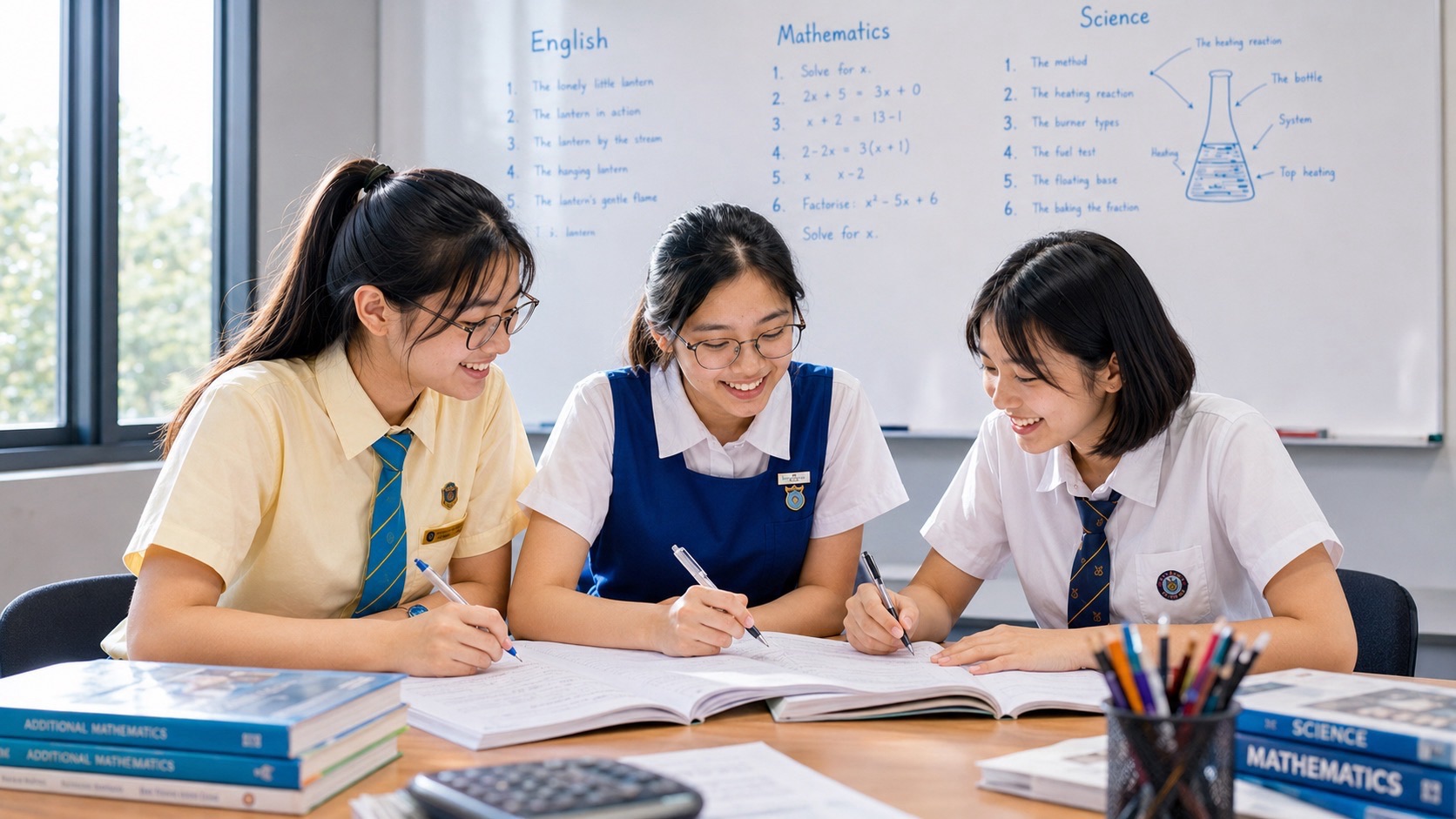
Secondary 4 G3 Geography tuition in Punggol should help a graduating student develop moving from everyday observation to geographical patterns, mechanisms, evidence and a conditional judgement, rather than merely complete another set of worksheets. The first Singapore-Cambridge Secondary Education Certificate (SEC) cohort in 2027 uses SEAB syllabus K329, previously referenced as 2279. Two compulsory 105-minute papers of 50 marks each contribute equally. Paper 1 assesses geographical methods and fieldwork (20 marks), tourism (15), and climate (15). Paper 2 assesses geographical thinking and sustainable development (15), tectonics (15), and Singapore (20). Unlike combined Humanities K335, separate K329 requires both Climate and Tectonics and the Singapore cluster. Confirm the actual subject registration and exam year with the school. The first useful teaching decision is to identify which recurring skill the learner cannot yet use independently.
A child may already enjoy noticing which walking routes are comfortable, how people use waterfront spaces, and why rainfall and shade vary. These experiences and earlier knowledge are learning resources, not predictions of intelligence or examination results. Niche syllabus engineering means using the actual curriculum to locate one missing relationship, teach it precisely, withdraw support and check a fresh independent response. At eduKate Punggol the small-group teaching approach emphasises observable individual progress. Confirm whether the centre currently offers the exact subject, specialist expertise, fees, group size and availability; school consultation may be sufficient. This high-frequency parent-question guide explains how to convert latent potential into capability and plan the final year responsibly. No grade or admission result is guaranteed.
- K329: 2027 G3 Geography, former reference 2279.
- Two compulsory 105-minute papers of 50 marks each contribute equally. Paper 1 assesses geographical methods and fieldwork (20 marks), tourism (15), and climate (15). Paper 2 assesses geographical thinking and sustainable development (15), tectonics (15), and Singapore (20). Unlike combined Humanities K335, separate K329 requires both Climate and Tectonics and the Singapore cluster.
- Both papers have three compulsory structured questions; approved calculators are allowed.
- Each paper includes one 9-mark judgement question, in Q2 or Q3; the other questions use point marking.
- The curriculum includes a ten-week extended fieldwork experience; Paper 1 Q1 assesses fieldwork, possibly in an unfamiliar setting.
- Approximate overall objectives: knowledge 30%, skills and analysis 40%, judgement 30%.
- Use actual schoolwork to identify the earliest unstable skill; check changed independent work and delayed retention.
- Confirm actual examination arrangements and availability; protect other subjects, rest and sustainable workload.
Five parent reading routes
- Examination registration and diagnosis
- Syllabus and core foundations
- Connected concepts and applications
- Independent evidence and tutorial decisions
- Four-week review and next steps
26 high-frequency questions parents ask
- 1. Which syllabus is my child actually taking?
- 2. What does the assessment scheme mean for study time?
- 3. How does latent potential become observable capability?
- 4. Does my child actually need tuition?
- 5. How does a familiar neighbourhood become a geographical system?
- 6. Why do map scale and distance need separate attention?
- 7. How do sense of place and spatial hierarchy differ?
- 8. How can sustainability and ecosystem services become practical reasoning?
- 9. How do hazards and resilience connect at neighbourhood scale?
- 10. How should a fieldwork question and hypothesis be formed?
- 11. Why does sampling matter more than the number of responses alone?
- 12. How should quantitative and qualitative results be interpreted?
- 13. Why are correlation, causation and reliability separate?
- 14. What does Tourism mean as a geographical system?
- 15. How should weather, climate and climate action be distinguished?
- 16. What should the child understand about tectonics and disaster risk?
- 17. What makes the Singapore cluster different from generic world Geography?
- 18. How should the nine-mark geographical judgement be developed?
- 19. How should both full papers be rehearsed without sacrificing fieldwork learning?
- 20. How do parents recognise genuine independent progress?
- 21. How should authenticity and appropriate learning resources be protected?
- 22. What might a focused small-group tutorial accomplish?
- 23. How should full papers and distinction goals fit into the final year?
- 24. What is a realistic four-week review of one learning gap?
- 25. How can a parent and child review the first two weeks together?
- 26. Which questions should a Punggol parent ask before choosing a tutor or post-secondary path?
2027 SEC K329 examination scheme
| Paper | Duration | Raw marks | Weight |
|---|---|---|---|
| 1 | 105 min | 50 | 50% |
| 2 | 105 min | 50 | 50% |
1. Which syllabus is my child actually taking?
SEC combines the former national examination arrangements into a certificate recording actual subjects and levels, beginning with the 2027 graduating cohort. Two compulsory 105-minute papers of 50 marks each contribute equally. Paper 1 assesses geographical methods and fieldwork (20 marks), tourism (15), and climate (15). Paper 2 assesses geographical thinking and sustainable development (15), tectonics (15), and Singapore (20). Unlike combined Humanities K335, separate K329 requires both Climate and Tectonics and the Singapore cluster. A pupil who sat the national examination in 2026 followed the applicable previous arrangement. Full Subject-Based Banding allows a mix of subject levels; Posting Group alone does not establish the student’s actual registration. Ask the school to confirm K329, the examination year and the subject combination.
Use the official syllabus and school instructions rather than rely on a sibling’s experience or a guide with an older label. Older exercises may still be useful when their content, scope and demands match; a booklet with the latest label is not automatically aligned. Build a simple map of outcomes: not taught, learning, independent on familiar tasks and independent on changed tasks. Check what has actually been covered before assuming a weakness. For the final year the parent needs a precise map of what to maintain, repair and extend, not a broad judgement that the child is good or bad at Geography.
Question index · Next question
2. What does the assessment scheme mean for study time?
Together the two papers contain six compulsory structured questions covering the five syllabus clusters. Paper 1’s fieldwork question can be set in a context outside the prescribed clusters. Each paper includes a nine-mark evaluation question, placed in Tourism or Climate for Paper 1 and Tectonics or Singapore for Paper 2. The published overall approximate weighting places 40% on data and analytical skills and 30% each on knowledge and judgement. Do not treat the separate Geography paper as the optional-cluster structure of K335.
Use weightings to understand the qualification, not to prescribe identical amounts of tuition for every child. A learner may have a narrowly defined problem that affects several questions, so repairing one relationship can have a wider effect. Ask the school which kinds of responses have repeatedly lost marks. Compare authentic work made under comparable conditions and distinguish knowledge, interpretation, communication and completion. A score is the outcome of a particular assessment; the first priority is a specific learning decision. No informal percentage establishes a national grade boundary. Check the actual published examination timetable and any school requirements before planning realistic rehearsal.
Previous question · Question index · Next question
3. How does latent potential become observable capability?
A child may have curiosity, motivation, observations, prior knowledge and access to teaching. These are what latent potential refers to here, not a measurable energy quantity or fixed intelligence score. A pupil notices that people gather near a particular sheltered walkway. The tutor asks whether the observation was made at one time, whether alternative paths were equally accessible and whether the shelter, location or nearby facilities might explain the pattern. The child first describes the observation, then proposes a bounded explanation and identifies evidence needed to distinguish alternatives. A fresh fictional map changes the arrangement of shade and facilities; the pupil must reconsider the mechanism rather than repeat the original explanation.
The teaching cycle is to observe the first independent response, identify the earliest unstable relationship, teach the necessary distinction, then test a changed task without the worked answer. Return to the skill several days later and ask whether it transfers to another situation. This makes moving from everyday observation to geographical patterns, mechanisms, evidence and a conditional judgement visible. If the pupil has already mastered a relationship, do not repeat it simply to fill a lesson. If the pupil cannot yet transfer, reduce the task or revisit the prerequisite. Progress may occur at different rates across learners and across topics. The syllabus is a map of learning outcomes, not a verdict on a child.
Previous question · Question index · Next question
4. Does my child actually need tuition?
Start with genuine marked schoolwork rather than one overall result. The child may understand the feedback, correct the answer and apply the relationship later without help. If so, school consultations and independent study may be sufficient. If a consequential error keeps returning despite appropriate teaching and effort, extra specialist support may be helpful. In Geography, the problem could concern the connection between a mapped pattern and a supported geographical explanation, a different prerequisite, question selection or communication.
Ask the learner to explain what they thought the question demanded and where their first attempt became difficult. Do not supply the answer before hearing their explanation. Then ask the actual subject teacher which errors recur. A family should consider time, cost, travel, the child’s willingness, competing school responsibilities and rest. Choose one useful next intervention and agree on evidence for reviewing it. There is no need to sign up for a complete extra course when school support already enables independent progress. Equally, a targeted lesson can be worthwhile where the evidence supports it.
Previous question · Question index · Next question
5. How does a familiar neighbourhood become a geographical system?
Geography looks at relationships between people, nature, services and places. Imagine an invented map showing housing, a local shop and a park. A pupil may identify all three locations without explaining why their arrangement matters. A spatial association means features tend to occur near one another; proximity alone does not establish which feature caused the other to be located there.
Ask the student to compare a clustered pattern with a more dispersed one, and distinguish a description from a proposed reason. Change the map’s scale to include a larger area and see whether the earlier pattern still holds. If the learner simply says ‘near the MRT’ without referring to the supplied features, ask which relationship the actual data supports. The independent skill is selecting a relevant spatial concept rather than reciting a neighbourhood name.
Previous question · Question index · Next question
6. Why do map scale and distance need separate attention?
On a fictional map at 1:10,000, 3 cm corresponds to 300 m on the ground. But a straight-line measurement is not necessarily the length of an actual path. A question may ask about direction, distribution, route, extent or accessibility. The student should read the legend and orientation and interpret the units before making a claim.
Give a changed scale of 1:20,000 with a distance of 2.5 cm. The ground distance is 500 m. Then show two routes of different shapes between the same points and ask why their walking distances may differ. A student who correctly calculates the straight-line value but calls it the walking distance needs a conceptual rather than numerical repair. Use authorised maps and do not treat fictional distances as actual Punggol route information.
Previous question · Question index · Next question
7. How do sense of place and spatial hierarchy differ?
A sense of place develops through experiences, memories and meanings attached to locations. Spatial hierarchy concerns the nested or related organisation of places at different scales, such as home, precinct, neighbourhood and town. A child may know a place well but not distinguish what the place means to a person from how the area is organised.
Ask for two fictional descriptions of the same gathering space, one from a regular visitor and one from someone who seldom visits. Discuss how experiences may shape meaning without assuming everyone’s perspective is identical. Then give a map of nested areas and ask which services operate at different scales. The changed task should require a different geographical concept. This trains careful language and prevents a personal impression being presented as a universal experience.
Previous question · Question index · Next question
8. How can sustainability and ecosystem services become practical reasoning?
A park may provide recreation, shade and habitat, but management choices must consider competing needs and long-term effects. Economic, social and environmental sustainability can interact. A hypothetical plan to expand a walking route may improve access while requiring land and maintenance. Merely listing advantages and disadvantages does not explain the trade-off.
Give a scenario with a stated budget and environmental constraint. Ask the pupil to explain one benefit, one possible limitation and a conditional judgement. Change the users or constraint in the next scenario. If the child repeats that every development is beneficial or harmful, ask what evidence would alter that judgement. The goal is to weigh appropriate criteria, not endorse one predetermined public policy.
Previous question · Question index · Next question
9. How do hazards and resilience connect at neighbourhood scale?
Risk depends on the hazard, exposure and vulnerability. A fictional path used by many people during heavy rain may present different concerns from a rarely used path with the same physical condition. Preparedness, monitoring and protective measures may reduce risk but cannot establish that it disappears. The syllabus links sustainable communities to environmental stewardship and risk management.
Ask the pupil to interpret a teacher-approved map with specified exposure and vulnerability information. Suggest one suitable measure and explain how it reduces the relevant risk. Change the hazard or affected population; the learner must reconsider the measure. Avoid using imaginary scenarios as claims about actual risks in Punggol or advising students to investigate hazardous locations.
Previous question · Question index · Next question
10. How should a fieldwork question and hypothesis be formed?
An inquiry question needs a workable scope. ‘Is Punggol good?’ is too broad to guide a study. An invented school-approved comparison might ask whether two types of public space show different patterns of use at a specified time. A hypothesis identifies a measurable expected relationship, not a conclusion already established. The choice of location, timeframe and variables should fit the resources and safety requirements.
Ask the learner to define the observation or measurement, what comparison is intended and which factors might affect the results. Then change the aim from observing use to investigating perceptions. The method may need to change from counts to appropriate survey or interview information. Genuine school fieldwork must use authorised methods and actual results. A parent can discuss the design without collecting or fabricating data for the child.
Previous question · Question index · Next question
11. Why does sampling matter more than the number of responses alone?
A convenience sample may be easy to obtain but may not represent all the relevant population. Random or stratified random approaches address selection differently; quota sampling is not the same as random sampling within strata. An invented survey of people available in one location at noon cannot automatically establish the views of everyone in the area. The method must match the inquiry and stated population.
Ask how a school-approved sampling plan could include different relevant groups or times while respecting permissions and practical constraints. Change the study objective from describing visitors at one location to considering multiple locations. Ask which limitations remain. The learner should not write that every larger sample is necessarily representative, or invent a sampling procedure that was not actually carried out.
Previous question · Question index · Next question
12. How should quantitative and qualitative results be interpreted?
An invented count series 8, 10, 10, 12, 20 has mean 12, median 10 and mode 10. The larger value affects the mean. A questionnaire response, interview account or mental map may reveal different information about experiences that a numeric count alone does not capture. Both forms of evidence have limitations.
Ask which statistic best describes a particular aspect of the data and why. Change 20 to 40: mean becomes 16 while the median stays 10. Then provide a short fictional account explaining why one participant avoids a route. It can reveal a possible reason but not establish every user’s view. The student should interpret the actual evidence rather than force every question into the same graph or average.
Previous question · Question index · Next question
13. Why are correlation, causation and reliability separate?
A scatter plot showing that two quantities tend to increase together indicates a positive association. It does not by itself establish that one causes the other. A hypothetical comparison of shade and temperature may also be affected by time, wind, cloud cover or measurement method. Reliability concerns the consistency of evidence; validity concerns whether the method and conclusion address the question properly.
Give a changed plot where the relationship is weak or an outlier appears. Ask which conclusion is supported, what alternative factor could matter and what would strengthen the investigation. Do not simply remove an inconvenient point. A well-designed revision exercise asks the student to explain both the observed pattern and the limits. Do not confuse hypothetical data with genuine fieldwork.
Previous question · Question index · Next question
14. What does Tourism mean as a geographical system?
Tourism links origins, destinations and travel routes, with businesses, communities and environments affected at several scales. A fictional increase in visitors may raise demand for services and create employment while placing pressure on infrastructure. Benefits may not reach every household in the same way. Understanding the connection between a change in visitor flows and local consequences is more important than memorising a list of destinations.
Provide a new hypothetical visitor dataset and ask for a trend, a possible effect with its mechanism and one limitation of the conclusion. Change the location’s capacity or transport connection. The pupil should explain why the outcome may differ. Sustainable tourism strategies should be evaluated according to the actual place and constraints, not described as universally successful.
Previous question · Question index · Next question
15. How should weather, climate and climate action be distinguished?
Weather concerns conditions over relatively short periods; climate describes patterns over longer times. A hot afternoon alone is insufficient to demonstrate a changing climate. The syllabus connects physical processes, climate change and responses. Mitigation addresses drivers of climate change; adaptation addresses vulnerability and impacts. A response may involve both, but its actual mechanism matters.
Use a fictional daily-weather table and a separate hypothetical multi-year chart. Ask which could support a claim about a long-term pattern and what evidence would still be needed. Compare a stated emissions-reduction measure with a measure addressing heat exposure. Ask what each is intended to change. The pupil must not treat a change in one day’s temperature as proof of a long-term trend.
Previous question · Question index · Next question
16. What should the child understand about tectonics and disaster risk?
Plate movements, geological processes and the distribution of earthquakes and volcanoes are connected. A physical hazard does not fully determine the consequences for people. Exposure, vulnerability and preparedness help explain differences in impacts. A student who recalls a boundary name must still use the actual diagram and explain the process that the question asks about.
Give a teacher-approved plate diagram and ask the learner to identify the relative motion and relevant process. Then compare two imagined places with differing exposure or preparedness. Ask why similar physical hazards may lead to different outcomes and which evidence supports a suitable risk-reduction measure. This is curriculum reasoning, not advice to enter a dangerous place or a prediction of a particular disaster.
Previous question · Question index · Next question
17. What makes the Singapore cluster different from generic world Geography?
Separate K329 includes Singapore’s position as a small island city-state, its opportunities and constraints, and approaches to sustainability and resilience. A child needs to connect the particular context to a geographical relationship. Limited land, for instance, can create competing demands, but a claim about an actual policy’s effectiveness must use relevant evidence. The question may ask how a strategy addresses a specific constraint rather than how Singapore is generally successful.
Use an imagined planning scenario with a fixed area and several potential uses. Ask how a proposed design could balance needs, what trade-offs remain and which additional information would inform a judgement. Change the available area or population needs. Then use actual school-approved Singapore case studies with accurate sources. Do not invent statistics about Singapore or present a fictional plan as government policy.
Previous question · Question index · Next question
18. How should the nine-mark geographical judgement be developed?
The extended judgement question uses level descriptors. It is not a command to write a memorised number of paragraphs. A useful approach is to identify the proposition, choose a relevant criterion, explain supported considerations and arrive at a reasoned conclusion. A statement that a strategy is ‘effective’ needs to say effective at what, for whom and under which conditions.
Give the student a fictional proposal to reduce crowding at a visitor site with a stated cost and access constraint. Ask which criteria matter, explain how the proposal addresses the issue and consider an alternative or limitation. Change the criterion in another task. The student must adjust the conclusion. Use the school’s actual marking guidance; no universal paragraph formula guarantees nine marks.
Previous question · Question index · Next question
19. How should both full papers be rehearsed without sacrificing fieldwork learning?
The two K329 papers contain compulsory questions across all five clusters. A learner who favours physical geography cannot omit Tourism or Singapore, and a learner who enjoys fieldwork cannot omit Tectonics. Complete mixed structured tasks once the underlying relationships are stable. The approved calculator supports relevant computations but cannot decide which dataset or interpretation the question requires.
Ask the pupil to use an examination-length practice set at an appropriate stage, then classify the earliest wrong decisions: scope, data reading, model, explanation or judgement. Keep an actual fieldwork record separate from a written answer about fieldwork. Change the context of the next task, not just the numeric values. The aim is accurate independent selection under the conditions of the new paper.
Previous question · Question index · Next question
20. How do parents recognise genuine independent progress?
A complete answer created with a teacher’s leading questions is supported performance, not necessarily independent mastery. Compare the first attempt with a changed response in which the learner must choose the relevant method or evidence. For K329, ask whether the pupil can explain the connection between a mapped pattern and a supported geographical explanation without being told which relationship to use. Record the degree of help honestly. A student who responds correctly with a visible model may need a further step before they can perform alone.
Give a new task that changes an important condition, quantity, source or question demand. If the learner chooses the appropriate relationship and explains the reason, revisit it after several days. If they cannot do so, identify whether the barrier is misunderstanding, memory, selection or expression. Preserve any part that was already correct. A parent does not need to mark every answer personally: the teacher can explain the relationship and what the fresh work demonstrates. Treat the record as a teaching aid rather than a measure of the child’s worth.
Previous question · Question index · Next question
21. How should authenticity and appropriate learning resources be protected?
Fieldwork is genuine inquiry, not a manufactured set of results. Ask the school about its extended fieldwork programme and approved activities. At home, use fictional or lawfully obtained maps and tables, clearly labelled. Never send children to collect unsafe traffic or weather observations or approach strangers unsupervised; follow school instructions for consent, privacy and site safety.
Keep discussions and jointly supported exercises separate from independently assessed schoolwork. Parents can help arrange time, lawful materials and teacher feedback, but should not write answers, fabricate observations or replace the pupil’s reasoning. If permitted assistance is unclear, ask the school. Any fictional example should remain labelled, and the student must be able to explain their own response. A polished answer from an adult or an AI system is not evidence of the child’s independent capability. Choose teaching resources that align with K329 and the actual examination year; this avoids both unnecessary material and missing outcomes.
Previous question · Question index · Next question
22. What might a focused small-group tutorial accomplish?
A possible ninety-minute learning session includes 10 minutes reviewing authentic feedback, 15 minutes for a first independent attempt, 20 minutes focused on one missing relationship, 20 minutes of changed tasks, 15 minutes of mixed reasoning and 10 minutes to agree on follow-up. This is an illustrative structure, not a promise about a specific class. In Geography, the teacher must observe what each learner can do individually, even where discussion with peers provides useful alternative reasoning.
Ask what the tutor intends to repair first and why a fresh task tests that relationship. For example, if the problem is the connection between a mapped pattern and a supported geographical explanation, a long lesson on an already secure topic is not automatically helpful. The tutor should be able to distinguish a pupil who understands but is slow from one who does not yet know which method or interpretation applies. Confirm specialist subject expertise, duration, actual group size, fees and availability. Some specialist subjects may not currently be offered; school support or a suitable specialist elsewhere may be the appropriate choice.
Previous question · Question index · Next question
23. How should full papers and distinction goals fit into the final year?
A distinction is a possible learning goal, not a promise. Full papers assess time management, changes of topic or demand, selection, completion and communication. They are most useful when basic relationships are sufficiently stable. If a particular error repeatedly breaks several responses, a short targeted diagnostic may be a better first use of revision time.
Move from accurate untimed work to changed mixed tasks, short timed sets and ultimately realistic paper rehearsals using the official K329 scheme. Compare the first unsuccessful decision rather than count red marks alone. If accuracy collapses without timing, repair the concept. If the learner succeeds independently but cannot complete work under appropriate time limits, gradually practise efficient selection and pacing. Keep other subjects, rest, school commitments and ordinary life in the plan. Avoid a timetable that relies on excessive late-night work or assumes a particular national grade from a practice score.
Previous question · Question index · Next question
24. What is a realistic four-week review of one learning gap?
Week 1: choose a genuine marked response and a fresh independent question. Identify a precise recurring problem, such as the connection between a mapped pattern and a supported geographical explanation. Week 2: clarify the relationship using a short worked example, then give the student a changed task without the model. Continue school work and maintain the other syllabus areas. Week 3: revisit the relationship after several days, connect it to an already secure skill and introduce a modest time constraint only if accuracy is stable.
Week 4: give a different unfamiliar task and compare the relevance, accuracy, explanation, completion and degree of assistance with the earlier evidence. Discuss the child’s own assessment of what has changed. Decide whether the next cycle should repair, maintain or extend. Repeat where necessary and adjust to school feedback. Four weeks is a suggested review interval rather than a guarantee of syllabus completion or a grade. For a graduating pupil, timetable this around real school deadlines and the actual national examination components.
| Week | Evidence | Decision |
|---|---|---|
| 1 | Marked work and independent sample | Find earliest recurring difficulty |
| 2 | Changed task after targeted instruction | Check transfer without model |
| 3 | Delayed mixed response | Check retention and pacing |
| 4 | Fresh unfamiliar task | Repair, maintain or extend |
Previous question · Question index · Next question
25. How can a parent and child review the first two weeks together?
Choose one earlier response that exposed the learning gap and one genuinely new response. Ask the child to explain the difference between the two and what prompted the changed decision. Try a second independent task: supply two fictional maps of the same area at different scales, ask the pupil to describe the pattern, then explain which scale is appropriate for a specified question. Ask how a fieldwork investigation could test one proposed explanation without overstating the evidence. The new example should not simply reproduce the earlier worked example. A pupil may gain confidence from a correct new response while still needing help with another strand; retain both observations.
If the explanation is clear, ask the teacher to check its accuracy and suggest one different application. If the new answer required a prompt, record it rather than treating that as failure. The next teaching decision may be to remove the prompt gradually or make the task smaller. If the workload is not sustainable, reduce it and consult the school. A family can review progress without turning every evening into another assessment. This supports long-term independence rather than relying on a tutor to produce the child’s best work.
Previous question · Question index · Next question
26. Which questions should a Punggol parent ask before choosing a tutor or post-secondary path?
Ask the school to confirm the registered subject and level, actual examination year, taught options or texts where applicable, and school assessment arrangements. Post-secondary entry depends on the relevant intake-year requirements, subject combination and institution, not one subject result alone. Follow current official MOE and institutional guidance rather than infer access to a particular JC, MI, polytechnic or ITE programme from a general tuition article.
At a consultation ask the tutor to examine one actual answer, explain what the child already does independently, identify the first recurring barrier and show what changed response will test the correction. Confirm whether specialist tuition for Geography is currently available, plus group size, duration, location, fee and policies. Consider travel around Punggol and the full timetable. The best decision may be school consultation, independent revision or a focused tutorial. The immediate next move is a genuine first attempt and a specific teaching decision. No teacher should promise a national distinction or guaranteed admission.
Previous question · Question index
Parent decision sheet: what the next response tells us
In Geography, a student may be able to complete familiar work but struggle to choose the correct relationship in a changed context. Before adding more questions, identify the first unsupported decision. If it involves the connection between a mapped pattern and a supported geographical explanation, give the learner a manageable changed task with no worked answer visible. Discuss the result and preserve whatever was already correct. The table below suggests different teaching responses. It is not an official marking scheme or a prediction of a national grade.
| Observed evidence | Possible next teaching decision | Independent check |
|---|---|---|
| Misreads the question | Clarify the exact demand and vocabulary | Different demand on a familiar topic |
| Knows facts but cannot link them | Teach the specific relationship | Changed application or supported explanation |
| Uses an appropriate method but makes another error | Repair the precise prerequisite | Fresh question with altered details |
| Succeeds only when given prompts | Withdraw support gradually | New task without the model |
| Accurate independent response after delay | Maintain and extend | Unfamiliar mixed task |
The learning process is not about maximising worksheet volume. Ask whether the learner can now make a decision independently that they could not previously make. If the child needs further support, choose a precise task and review it again. When the skill is stable, retain light practice and extend to another outcome. Keep the child’s own explanation and the teacher’s model distinct, and recognise the limits of the evidence. Progress on a narrow relationship does not establish full syllabus mastery, but it can make the next learning decision clearer. That is the practical meaning of converting potential into capability.
Connected Secondary 4 G3 SEC parent guides
- Secondary 4 G3 History K330 tuition guide
- Secondary 4 G3 Literature in English K331 tuition guide
- Secondary 4 G3 Principles of Accounts K342 tuition guide
Official references and connected Punggol guides
- Official SEAB 2027 Geography K329 syllabus PDF
- SEAB 2027 G3 school-candidate syllabus directory
- Official SEC examination overview and timetable
- MOE official education and post-secondary information
- Detailed Punggol K329 examination guide
- Related Punggol Geography mastery guide
- Connected Punggol subject-level guide
- eduKate Punggol — check current teaching arrangements
- Clementi teaching-format reference
Reference review: 28 November 2026. The official assessment text was checked; the PDF assessment-page image returned a cache miss. The live Clementi reference returned HTTP 429, so its established two-paragraph opening, point-form summary, five reading routes, 26 linked questions and four-week review were retained. All invented illustrations are learning exercises, not actual or predicted examination questions. Confirm school requirements, examination registration and teaching availability. No grade or admission outcome is guaranteed.


