
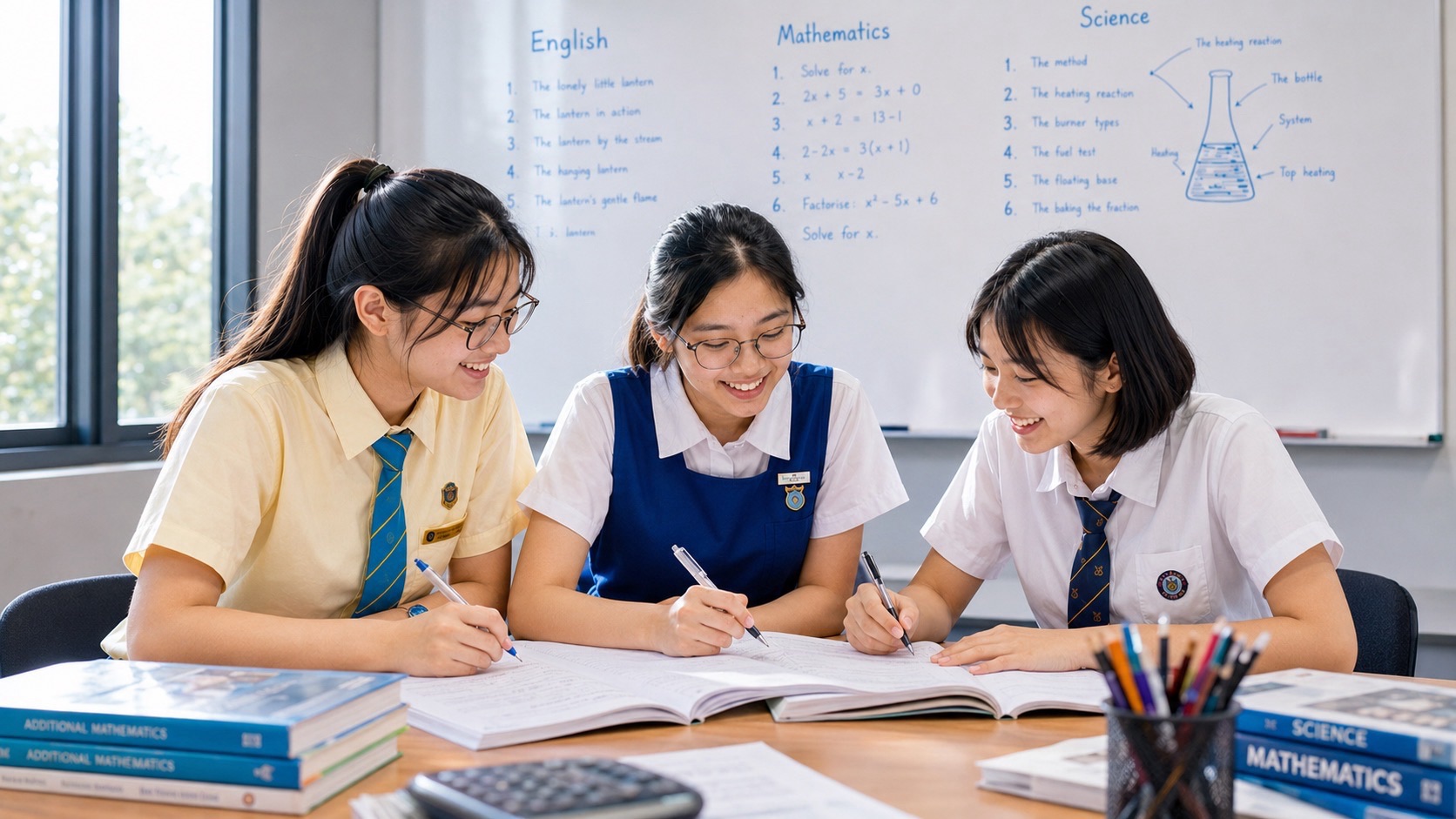
Punggol Secondary 1 English tuition is most useful when it does one clear job: help a student cross the bridge from Primary 6 into secondary-school English without losing the strengths already built. At eduKate Punggol, our Secondary 1 English tutorials are kept to three students so the tutor can see how each learner reads a question, builds an answer, plans a piece of writing, chooses vocabulary, corrects grammar and speaks through an idea. The class is not designed around a promise of a particular grade. It is designed around something more practical: making the student’s English decisions visible enough to teach.
Secondary 1 is a transition year, but that phrase can sound softer than the reality. The vocabulary becomes less concrete. Reading questions demand more inference. Writing becomes longer and less scaffolded. Students meet new teachers, new routines, new subjects and a timetable that expects greater independence. Under Full Subject-Based Banding, English is also studied at an appropriate subject level rather than through the old streaming labels. The result is a year in which a child can look perfectly comfortable on the surface while small weaknesses begin to compound underneath.
A good Secondary 1 English tutor should therefore do more than provide additional worksheets. The tutor should help the student understand what has changed, identify which habits still work, replace the ones that do not, and build a system that can carry the student through the next three years. This page explains how we approach that job at eduKate Punggol, what parents can look for, and why a three-student tutorial can be a useful format for close English teaching.
Secondary 1 English is a bridge, not a restart
A Primary 6 student does not arrive in Secondary 1 with an empty mind. The child already knows how to read, write, speak, listen, answer comprehension questions and work with vocabulary. The mistake is to treat Secondary 1 as if all of that must be thrown away. The better approach is to ask which Primary-school habits remain useful and which now need to evolve.
For example, a Primary student may be used to locating an answer close to a keyword in the passage. In Secondary 1, that can still help with literal questions, but it becomes less reliable when the question asks about tone, intention, implied meaning or the effect of language. A child who has learned to write a clear composition may still need to adjust to broader topics, more complex perspectives and greater independence in planning. A student with a strong vocabulary may need to learn that sophisticated writing is not the same as inserting the most impressive word available.
That is why we think of the first secondary year as a bridge. The tutor’s job is to help the student carry forward what is sound, identify what no longer fits, and deliberately construct the next version of the learner. When this is done well, Secondary 1 does not feel like a sudden collapse of confidence. It becomes a year in which the child learns how secondary English works.
What actually changes after Primary 6?
The most visible change is difficulty, but difficulty is only the symptom. The deeper change is that English asks for more independent judgement. Students must decide what a question is doing, what information matters, how much evidence is enough, what register fits the situation, how a paragraph should move and when a sentence is clear enough to stop revising.
In Primary school, scaffolds are often more visible. In Secondary 1, the scaffold begins to recede. A question may not tell the student exactly how to organise the answer. A writing prompt may allow several legitimate directions. A passage may be understood at more than one level. The student must learn to make decisions and then defend them with language.
This is why a child can appear to become weaker in English after entering Secondary 1 even when the child has not actually forgotten anything. The demand has changed. The child is being asked to do more with the same language system. Once parents understand this, the correct response is usually not to panic and not to multiply homework indiscriminately. It is to find the exact movement that is failing and teach it.

Full Subject-Based Banding: teach the student in front of us
Singapore’s secondary-school landscape now uses Full Subject-Based Banding. Students take subjects at G1, G2 or G3 where appropriate, and the subject level matters more to teaching than the old assumption that one stream label explains the whole child. For a tutor, the practical lesson is simple: start from the student’s actual English course, school work and present performance.
A learner may be strong in spoken English but weaker in written accuracy. Another may read confidently but struggle with inference. A third may have good ideas but weak paragraph control. Two students studying English at the same subject level can therefore need very different first moves. Class level tells us the stage of schooling; scripts tell us what to teach next.
We use school assignments, test papers, teacher comments and the student’s own attempts as evidence. The goal is not to relabel the child. It is to locate the point at which performance begins to break down. That may be vocabulary, grammar, task interpretation, evidence selection, idea development, confidence or simply the unfamiliarity of a new school system.
Parents who want the official framework can read the Ministry of Education’s Full Subject-Based Banding secondary-school guide. The teaching principle we take from it is flexibility: subject demand should be understood at the subject level, while the student remains a whole person with strengths and weaknesses that do not fit neatly into one label.
Why English can look fine until the first difficult paper
English is unusual because students use it every day. A child may chat fluently with friends, understand videos, message quickly and follow classroom conversation. That fluency can create the impression that the subject is secure. Then the first difficult secondary paper arrives and the marks say otherwise.
The reason is that everyday English and academic English overlap, but they are not identical. Everyday conversation is supported by tone, context, gesture, shared knowledge and the ability to clarify immediately. A written answer has none of those supports. It must carry its meaning on the page. A comprehension response must be precise enough for another reader to see why it answers the question. A situational piece must suit purpose and audience. A continuous-writing response must organise ideas across many paragraphs. Oral communication requires a student not merely to talk, but to develop a thought.
This does not mean everyday English is inferior. It means the student needs more than one mode. Secondary 1 is a good year to make those modes visible before weak habits become normal.
Reading: from finding information to making meaning
Strong secondary reading is not simply fast reading. It is controlled attention. Students must notice what a text says, how it says it, what it implies and why particular details matter. They need to distinguish a fact from an inference, an author’s view from a character’s view, a literal description from a loaded phrase, and a supporting detail from the main point.
In a three-student tutorial, reading can be taught aloud as a thinking process. The tutor can ask one student what a phrase means, another what evidence supports that interpretation, and the third whether a different reading is possible. That discussion is valuable because students hear that reading is not magic. It is a sequence of decisions.
We teach students to slow down at useful places: command words, contrast markers, changes in tone, unfamiliar vocabulary, pronoun references, cause-and-effect relationships and sentences that appear to carry the writer’s main judgement. The aim is not to annotate every line until the page becomes unreadable. The aim is to notice the information that changes the answer.
Over time, this creates a reader who is less likely to say, “I understood the passage but I do not know why my answer is wrong.” The student begins to see the route from text to evidence to conclusion.
Comprehension: the answer must match the question
Many comprehension errors are not caused by a failure to understand English. They are caused by answering a nearby question. A student sees familiar words, finds a relevant sentence and begins writing before deciding exactly what is being asked.
We therefore teach a simple discipline: classify the demand before constructing the answer. Is the question asking for a fact, an inference, a reason, an effect, a comparison, a reference, a vocabulary meaning or an explanation of language? What would count as sufficient evidence? Does the answer require the student’s own words? Is one idea enough or are two parts required?
This sounds basic, but it is one of the most useful habits a Secondary 1 student can build. It changes comprehension from answer hunting into task solving. The tutor can then correct the reasoning, not only the final sentence. If the evidence was correct but the phrasing was vague, that is one kind of repair. If the evidence itself was wrong, that is another. If the student understood but failed to answer both parts, the correction is different again.
English improves faster when errors are named accurately.
Vocabulary: precision before decoration
Secondary students often believe stronger vocabulary means longer words. It does not. Strong vocabulary means having enough words to choose accurately for the meaning, tone and context.
A useful vocabulary programme therefore does more than hand out lists. Students need to understand connotation, collocation, register and word family. They should know not only that two words are similar, but when one sounds natural and the other does not. They should meet new vocabulary in reading, use it in discussion, test it in sentences and later retrieve it in writing.
For a Secondary 1 learner, this matters especially because reading becomes a major source of language growth. A child who learns to pause at an unfamiliar but important word, infer meaning from context, verify it and then reuse it is building a system that can continue without the tutor.
We also separate receptive vocabulary from productive vocabulary. A student may recognise a word when reading yet be unable to use it naturally in a sentence. That is normal. The goal is gradual conversion: see it, understand it, compare it, use it, receive correction and use it again later.
Grammar: correction must transfer into real writing
Grammar exercises can produce high scores without changing a student’s writing. That happens when grammar is learned as isolated right-or-wrong questions but not connected to the learner’s own recurring mistakes.
We prefer to build a personal error map. One student may repeatedly shift tense in narratives. Another may have subject-verb agreement problems. Another writes sentence fragments. Another produces long sentences whose clauses are connected loosely. The tutor can still teach common grammar, but the student’s actual writing decides what receives extra attention.
The correction loop matters. First, identify the error. Second, explain why it is an error. Third, rewrite the sentence. Fourth, use the same principle in a new sentence. Fifth, check whether the error returns in the next piece of authentic writing. Only then do we know whether the correction travelled.
This is one reason a class of three is useful. The tutor has enough room to inspect sentences closely while still allowing students to compare alternatives and discuss why one expression works better than another.
Continuous writing: from filling a page to designing a response
Secondary 1 is a good year to teach students that writing begins before the first sentence. The writer must understand the prompt, choose a direction and build a route. Without that, even fluent prose can wander.
We teach planning as decision-making rather than as a rigid template. What is the central idea? What should the reader understand or feel by the end? Which scene, example or argument is necessary? What can be left out? How should the paragraphs move? What is the role of the opening? What should change before the conclusion?
For narrative writing, students learn that a sequence of events is not automatically a story. There should be selection, movement and consequence. For reflective or discursive work, the student must develop ideas rather than repeat them in different words. For argumentative writing, the child must learn to support a position without turning the essay into a list of unsupported opinions.
At this stage we are not trying to force every student into the same voice. We are trying to give each student enough control to produce a coherent piece under school conditions. Strong writing should sound like the student at their best, not like a memorised model essay pasted onto a new topic.

Situational writing: audience, purpose and context
Situational writing teaches a lesson that matters far beyond school: communication changes when the audience and purpose change. The same student should not write to a close friend, a principal, a community organisation and a future employer in exactly the same way.
We train students to ask four questions before drafting. Who am I in this situation? Who is receiving the message? What must the communication achieve? Which details from the task are required? Only after those decisions do format and language become useful.
This prevents a common problem: students memorise a format but fail to fulfil the actual situation. A polished email that misses a required point is still incomplete. A formal letter that sounds robotic may not communicate effectively. A friendly message can still be organised and precise.
Secondary 1 is early enough to build this habit properly. Once the student becomes used to reading communication tasks as real situations, later examination preparation becomes easier because the purpose-and-audience instinct is already present.
Oral communication: turn an opinion into a developed response
Many students have opinions. Fewer know how to develop them in real time. A child may answer, “Yes, I agree because it is important,” and then stop. The problem is not a lack of intelligence. The student has not yet learned a reliable way to extend spoken thought.
We practise a simple movement: position, reason, example, consequence or qualification. The pattern is flexible, not robotic. It gives the student somewhere to go after the first sentence. In a three-person group, students can hear how peers approach the same prompt and learn that strong oral communication allows different reasonable answers.
Oral work also improves writing. Students who can explain an idea aloud often become better at developing written paragraphs. Vocabulary becomes more usable when spoken. General knowledge becomes more accessible when discussed rather than merely memorised.
The goal is not to manufacture a particular accent or personality. It is to help the student become clearer, more relevant and more willing to participate in a thoughtful conversation.
Why three students instead of a larger class?
English benefits from two things that can pull in opposite directions: individual correction and social interaction. One-to-one tuition gives maximum individual attention but less peer comparison. Large classes create more voices but reduce the amount of time a tutor can spend on each student’s actual writing and reasoning. A three-student tutorial is our attempt to hold both advantages together.
Every learner remains visible. If a student has misread a question, the tutor can catch it. If a paragraph is weak, there is time to inspect it. If a grammar error keeps repeating, it can be named. At the same time, students still hear alternative interpretations, compare word choices, discuss perspectives and practise spoken English with peers.
The format also makes differentiation practical. Three students can work on a shared passage while receiving different prompts. One may need support identifying evidence. Another may be ready to explain language effect. A stronger student may be challenged to evaluate a different interpretation. They remain in one coherent lesson without pretending they need identical help.
Small classes are not automatically good. The quality still depends on the teaching. The point of the small number is to make close teaching possible.
What a 90-minute Secondary 1 English lesson can look like
Our lessons are normally around 90 minutes. The exact sequence changes with the students, but a useful lesson often moves through five phases.
- Retrieval and review. We begin by checking something previously taught. This might be vocabulary, a comprehension movement, a grammar pattern or a revised paragraph. Retrieval tells us whether last week’s correction survived.
- Model the new decision. The tutor shows how an experienced reader or writer approaches a problem. We make the invisible thinking visible: what to notice, what to ignore, why a particular answer is stronger.
- Guided attempt. Students try the movement with prompts. Because there are only three learners, the tutor can see where each one begins to diverge.
- Independent transfer. The task changes. The support reduces. Students apply the principle to a new passage, prompt or situation.
- Correction and next move. We do not end at the mark. Students inspect the error, rewrite where needed and leave knowing what to watch for next time.
Some weeks will emphasise writing, others reading or oral, but the architecture stays similar: understand, attempt, inspect, correct, transfer.
Three common Secondary 1 starting points
1. The student who was strong in Primary 6 but suddenly looks average
This child often needs recalibration rather than remediation. The foundations are present, but the student has not yet adjusted to the new level of independence and precision. We focus on explaining the changed demand, then sharpening reading, paragraph development and task interpretation.
2. The student carrying Primary-school gaps
This learner may have weak sentence control, a narrow working vocabulary or difficulty understanding longer passages. The correct response is not to rush into advanced secondary worksheets. We repair the missing foundation while keeping the student connected to school work. The route is repair and progress at the same time.
3. The strong student who needs stretch
This learner does not need more easy exercises. The student needs richer texts, sharper feedback, more difficult writing decisions and questions that require explanation rather than recall. Stretch should increase depth, not simply volume.
How we diagnose before adding more work
A mark alone does not tell us enough. A 65 can come from many combinations. One student may have strong writing and weak comprehension. Another may understand the passage but lose marks through incomplete answers. Another may have weak grammar but excellent ideas. Treating all three students with the same worksheet is inefficient.
We prefer recent evidence: school scripts, compositions, comprehension papers, teacher annotations, oral observations and examples of work the child finds difficult. We look for patterns across several pieces rather than overreacting to one test.
Parents can do the same. Instead of asking only, “What grade did you get?” ask: Which section lost the most marks? Which mistake keeps repeating? What did the teacher say? Could the child rewrite the answer now? Does the child know what a stronger response looks like?
Good diagnosis makes tuition smaller, not larger. Once the real bottleneck is found, less random practice is needed.
Repair, stabilise, then stretch
We use three broad teaching states because they keep priorities clear.
Repair is for a skill that is not dependable. The tutor slows down, models explicitly and provides enough support for the student to perform the movement correctly.
Stabilise begins when the student can do the skill but not consistently. We vary the task, reduce prompts and require the learner to recognise when the skill is needed.
Stretch is for a skill that has become secure enough to carry more complexity. We use denser texts, more nuanced questions, wider perspectives or stricter time conditions.
Students can be in different states for different components. A learner may need repair in grammar, stabilisation in comprehension and stretch in oral. That is normal. English is a system of connected capabilities, not one single ability.
What progress should look like before the grade changes
Parents understandably look at grades, but useful progress often appears in the work before it appears in the report book. The student starts underlining the actual demand of a question. Comprehension answers become shorter but more complete. Planning becomes faster. Paragraphs have clearer jobs. The same grammar mistake appears less often. Vocabulary becomes more natural. The student can explain why a correction is necessary instead of merely accepting it.
These are leading indicators. They show that the mechanism is changing. Grades can still fluctuate because school papers vary in difficulty and because performance under time takes longer to stabilise. We would rather see a student build transferable control than produce one unusually high mark that cannot be explained or repeated.
There are no honest grade guarantees in English tuition. There can, however, be visible evidence that the learner is making stronger decisions.
What parents can do at home without becoming the second tutor
Parents do not need to mark every essay. In fact, turning home into a second classroom can increase tension. A few lower-friction habits are often more sustainable.
- Ask the child to explain one interesting idea from something read, watched or discussed that week.
- Keep good reading material within reach without turning every page into a test.
- When the child receives a marked script, ask what one repeated error will be watched next time.
- Encourage rewriting of a small section after feedback rather than demanding an entirely new essay.
- Use ordinary conversation to develop reasoning: Why do you think that? What example supports it? Is there another perspective?
- Protect sleep and manageable schedules. A tired child does not become a better reader by adding one more late-night worksheet.
The home does not need to replicate tuition. It can support curiosity, explanation and steady routines.
When tuition may not be necessary
Tuition is not automatically the correct answer for every Secondary 1 student. Some learners are settling well, receive enough support from school, read widely, respond to teacher feedback and can improve independently. Adding another lesson may not create enough value to justify the time.
Parents can ask whether there is a specific problem to solve. Is the child repeatedly confused about English tasks? Are marks falling because of identifiable weaknesses? Is confidence deteriorating? Does the student need feedback that is difficult to obtain in the current setting? Is there a mismatch between the child’s effort and the quality of the work produced?
If the answer is no and the child is thriving, the better choice may be to protect time for reading, rest, activities and self-directed learning. A useful tutor should be able to say this. Tuition should solve a learning problem, not create one by overloading the student.
How to choose a Secondary 1 English tutor in Punggol
Parents can evaluate a programme by asking practical questions rather than relying on superlatives.
- Will the tutor inspect actual work? A useful starting point should be based on the student’s scripts and present needs.
- How are corrections handled? Marking should lead to explanation, rewriting and later transfer.
- How small is the class in practice? Ask for the actual maximum, not a vague phrase such as small group.
- How does the tutor differentiate? Students at the same level may need different scaffolds and extensions.
- How are reading, writing, vocabulary, grammar and oral connected? English should feel like one system rather than unrelated worksheets.
- How is progress recognised? Look for evidence in the work, not promises of a predetermined result.
For a wider parent checklist, see our guide on how to choose a tutor in Punggol.
How this page fits the wider eduKate Punggol English system
This page has one job: explain the Secondary 1 tutor and small-group tuition decision. It is not intended to become the entire Secondary English library. Parents who want the wider year-level picture can continue to Secondary 1 English in Punggol: the life, home, school and tuition year. To see the lesson format in more detail, read Inside a 3-student Secondary 1 English tutorial. For the bigger curriculum and pathway context, use our Secondary English Education Systems article.
Keeping those jobs separate matters. A commercial tutor page should help a parent decide whether the class fits the child. A wider explanatory hub should own the much larger question of how English education works. This separation keeps the website useful to readers and reduces unnecessary overlap between pages.
Frequently asked questions
How many students are in the class?
Our small-group model is built around a maximum of three students. This allows close inspection of each learner’s work while keeping enough peer interaction for discussion, comparison and oral practice.
How long is a lesson?
Lessons are normally around 90 minutes. The exact balance of reading, writing, vocabulary, grammar and oral work changes according to what the group needs.
Does the class follow G1, G2 and G3 English?
Teaching begins from the student’s actual school subject level and work. Full Subject-Based Banding means subject level should be understood individually, not through the old stream labels.
Is Secondary 1 too early for tuition?
It is too early for panic, but not too early for correct diagnosis. Tuition is useful when there is a clear learning job: repairing a foundation, helping the child adapt to secondary demands, stabilising inconsistent work or stretching a strong learner.
Do students do full examination papers every week?
No. Practice papers have a place, but the first year of secondary school should still contain explicit teaching. If a student does not understand the underlying movement, repeating whole papers can simply repeat the mistake.
Can you guarantee an A?
No. English performance depends on the student’s starting point, attendance, school demands, practice, response to feedback and examination conditions. We can teach carefully, diagnose specifically and track evidence of improvement; we do not promise a predetermined grade.
What should we bring for an initial discussion?
Recent school work is useful: compositions, comprehension papers, teacher comments and any task the student repeatedly finds difficult. Several pieces of work reveal more than one isolated mark.
Where are lessons held?
eduKate Punggol is at 83 Punggol Central, Singapore 828761. Classes and consultations are by arrangement.
The Secondary 1 objective: a student who increasingly knows what to do next
The best outcome of the first secondary year is not a child who needs more and more prompting. It is a learner who is gradually gaining a map. When the comprehension question changes, the student knows how to classify it. When a writing prompt appears, the student knows how to plan. When a sentence sounds wrong, the student has ways to inspect it. When an oral question is unfamiliar, the student knows how to develop a response rather than freeze.
That is what we mean by building control. It does not make English mechanical. It gives the student enough structure to use language more freely and intelligently.
At eduKate Punggol, our Secondary 1 English tutorials use a three-student format because we want every student visible: the reader, the writer, the speaker and the thinker behind the final answer. We repair what is weak, stabilise what is inconsistent and stretch what is ready.
If you would like to discuss a student’s current English work, WhatsApp eduKate Punggol at +65 8823 1234. Bring the work. We can begin by finding the first useful teaching job.
Curriculum context reviewed 16 September 2026. Families should confirm current subject-level arrangements and examination requirements with the student’s school and the latest MOE/SEAB documents.
Four worked Secondary 1 examples: what the mark hides and what we teach next
A useful way to judge tuition is to ask what happens after the tutor sees a weak answer. The following examples show the difference between simply assigning more practice and identifying the teaching move underneath the mistake. They are not promises about any individual student; they illustrate the reasoning we use when inspecting work.
Example 1: the student who understands the passage but writes an incomplete inference
Imagine a student reads a passage accurately and can explain the situation in conversation. On paper, however, an inference answer says only that a character was “uncomfortable”. The evidence in the passage actually shows the character avoiding eye contact, shortening replies and trying to leave. The student has the general idea, but the written answer does not show how the evidence supports it.
The wrong teaching response is to say, “Do more inference questions.” The more useful response is to teach the evidence chain. First identify the clue. Then name what the clue suggests. Then connect the two explicitly. The tutor may model one example, guide the student through a second, and ask for an independent third. A later passage checks whether the movement transfers without prompting.
The important diagnostic point is that this is not primarily a reading-comprehension failure. It is a reasoning-to-expression failure. Once that distinction is clear, practice becomes much more efficient.
Example 2: the student who writes a long composition with very little movement
Another student may produce 900 words quickly. The piece looks impressive because it is long, but the middle repeats the same emotional point and several events do not change the story. The issue is not effort and it may not be vocabulary. The student has not learned to select.
We might ask the learner to reduce the story to five essential beats: starting situation, disruption, escalation, decisive moment and consequence. Which existing paragraphs serve those beats? Which are only decoration? The student then rebuilds one section with a clearer job. The tutor is teaching narrative architecture, not simply asking for “more details”.
On a later task, the student plans the movement before drafting. If the writing becomes shorter but more purposeful, that can be genuine progress even before a school grade changes.
Example 3: the student whose grammar exercises are excellent but whose essays remain inaccurate
A child may score well on isolated grammar worksheets and still make tense or sentence-boundary errors in authentic writing. This is a transfer problem. Knowing the rule when the exercise announces the rule is different from detecting the need while simultaneously planning ideas, choosing vocabulary and writing under time.
The tutor can build a personal editing routine. If tense shifts are the dominant problem, the student learns to scan verbs after drafting. If sentence fragments recur, the learner checks whether every sentence has a complete grammatical structure. The next composition becomes the test: does the student catch more of the pattern independently?
This is why we do not treat a high grammar-worksheet score as proof that grammar no longer needs attention. The question is whether the knowledge survives inside real communication.
Example 4: the fluent speaker whose oral answers stop after one sentence
Some Secondary 1 students speak English comfortably every day but give thin formal responses. A prompt asks whether schools should encourage more outdoor learning and the student says, “Yes, because it is healthier.” The language is correct. The development is missing.
We teach a flexible extension: position, reason, example, consequence. The student might explain what healthier means, give a concrete school example and consider how outdoor activity could affect attention or wellbeing. Another student may disagree and offer a different perspective. The aim is not to memorise a script. It is to learn how to keep thinking after the first answer.
That same skill later improves paragraphs because the learner becomes more accustomed to developing rather than merely stating an idea.
A simple parent checklist before joining Secondary 1 tuition
Before adding a class, parents can look at the child’s recent work and ask a few concrete questions. Can the student explain why marks were lost? Do the same comments appear across several scripts? Can the child revise a paragraph after feedback? Does the student understand the difference between a literal answer and an inference? Is writing becoming more independent, or does every task require heavy prompting? Can the child speak about an unfamiliar topic for more than one sentence?
If the child can already diagnose and correct many of these issues with school support, tuition may not be necessary. If the learner is working hard but cannot see why performance is stuck, close feedback may add value. The decision should be based on a learning job, not on the idea that every Secondary 1 student automatically needs tuition.
Our own first question remains the same: What does the student’s work tell us to teach next? In a three-student class, we have enough visibility to keep asking that question throughout the year.





