
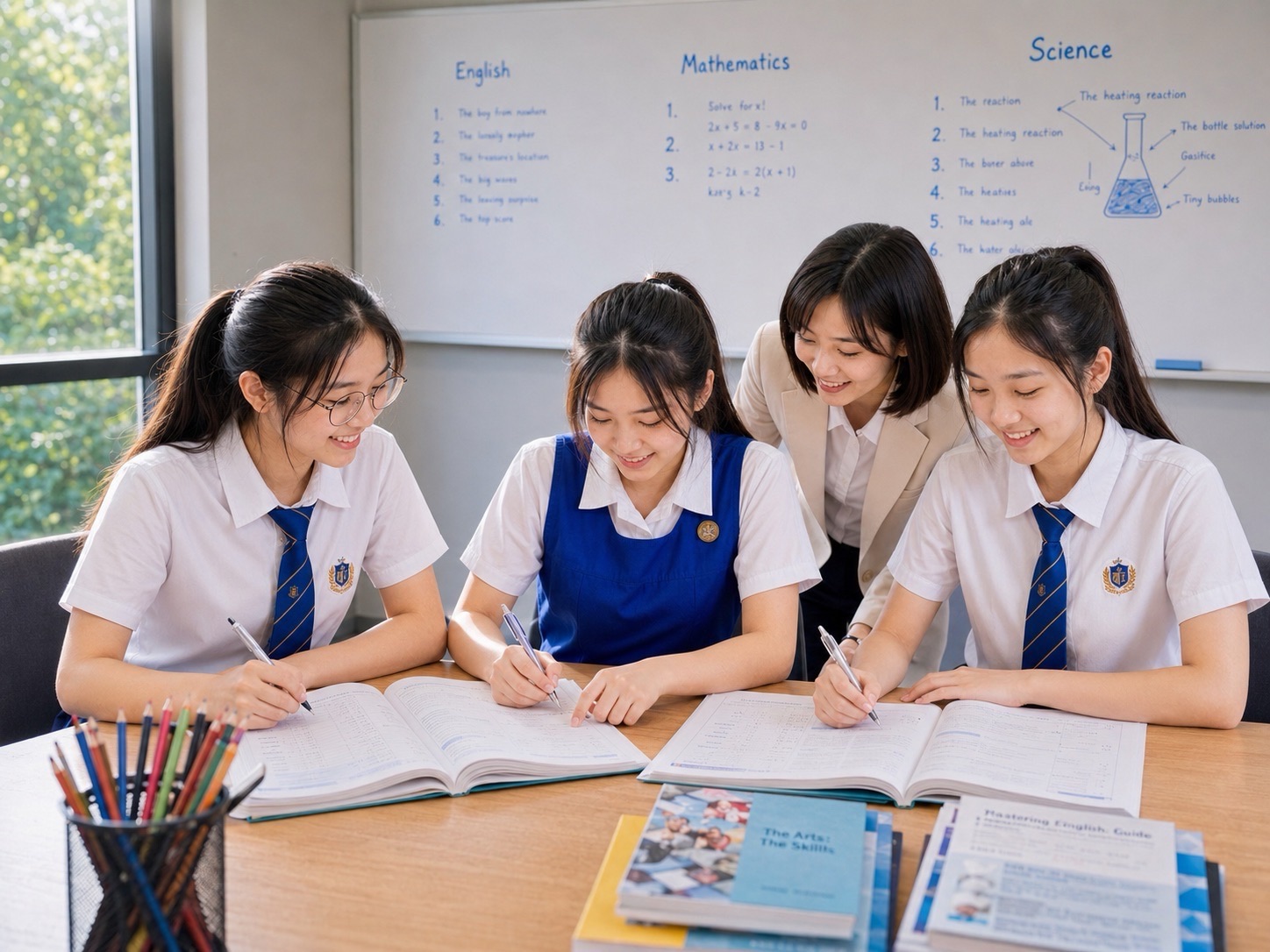
Primary Mathematics tuition is most useful when it reveals how a child thinks through a problem, not when it simply adds another pile of sums. A student can know arithmetic facts and still struggle to represent a word problem, select a strategy, explain the reasoning or notice an unreasonable answer.
This page has one job: help Punggol parents understand when guided small-group problem solving adds value, what a tutor should observe, and how support should gradually turn into independent mathematical control.
For the broad current programme across levels, use Punggol Mathematics Tuition. The level-specific pages for Primary 1 through Primary 6 sit within that pathway. This older article now focuses on the learning mechanism of guided problem solving rather than trying to own every Primary Mathematics query.
What “good at Mathematics” actually contains
A primary-school Mathematics result compresses several abilities into one score. When the score falls, we need to reopen that compression.
- Knowledge: facts, concepts, rules and formulae.
- Fluency: carrying out routine procedures accurately enough.
- Representation: turning information into a model, diagram, table, number sentence or equation.
- Interpretation: understanding what the question gives and asks.
- Strategy selection: choosing a workable route.
- Reasoning: connecting steps and making justified inferences.
- Communication: showing enough working for the solution to be understood.
- Checking: noticing whether an answer is plausible.
- Retention: retrieving earlier knowledge later.
- Transfer: using the same idea when a question looks different.
Two children with the same mark can therefore need completely different help.
The 2026 PSLE Mathematics direction
SEAB lists PSLE Mathematics as subject 0008 for the revised examination from 2026. Its assessment objectives include recalling mathematical facts and procedures, applying concepts and skills in varied contexts, and reasoning mathematically by analysing information and selecting appropriate problem-solving strategies.
That combination explains why a good Primary Mathematics programme cannot choose between fundamentals and problem solving. Students need both. Weak fundamentals overload the child during complex problems; pure routine practice does not teach the child what to do when the problem no longer resembles the worksheet.
Official references: SEAB PSLE formats examined in 2026 and PSLE Mathematics 0008 syllabus.
The word-problem bottleneck
Parents often say, “My child can do the calculation but cannot do problem sums.” That statement is useful because it narrows the search. We can test where the chain breaks.
- Can the child read the problem accurately?
- Can the child identify the quantities and relationships?
- Can those relationships be represented?
- Can the child select a strategy?
- Can the required operations be executed accurately?
- Can the child interpret the computed answer in the original context?
- Can the child check whether it makes sense?
If step two fails, drilling multiplication may not solve the problem. If step five fails, the representation may be correct but arithmetic fluency needs repair. Guided tuition becomes valuable when it can distinguish these cases quickly.
Why guided problem solving is different from giving hints
A hint can make a question easier without making the student stronger. Guided problem solving should reveal the decision the student could not yet make and then teach that decision explicitly.
Instead of “use a model here”, the tutor might ask:
- What quantities are being compared?
- What stays the same?
- What changes?
- Is the question about a total, a difference, a part-whole relationship, a rate or a repeated unit?
- What would a diagram need to show?
- Can you estimate whether the final answer should be larger or smaller than this number?
Over time, those questions should move from the tutor’s voice into the student’s internal checklist.
The support ladder: from “show me” to “I can start”
Support should fade. A useful progression looks like this:
- Model: tutor demonstrates and explains a new representation or method.
- Joint solve: student makes some decisions while the tutor stabilises the route.
- Prompted solve: tutor asks discriminating questions but does not supply the method.
- Independent solve: student completes a similar problem alone.
- Varied solve: the surface details change.
- Mixed solve: the student must identify the topic or strategy without a label.
- Delayed solve: the problem type returns later to test retention.
If a student remains permanently at stages one and two, tuition can create the appearance of progress while increasing dependence.
What a 3-pax Mathematics class makes possible
eduKatePunggol’s current small-group model is up to three students, typically for 1.5 hours. For Mathematics, the advantage is the ability to inspect working while still requiring each student to do enough independent thinking.
- The tutor can see where a student first goes off-route.
- A representation can be corrected before the entire solution is built on it.
- Students can compare two legitimate methods and discuss efficiency.
- One student’s explanation can expose an assumption another student has not noticed.
- Questions can be adjusted in difficulty without abandoning the shared concept.
- The tutor can remove prompts quickly and test whether learning survives.
The format is valuable only when the class remains diagnostic. Three students doing the same worksheet silently is not automatically personalised learning.
Primary 1–2: build number meaning before speed
In the early primary years, students need secure quantity sense, place value, operations and the ability to describe simple mathematical relationships. Speed has a role, but fast recall should grow on top of understanding.
Common warning signs include counting strategies that never become more efficient, confusion around place value, weak comparison of quantities and difficulty translating a simple story into an operation.
Primary 3–4: connect operations to representation
As topics widen, students meet more complex multiplication and division, fractions, measurement, geometry and multi-step problems. The important movement is from “I know this operation” to “I know why this operation represents the situation.”
This is also where a student can begin building a personal problem-solving checklist instead of relying on an adult to identify every method.
Primary 5–6: protect prerequisite chains
Upper-primary Mathematics becomes more demanding because new topics sit on older foundations. Fractions connect to ratio and percentage. Measurement and geometry problems may require several earlier skills. Complex problem sums make reading, representation and strategy selection more important.
If a Primary 6 student is weak in a topic, the fastest repair may begin at a Primary 4 or Primary 5 prerequisite. That is not going backwards. It is rebuilding the condition that the current question assumes.
The “careless mistake” audit
Carelessness is sometimes real, but repeated “careless” errors deserve a more precise label.
- Reading error: a condition was missed.
- Representation error: the diagram or model does not match the question.
- Operation error: the relationship was understood but the wrong calculation was selected.
- Execution error: the correct operation was carried out inaccurately.
- Unit error: the quantity was not converted or labelled correctly.
- Checking error: the answer was implausible but passed through unchallenged.
- Working-memory overload: too many steps were held mentally instead of written clearly.
The repair depends on the category. “Be more careful” is not a complete intervention.
Practice quantity versus practice quality
More questions help when the student needs fluency. They help less when the student is repeating an incorrect method. A good practice set therefore has a purpose.
- Fluency set: enough repetition to make a routine skill dependable.
- Variation set: same concept, different surface forms.
- Discrimination set: neighbouring concepts mixed together.
- Retrieval set: older topics return without warning.
- Transfer set: less familiar problems require the idea to be reconstructed.
- Exam set: realistic timing and mixed demand.
Students need different proportions of these modes at different stages.
When Primary Mathematics tuition may help
- Foundational gaps are preventing the child from following the current school topic.
- Problem sums repeatedly fail at the representation or strategy stage.
- The same error categories return after school corrections.
- Homework takes unusually long because the child cannot start independently.
- Earlier topics are forgotten too quickly.
- Marks fluctuate widely between routine and unfamiliar questions.
- The child has lost confidence because effort is no longer producing predictable results.
- Parents need a clearer diagnosis than “more practice”.
When another class may not be necessary
A child who understands school lessons, completes corrections, retrieves earlier work and is progressing steadily may not need tuition. Independent practice, sleep and ordinary childhood time have value. Likewise, a learner requiring specialised educational support may need a different setting from a mainstream small group.
Tuition should address an identifiable constraint. It should not be added merely because Mathematics is important.
What progress should look like
- The child starts more questions without prompting.
- Models and diagrams better match the problem.
- Calculation errors become less frequent.
- The student explains why a strategy is suitable.
- Earlier topics can be retrieved after a delay.
- Mixed questions cause less freezing.
- Checking catches more unreasonable answers.
- Homework becomes more predictable because less time is lost to uncertainty.
These behaviours are useful leading indicators. They do not justify a guaranteed score claim, but they show whether the learning system is becoming stronger.
Continue to the current Punggol Mathematics pathway
For level-specific Primary Mathematics information and current class routes, continue to Punggol Mathematics Tuition. Parents looking at the wider primary-school journey can also use The Primary Pathway.
About this rebuilt 2017 page
The original article described a Primary 4 “Age” problem-sum lesson and an older six-student group model. The useful historical observation was that understanding the mechanism allows students to solve later variations. This 2026 rebuild keeps that principle, updates the class model and current PSLE context, removes stale marketing claims, and turns the page into a focused guide to guided mathematical problem solving.


