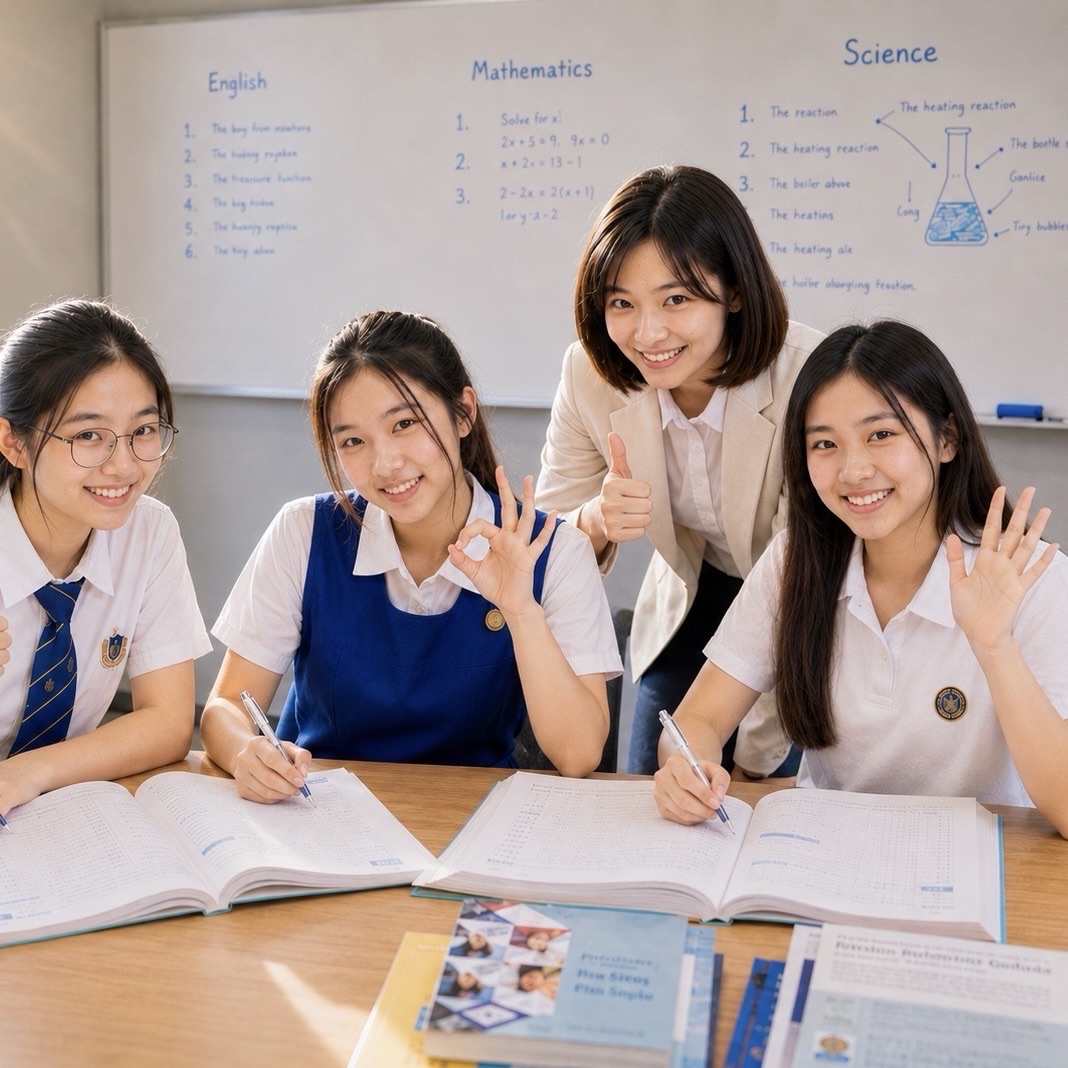
Sengkang Secondary English Tuition with eduKatePunggol
Sengkang Secondary English Tuition with eduKatePunggol provides careful English support for Secondary 1 to Secondary 4 students who need to strengthen comprehension, vocabulary, writing, oral communication and examination performance.
Classes are conducted in small groups of up to three students at eduKatePunggol, near Punggol MRT and Waterway Point. The centre serves students from both Punggol and neighbouring Sengkang who prefer a quieter learning environment where the tutor can observe each student’s work closely, correct errors early and adjust the lesson appropriately.
The purpose is not simply to complete more English worksheets.
It is to help the student understand how the different parts of Secondary English work together—and to turn that understanding into dependable performance.
Secondary English Is a Connected Performance
A student’s English result does not come from vocabulary, grammar, comprehension or writing in isolation.
It is better understood as a connected relationship:
Dependable Secondary English
= Meaning Control × Language Control × Expression × Execution
Each part matters.
- Meaning Control is the ability to understand what a question, passage, image or discussion is actually asking.
- Language Control includes vocabulary, grammar, sentence construction, tone and precision.
- Expression is the ability to organise and communicate ideas clearly.
- Execution is the ability to produce the required answer independently and within the available time.
The relationship is multiplicative rather than additive.
A student may have good ideas but lose marks because the language is unclear. Another may know many impressive words but misunderstand the passage. A third may understand the question but be unable to organise an effective response under examination conditions.
Improvement therefore requires more than adding isolated techniques.
The weak component must be identified, repaired and reconnected to the complete task.
Why Secondary English Becomes More Difficult
The move into Secondary English is not merely a change from easier worksheets to harder worksheets.
The student is increasingly expected to:
- interpret rather than merely locate information;
- distinguish evidence from assumption;
- recognise purpose, tone and perspective;
- explain implied meaning;
- connect information across a text;
- select relevant ideas;
- write for different audiences and purposes;
- support opinions with reasoning;
- control vocabulary and grammar while handling more complex ideas;
- and complete all of this with increasing independence.
This creates a common problem.
A student can appear generally capable in English but still perform inconsistently because one important connection is unstable.
For example:
- the student understands the passage but gives an incomplete answer;
- knows the vocabulary but cannot retrieve it while writing;
- has several ideas but cannot choose the most relevant one;
- writes fluently but does not answer the exact question;
- understands corrections but repeats the same mistake in the next assignment;
- or performs well during guided practice but loses control in a timed paper.
Sengkang Secondary English Tuition should therefore do more than expose students to additional material. It should reveal where the performance chain is breaking.
How eduKatePunggol Approaches Secondary English
At eduKatePunggol, progress is organised around another practical relationship:
Progress
= Diagnosis × Sequence × Guided Practice × Feedback × Transfer
Diagnosis
The tutor first identifies what the student can already do independently.
This may involve examining:
- school examination papers;
- comprehension responses;
- situational and continuous writing;
- vocabulary use;
- grammar patterns;
- oral responses;
- recurring teacher comments;
- incomplete answers;
- and the student’s working process.
The aim is to locate the actual bottleneck.
A composition problem may begin with vocabulary, weak interpretation, poor planning or limited sentence control. A comprehension problem may begin with the student misreading the question rather than misunderstanding the passage.
Correct diagnosis prevents the student from spending months practising the wrong thing.
Sequence
English skills have dependencies.
Students cannot write precise explanations without precise vocabulary. They cannot construct a convincing argument without understanding the issue. They cannot answer an inference question well without connecting evidence to reasoning.
Lessons are therefore sequenced so that the student builds the necessary foundation before being asked to perform the complete task.
Guided Practice
During guided practice, the tutor makes the thinking process visible.
The student learns how to:
- inspect a question;
- locate the important language;
- identify the required response;
- choose evidence;
- organise an explanation;
- construct the answer;
- and check whether the answer is sufficiently precise.
Guidance is gradually reduced as control improves.
Feedback
Feedback should tell the student more than whether an answer is right or wrong.
Useful feedback identifies:
- what the student misunderstood;
- where the response lost precision;
- which sentence weakened the argument;
- why an example was insufficient;
- how the vocabulary changed the tone;
- and what the student should do differently next time.
Transfer
The final test is whether the student can use the skill in a new passage, topic or examination question.
A student has not fully learnt a technique merely because it worked once with the tutor’s help.
The skill becomes dependable when it can be retrieved and applied independently.
Building Vocabulary as a Working Language System
Secondary students are often told to “improve their vocabulary”.
However, memorising disconnected lists of difficult words rarely produces dependable writing or comprehension.
A word becomes useful only when the student knows:
- its meaning;
- its different possible senses;
- its connotations;
- its common word partnerships;
- its grammatical behaviour;
- its level of formality;
- the situations in which it is appropriate;
- and how to retrieve it when needed.
The learning sequence becomes:
Encounter → Understand → Connect → Retrieve → Use → Refine
Consider the difference between knowing the definition of a word and controlling it.
A student may know that reluctant means unwilling. Language control means also understanding the difference between:
- reluctant;
- hesitant;
- resistant;
- apprehensive;
- unwilling;
- and opposed.
These words occupy related territory, but they are not interchangeable.
The student must learn to select the word that matches the intended meaning, intensity and context.
This improves more than composition writing. It also supports:
- comprehension;
- summary;
- editing;
- oral communication;
- inference;
- tone analysis;
- and the interpretation of complex questions.
Vocabulary is therefore taught as part of the entire English system rather than as a decorative addition to an essay.
A More Reliable Method for Comprehension
Many students read the whole passage, look at the question and then write whatever appears reasonable.
This can produce answers that sound intelligent but are not sufficiently supported.
A more dependable comprehension sequence is:
Question → Search Area → Evidence → Reasoning → Answer → Check
1. Question
The student first determines what the question is asking.
Is it asking for:
- a fact;
- an explanation;
- an inference;
- a comparison;
- a reason;
- the writer’s attitude;
- the effect of a phrase;
- or evidence supporting a conclusion?
A student who misclassifies the question is likely to search for the wrong kind of answer.
2. Search Area
The student locates the relevant part of the text.
This does not always mean finding one matching sentence. The answer may depend on information distributed across several lines or paragraphs.
3. Evidence
The student identifies the words, actions, contrasts or details that support the response.
4. Reasoning
The evidence must then be interpreted.
This is often the missing step in weaker answers.
The student may copy relevant material but fail to explain what that material shows.
5. Answer
The final response should answer the question directly, using sufficient precision without unnecessary material.
6. Check
Before moving on, the student checks:
- Did I answer the exact question?
- Did I use the correct evidence?
- Is the relationship between the evidence and conclusion clear?
- Is the answer sufficiently complete?
- Have I introduced an unsupported assumption?
This structure can be adapted across literal, inferential, language-use and higher-order comprehension questions.
Writing That Begins Before the First Sentence
Secondary writing is not solved by memorising a collection of model essays.
Students need to understand how a piece of writing is constructed.
A useful writing sequence is:
Purpose → Interpretation → Position → Evidence → Structure → Language → Editing
Purpose
Who is the student writing for, and what should the writing achieve?
The required tone and content change depending on whether the student is writing:
- an email;
- a speech;
- an article;
- a personal reflection;
- an argumentative essay;
- an expository response;
- or a narrative.
Interpretation
The student must identify the actual boundaries of the question.
Many essays become irrelevant because the student begins writing before deciding what the topic means.
Position
For discursive, expository or argumentative writing, the student needs a clear controlling position.
This position guides which ideas belong in the essay and which should be excluded.
Evidence
Ideas become convincing when they are supported by:
- examples;
- observations;
- explanations;
- comparisons;
- consequences;
- or relevant real-world knowledge.
Evidence should not merely decorate a paragraph. It should help prove the point being made.
Structure
The order of ideas affects the reader’s understanding.
Students learn how to move from:
- introduction to position;
- position to supporting reason;
- reason to evidence;
- evidence to explanation;
- paragraph to paragraph;
- and final synthesis to conclusion.
Language
Only after the reasoning is clear should the student refine sentence structure, vocabulary, transitions and tone.
Editing
Editing is not a final search for spelling mistakes.
It includes checking:
- whether the question has been answered;
- whether the ideas are arranged logically;
- whether each paragraph has a clear function;
- whether examples support the point;
- whether sentences communicate the intended meaning;
- and whether grammar errors interfere with clarity.
Grammar Is Taught Through Meaning
Grammar exercises can help students recognise patterns, but recognition alone does not ensure correct use during writing.
At Secondary level, grammar should support meaning.
Students need to understand how grammatical choices change:
- time;
- emphasis;
- certainty;
- responsibility;
- sequence;
- tone;
- and the relationship between ideas.
For example, a student may complete a worksheet on conjunctions correctly but still produce a paragraph containing several loosely connected thoughts.
The deeper task is to understand what relationship is being expressed:
- cause;
- contrast;
- concession;
- result;
- condition;
- sequence;
- or addition.
Once that relationship is clear, the student can choose an appropriate structure.
This helps grammar move from an isolated exercise into comprehension, composition, editing and oral communication.
Oral Communication Requires Structured Thinking
Speaking confidently is not the same as speaking continuously.
A student may have plenty to say but produce an unfocused response. Another may understand the topic but pause because the ideas have not been organised.
A useful oral sequence is:
Observe → Interpret → Select → Organise → Speak → Extend
The student learns to:
- notice significant details;
- determine what those details suggest;
- select the most useful ideas;
- arrange them into a sensible order;
- express them clearly;
- and extend the response through explanation, examples or personal reflection.
This creates responses that sound natural while remaining coherent.
The same process supports classroom discussion, presentations, interviews and future communication beyond the examination.
The Connections Between English Components Matter
A major difference between surface practice and deeper instruction is the treatment of transitions.
Consider the path from reading to writing:
- The student encounters an idea in a text.
- Vocabulary gives the idea greater precision.
- Comprehension reveals how the writer develops it.
- Discussion allows the student to test an interpretation.
- Planning turns the interpretation into an organised position.
- Writing converts the position into paragraphs.
- Editing improves accuracy and clarity.
- Feedback identifies what remains unstable.
- A new task tests whether the improvement transfers.
These transitions are where many students lose control.
They may perform individual exercises successfully but be unable to combine the skills during a complete examination task.
For this reason, lessons at eduKatePunggol move between isolated repair and integrated performance.
A weak component is strengthened separately when necessary. It is then reintroduced into the full English task so the student learns when, where and how to use it.
Secondary 1 English Tuition for Sengkang Students
Secondary 1 is a transition year.
Students face longer texts, greater vocabulary demands and more complex writing expectations. Answers that were acceptable in Primary school may no longer contain enough explanation or precision.
The immediate priorities commonly include:
- adjusting to Secondary-level comprehension;
- building vocabulary depth;
- writing organised paragraphs;
- understanding tone and purpose;
- improving sentence control;
- supporting ideas with evidence;
- and developing independent study habits.
The goal is not to rush into upper-secondary examination drills.
It is to establish a dependable Secondary English foundation before weak habits become normal.
eduKatePunggol describes its Secondary 1 programme as a bridge from Primary to Secondary English, with attention to comprehension, vocabulary, writing, grammar and oral communication.
Secondary 2 English Tuition for Sengkang Students
Secondary 2 is a consolidation and direction-setting year.
At this stage, students should become more consistent across different text types and writing tasks.
The programme may focus on:
- deeper inference;
- evidence-based answers;
- summary control;
- editing;
- vocabulary selection;
- paragraph development;
- situational awareness;
- discursive reasoning;
- and preparation for upper-secondary expectations.
Students who still depend heavily on prompting may need a stabilisation route.
Students whose foundations are secure can begin extending the depth, flexibility and sophistication of their responses.
Secondary 3 English Tuition for Sengkang Students
Secondary 3 introduces stronger upper-secondary demands.
Students must handle more complex issues, perspectives and argumentative structures. General statements become less convincing. Writing requires clearer positions, stronger evidence and better control of tone.
The student may need support with:
- argumentative and discursive writing;
- situational writing;
- summary;
- higher-order comprehension;
- language-use questions;
- oral discussion;
- editing;
- examination pacing;
- and the connection between evidence and explanation.
This is also the stage where earlier weaknesses become more visible.
A student with limited vocabulary may struggle to discuss complex issues. A student with weak paragraph control may find argumentative writing increasingly difficult. A student who has relied on intuition may begin losing marks in questions requiring precise evidence.
Early diagnosis in Secondary 3 leaves time for genuine repair before the graduating year.
Secondary 4 English Tuition for Sengkang Students
Secondary 4 is the year of integration and execution.
The student must bring reading, vocabulary, grammar, writing, oral communication and examination management together.
At this stage, tuition should not become a frantic collection of disconnected tricks.
The work should be selective:
- identify the remaining high-impact weaknesses;
- repair recurring errors;
- improve response selection;
- strengthen examination routines;
- practise under realistic conditions;
- and make performance more stable.
Singapore’s graduating Secondary students will move into the Singapore-Cambridge Secondary Education Certificate system from 2027, with subjects examined at G1, G2 or G3 levels. The 2026 graduating cohort remains under the existing GCE examination structure. SEAB states that the overall examination standards remain unchanged under the SEC transition.
This makes underlying English capability especially important. Students still need to read accurately, think clearly, communicate meaning and execute the required paper at their respective subject level.
G2 and G3 Secondary English Support
eduKatePunggol’s Secondary English pathway supports students working within the Full Subject-Based Banding environment, including G2 and G3 English. Its current English programme covers Secondary 1 to Secondary 4 and includes analytical writing, comprehension, summary and oral communication.
The appropriate programme should follow the student’s actual language coordinate rather than relying only on a broad label such as “weak”, “average” or “good”.
Two students receiving the same overall mark may require very different instruction.
One may need:
- stronger foundations;
- clearer vocabulary;
- shorter guided steps;
- and more frequent retrieval.
The other may need:
- greater precision;
- deeper interpretation;
- stronger evidence;
- more sophisticated expression;
- and improved timed execution.
Small-group tuition allows these differences to be handled without separating English into a completely private and dependent learning experience.
Why Small Groups of Three Matter
eduKatePunggol keeps its tuition groups to three students per class so the tutor can monitor individual progress and adjust lesson pacing.
In Secondary English, this matters because the tutor needs to see more than a final mark.
The tutor should be able to observe:
- how the student reads the question;
- what the student highlights;
- how evidence is selected;
- whether the student can explain an inference;
- how an essay is planned;
- which vocabulary is retrieved;
- how corrections are applied;
- and whether the student can perform without prompting.
A group of three also allows students to encounter alternative interpretations and ideas.
This can strengthen discussion and reasoning without allowing the student to disappear inside a large class.
The desired environment is:
- personal without creating dependence;
- interactive without becoming crowded;
- structured without becoming inflexible;
- and demanding without becoming impersonal.
Three Routes Through Secondary English Tuition
Not every student requires the same starting point.
1. Repair
The repair route is for students with recurring gaps that are already affecting school performance.
The immediate aim is to locate the fracture, rebuild the required foundation and stop errors from spreading into later work.
This may include:
- sentence construction;
- grammar;
- vocabulary;
- literal comprehension;
- paragraph organisation;
- or basic question interpretation.
2. Stabilise
The stabilisation route is for students who understand many concepts but perform inconsistently.
They may do well in one paper and poorly in another, or complete work successfully with help but struggle independently.
The aim is to make correct performance repeatable.
3. Extend
The extension route is for students with stable foundations who are ready to improve sophistication, depth and examination control.
This may involve:
- more nuanced interpretation;
- stronger argumentation;
- better evidence;
- precise vocabulary;
- flexible sentence structures;
- and more effective editing.
These routes are not permanent labels.
A student may require repair in one component, stabilisation in another and extension in a third.
Common Signs That Secondary English Support May Be Useful
Parents may consider Sengkang Secondary English Tuition when the student:
- reads regularly but still misunderstands questions;
- loses comprehension marks despite locating relevant lines;
- gives answers that are too vague;
- memorises vocabulary but rarely uses it;
- writes essays containing ideas but little development;
- depends heavily on model compositions;
- repeats the same grammar errors after correction;
- takes too long to begin writing;
- struggles to organise oral responses;
- performs inconsistently across English components;
- has dropped in results after entering Secondary school;
- or is approaching upper-secondary examinations with unstable foundations.
One poor result does not automatically mean that tuition is necessary.
The more useful question is whether the result reveals a persistent problem that the student cannot yet diagnose or repair independently.
What Progress Should Look Like
Progress in English is not visible only through a sudden jump in marks.
Earlier signals often include:
- the student understands questions more accurately;
- answers become more direct;
- evidence is selected with less prompting;
- vocabulary becomes more precise;
- essay plans become clearer;
- paragraphs have stronger internal logic;
- grammar errors become less frequent;
- editing becomes more purposeful;
- oral responses become better organised;
- and the student can explain why an answer works.
These are important because they show that control is moving from the tutor to the student.
Marks should eventually reflect this improvement, but the deeper objective is independent capability.
What Happens During the First Stage
The first stage of Secondary English Tuition with eduKatePunggol is usually about orientation and diagnosis.
The tutor needs to understand:
- the student’s present school level;
- subject level where relevant;
- recent results;
- stronger and weaker components;
- examination habits;
- recurring errors;
- current school topics;
- and the amount of independent control already present.
From there, lessons can be organised around the highest-impact need.
A student with weak comprehension precision should not receive exactly the same lesson as a student who understands texts well but cannot develop an essay.
The learning sequence should match the student.
Sengkang Secondary English Tuition Near Punggol MRT
eduKatePunggol is located at 83 Punggol Central, Singapore 828761, near Punggol MRT, Punggol Bus Interchange and Waterway Point. The centre conducts Primary and Secondary tuition by appointment and currently lists weekday and weekend operating hours.
For Sengkang families, this provides access to a nearby small-group Secondary English programme without placing the student in a large lecture-style environment.
The emphasis remains straightforward:
Diagnose carefully.
Teach in the correct sequence.
Practise with purpose.
Correct precisely.
Reapply independently.
Is eduKatePunggol the Right Secondary English Tuition for Your Child?
The programme may be suitable for a student who needs:
- closer observation than a large class can provide;
- clearer explanations;
- help connecting English components;
- structured comprehension reasoning;
- better writing organisation;
- more precise vocabulary;
- individual correction;
- stronger examination routines;
- or a stable route from Secondary 1 towards the graduating examination.
It may also suit a capable student who is already performing reasonably well but wants to move from intuitive English to more deliberate control.
The purpose is not to make the student permanently dependent on tuition.
The purpose is to build enough understanding, method and practice for the student to perform with increasing independence.
Frequently Asked Questions
Where is the Sengkang Secondary English Tuition conducted?
Lessons are conducted at eduKatePunggol, 83 Punggol Central, near Punggol MRT and Waterway Point. The programme is suitable for Sengkang families looking for small-group Secondary English support in the neighbouring Punggol area.
How many students are in each class?
eduKatePunggol conducts small-group classes with up to three students.
Which Secondary levels are covered?
The English programme supports Secondary 1, Secondary 2, Secondary 3 and Secondary 4 students.
Does the programme support G2 and G3 English?
Yes. eduKatePunggol’s current Secondary English programme includes support for students studying English under the Full Subject-Based Banding environment, including G2 and G3 pathways.
What areas of English are taught?
Depending on the student’s needs, lessons can cover vocabulary, grammar, comprehension, summary, situational writing, continuous writing, oral communication, editing, interpretation and examination execution.
Will every student receive the same worksheet?
Students may work on shared English objectives, but the tutor can vary the level of guidance, questioning, correction and extension for each learner.
Can tuition help a student who already reads frequently?
Reading is valuable, but reading volume does not automatically produce comprehension precision, writing structure or examination control. Tuition may help the student convert reading experience into more deliberate language performance.
Is the programme only for weak students?
No. Some students need foundation repair, while others need greater consistency, precision or extension.
How do parents enquire?
Parents may contact eduKatePunggol at +65 8823 1234 to discuss the student’s level, present difficulties and suitable class availability.
A Clearer Route Through Secondary English
English becomes difficult when students are expected to perform a complete task before its underlying parts are stable.
The solution is not endless practice without diagnosis.
It is to understand the performance:
Meaning Control × Language Control × Expression × Execution
Then build progress through:
Diagnosis × Sequence × Guided Practice × Feedback × Transfer
With careful teaching, the student begins to see that vocabulary supports comprehension, comprehension supports reasoning, reasoning supports writing, and writing reveals whether meaning is truly under control.
That is the purpose of Sengkang Secondary English Tuition with eduKatePunggol.
Not simply to complete another worksheet.
But to help the student read with greater accuracy, think with greater structure, communicate with greater precision and perform with greater independence.