
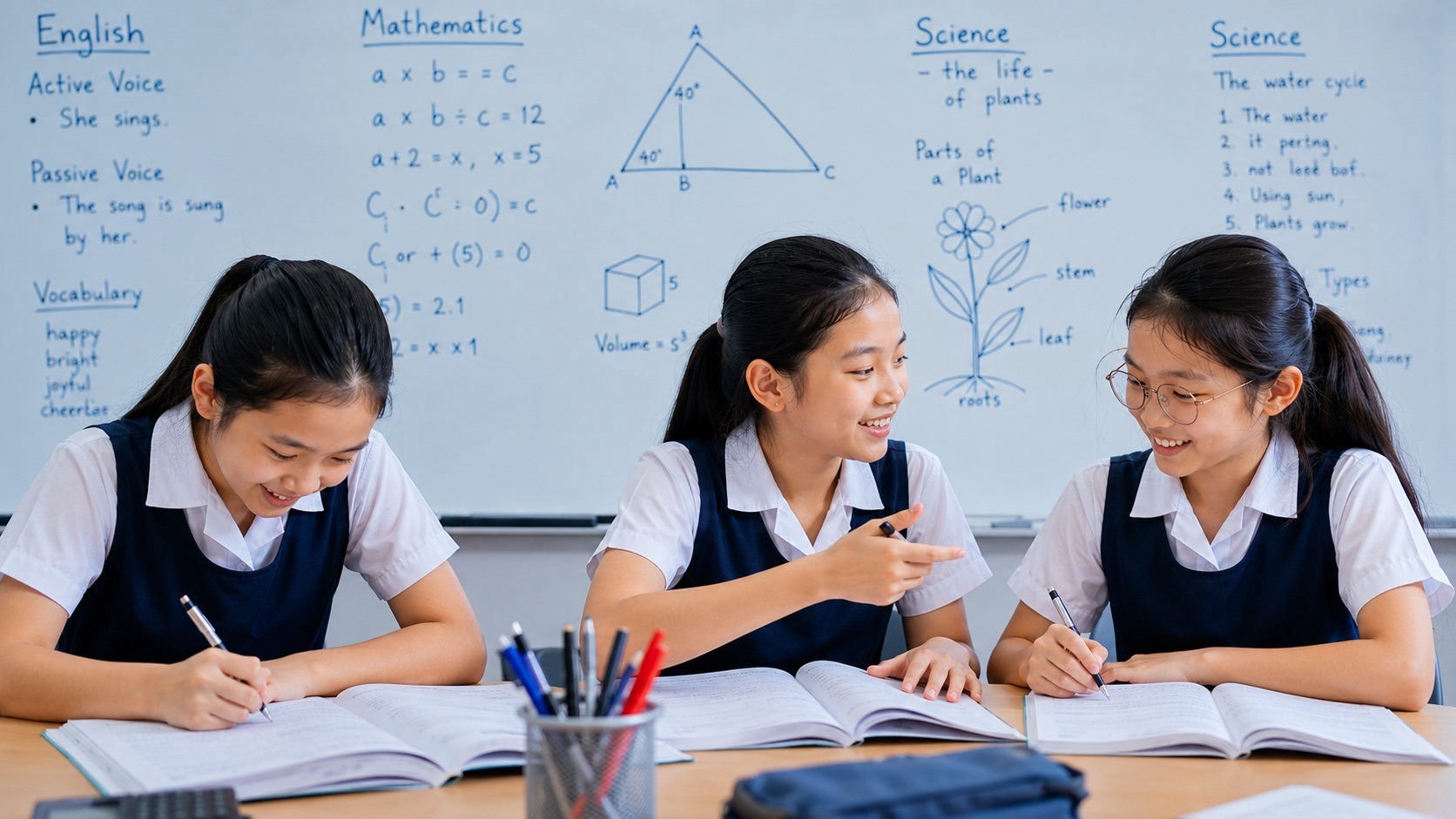
Current Primary 2 programme owner: this page owns the tutor-method, early-literacy integration and independence job. For current class information, local programme details and consultation, use Primary 2 English Tuition at eduKatePunggol.
Punggol Primary 2 English Tutor | Early Literacy to Independent English
Primary 2 is a quiet but important year in English. The child is no longer only learning how print works. Reading, vocabulary, grammar, speaking and writing are beginning to interact. A pupil may be able to sound out a sentence yet miss its meaning, know a word during a spelling test yet fail to use it in writing, or answer orally but struggle to put the same idea on paper. The job of good Primary 2 English tuition is therefore not to rush ahead. It is to make these early language systems work together reliably.
The Ministry of Education’s Primary English Language Syllabus 2020 emphasises developing and extending language skills through enjoyment of language, extensive reading, and the use of oracy, reading and writing to build knowledge and independent language use. That is a useful way to understand Primary 2: the year should deepen foundations and increase independence rather than turn seven- or eight-year-olds into premature examination candidates.
This page owns the Primary 2 tutor-method and learning-independence job. It is distinct from our Primary 1 readiness guide, which asks whether a child is ready to enter formal school English. Primary 2 asks a different question: now that the child has one year of primary schooling behind them, which literacy systems need stabilising so that Primary 3 does not arrive on top of hidden gaps?
Short answer: a strong Primary 2 English tutor helps the child move from recognising → understanding → expressing → checking → doing more independently. The target is not simply more worksheets. It is a more reliable reading, vocabulary, sentence and communication system.

What changes from Primary 1 to Primary 2?
Primary 1 is often dominated by entry into formal literacy: sound-letter relationships, basic reading, classroom language, handwriting and simple sentence construction. Primary 2 begins to ask whether those foundations can survive longer text, less adult prompting and more varied language tasks.
The child is expected to read more smoothly, follow longer instructions, remember and reuse more vocabulary, write more than isolated sentences and answer questions with greater specificity. None of these changes is dramatic by itself. Together, however, they increase cognitive load.
This is why a child can appear “fine” in Primary 1 and suddenly seem slow or reluctant in Primary 2. The earlier skill may still exist, but it is not automatic enough to support the next layer.
The Primary 2 English system
| System | What Primary 2 should build | Typical warning sign |
|---|---|---|
| Reading | Fluent enough decoding plus meaning | Reads words but cannot explain passage |
| Vocabulary | Word meaning, phrase use and recall | Knows definitions but cannot use words |
| Grammar | Stable basic sentence relationships | Worksheet success, writing errors |
| Writing | Complete sentences and short connected text | Writes fragments or only one idea |
| Listening | Follow multi-step spoken language | Misses part of instructions |
| Speaking | Complete answers, retelling, explanation | One-word responses |
| Independence | Attempt, check and ask useful questions | Waits for adult before every step |
Primary 2 diagnostic profile 1: reads aloud well, understands weakly
This child sounds like a good reader. The voice is fluent and the words are mostly correct. Ask what happened, why a character acted, or what one sentence means, and the answers become vague.
The tutor should not simply move the child to harder books. The first repair is meaning. Pause after one paragraph. Ask for a one-sentence retell. Identify one important detail. Explain one cause or feeling using evidence.
Reading fluency is useful because it frees attention for comprehension. If comprehension does not follow, that attention must be deliberately redirected toward meaning.
Primary 2 diagnostic profile 2: understands stories but decodes slowly
This child has strong oral language and can discuss stories read aloud by an adult, but independent reading is laborious. Reading demands so much effort that comprehension collapses by the end of a sentence.
The tutor should protect oral language while repairing decoding. Use age-appropriate phonics and word-pattern work, repeated reading of short passages and books at a level where the child can succeed. Do not replace all reading with flashcards. The child still needs stories and knowledge above their current decoding level through read-alouds.
Primary 2 diagnostic profile 3: strong spelling tests, weak composition spelling
The child memorises weekly words but misspells them when writing a story. This is a transfer problem. The spelling exists under narrow retrieval conditions and disappears when attention is shared with ideas and handwriting.
Move target words into sentences and delayed writing. Three days after the spelling test, ask the pupil to write a short paragraph containing some of the words without announcing which ones. If the spelling disappears, more transfer practice is needed.
Primary 2 diagnostic profile 4: speaks well, writes very little
The ideas are present orally. The bottleneck may be handwriting, spelling load, fear of mistakes or lack of sentence planning.
Use oral rehearsal. Ask the pupil to say one complete sentence, keep the idea in working memory, then write it. For longer work, use three keywords: beginning, important event, ending. The tutor should not transcribe for the child; the bridge must be built by the child.
Primary 2 diagnostic profile 5: completes worksheets, freezes on open questions
Recognition is stronger than production. The pupil can choose the right grammar answer but cannot generate a sentence using the same form.
Every worksheet target should therefore end in production. After choosing has rather than have, write a new sentence using the same agreement pattern. After identifying an adjective, use one to describe an object. Transfer is the proof that the rule has become usable.
Primary 2 diagnostic profile 6: gives very short oral answers
The child may know more than they express. One-word answers can arise from confidence, limited vocabulary, weak sentence retrieval or a habit of adults completing the thought.
Use answer expansion. “Which animal do you prefer?” Child: “Dogs.” Tutor: “Dogs because…?” The target becomes: “I prefer dogs because they are playful and easy to train.” Do not demand a speech. Build one complete idea, then one reason.
Primary 2 diagnostic profile 7: vocabulary is recognisable but not active
The pupil can match enormous with “very large” but never uses it. Active vocabulary requires retrieval in different contexts.
Teach meaning, collocation and one natural phrase. Then speak it, write it, revisit it in a new story and distinguish it from neighbouring words. Vocabulary becomes useful when it travels.
Primary 2 diagnostic profile 8: dependent on adult prompting
The child waits: “What do I do?” “Is this right?” “What word should I use?” Excessive prompting can hide whether the skill is actually learned.
Use a help ladder. First ask the child to reread. Then point to the relevant sentence. Then offer a choice of strategies. Give the answer only after the child has attempted a productive move. Over time, remove the lower rungs.
Reading fluency: accurate enough to carry meaning
Fluency includes accuracy, reasonable pace and phrasing. The goal is not speed for its own sake. A child who races can skip endings and meaning. A child who decodes every word separately can lose the sentence before reaching the full stop.
Use short repeated reading. The first reading focuses on word accuracy. The second on phrasing. The third asks for meaning. Repetition should produce easier processing, not just faster sound.
Reading comprehension: move beyond “what happened?”
Primary 2 pupils can begin to answer simple who, what, where, when, why and how questions. They can identify sequence, cause, feeling and basic inference when the text provides clear clues.
Do not force advanced inference terminology. Ask useful questions: “How do you know she was worried?” “Which sentence gives you the clue?” “What happened before this?” The pupil learns that answers come from the text.
Retelling as a bridge between reading and writing
After reading, close the book. Ask for beginning, important event and ending. The child must select rather than repeat every detail.
Then write one or two sentences about the important event. Retelling strengthens memory, sequence, vocabulary and sentence production together.
Vocabulary: teach words as usable relationships
A word is better learned when the pupil knows what it means, how it sounds, how it is spelt, what words commonly appear with it and where it does not fit.
Instead of “furious = very angry”, compare annoyed, angry, furious. Use situations. Ask which intensity fits. Then write and speak examples.
Vocabulary notebooks should stay small and alive
A huge notebook can become a museum of forgotten words. Keep a manageable active set. Each entry can contain the word, simple meaning, one phrase, one child-generated sentence and one revisit date.
Retire words once they are used naturally. Add new ones from reading and lessons.
Grammar: sentence meaning before terminology
Primary 2 pupils need increasingly stable basic relationships: subject and verb, singular and plural, present and past, pronouns, articles, prepositions and sentence punctuation. Terminology can help, but the child must use the pattern.
Compare “He walk to school” and “He walks to school.” Change the subject to they. The pupil sees agreement as a relationship rather than a list of labels.
Sentence construction: complete before complex
Primary 2 writing benefits from strong complete simple sentences. “The bird flew away.” “Maya opened the box.” These are not childish weaknesses. They are stable building units.
Then expand: where, when, why, how. “Maya opened the box carefully because she heard a sound inside.” Complexity should grow from meaning, not from a requirement to use longer sentences.
Paragraph beginnings
By Primary 2, some pupils are ready to group two or three related sentences. A short paragraph might introduce a person, describe an activity or retell one part of an event.
Teach one paragraph job at a time. Do not force formal composition structures beyond what the child can control.
Writing from pictures
Picture writing is useful because it reduces idea-generation load. Ask the pupil to identify who, where, what happened and one detail. Say the sentence first, then write.
As control improves, ask for sequence and cause. The picture is a scaffold, not a permanent dependency.
Listening: multi-step classroom language
Primary 2 pupils encounter longer instructions and more classroom routines. Practise with two- and three-step directions and ask the child to repeat them before acting.
Listening practice can also use short stories. First listen for gist, then listen for one detail. Different purposes train different attention.
Speaking: full ideas, not performance speeches
Build everyday explanation: preference + reason, event + sequence, object + description, opinion + example.
Use real conversation and story discussion. Formal oral performance can come later. A child who can communicate clearly in ordinary interaction is building a strong base.
Spelling: pattern plus transfer
Use sound, spelling patterns, morphology and memory. Group words where a pattern is genuinely useful. Practise irregular high-frequency words separately when needed.
Most importantly, move spelling into sentences. A spelling test is a rehearsal; independent writing is the transfer test.
The Primary 2 error ledger
| Error | System | Repair | Retest |
|---|---|---|---|
| Reads but cannot retell | Comprehension | One-sentence summary | New passage |
| He have | Agreement | Compare he/they pattern | Fresh sentence |
| Because fragment | Sentence | Add main clause | Next paragraph |
| Word correct in test, wrong in story | Spelling transfer | Delayed sentence use | 3–7 days |
| One-word oral answer | Speaking | Answer + reason | New topic |
A 90-minute Primary 2 small-group lesson
- 10 minutes — retrieval: old vocabulary, spelling and one grammar pattern.
- 20 minutes — reading: fluency, vocabulary and meaning.
- 15 minutes — oral: retell, answer and explain.
- 20 minutes — sentence/writing: convert ideas into written language.
- 15 minutes — grammar/spelling repair: use errors from real work.
- 10 minutes — independence: self-check and one home target.
In a group of up to three pupils, the same story can serve different goals. One child may work on decoding, another on inference and another on paragraph writing. Small-group tuition works best when the shared material does not erase individual diagnosis.
A six-week Primary 2 repair cycle
- Week 1: baseline reading, oral and writing sample.
- Week 2: decoding/fluency or comprehension priority.
- Week 3: vocabulary and sentence control.
- Week 4: short paragraph and oral-to-writing transfer.
- Week 5: mixed reading/writing with reduced prompting.
- Week 6: new unseen text and independent writing retest.
How parents know the tuition is working
- Reading requires fewer prompts.
- The child can retell more accurately.
- Spoken answers become fuller.
- Writing contains more complete sentences.
- Repeated grammar errors decline.
- Vocabulary appears outside the original lesson.
- The child checks some work independently.
- Resistance to English tasks decreases because tasks feel more manageable.
Marks may follow, but these behaviours are often earlier and more informative signs that the system is strengthening.
When Primary 2 tuition may not be necessary
A child who reads with growing fluency and understanding, writes complete age-appropriate sentences, responds to school feedback and enjoys using English may not need separate tuition. Shared reading, conversation and normal school work may be enough.
Extra support is useful when one or more early systems remain persistently fragile despite appropriate school and home practice.
Questions parents can ask a Primary 2 English tutor
- Is my child’s main reading issue decoding or comprehension?
- How do you move spelling from tests into writing?
- How do you teach vocabulary for active use?
- How do you build complete sentences before longer writing?
- How do you use oral rehearsal without writing for the child?
- How do you track recurring grammar errors?
- How do you reduce prompting over time?
- How much real reading happens in class?
- How do you know when Primary 2 support is no longer necessary?
At eduKatePunggol
eduKatePunggol normally teaches up to three pupils for about 90 minutes at 83 Punggol Central. The small group allows each child to read aloud, speak, write and receive direct correction without turning the lesson into one-to-one dependence.
A Primary 2 lesson should still feel developmentally appropriate. It can be structured and rigorous without becoming a Primary 6 examination class. The tutor’s responsibility is to make the next stage easier by stabilising the current one.
Useful next pages
- Primary 1 English Readiness
- Primary English Spelling & Grammar
- Primary English Communication Transfer
- Primary 3 English Tutor
Frequently asked questions
Should Primary 2 already be preparing for PSLE?
Primary 2 should build foundations that later support PSLE, but it does not need premature exam drilling. Reading, vocabulary, grammar, speaking and writing should grow in age-appropriate ways.
How much homework should a Primary 2 tutor give?
Enough to retrieve and transfer the current targets without replacing school, reading, sleep and play. Short high-quality practice is often more useful than a large repetitive pack.
Is phonics still useful in Primary 2?
Yes, when decoding remains a weak link. For a fluent reader, lesson time may be better spent on comprehension, vocabulary and writing.
Should a child memorise model paragraphs?
Models can demonstrate sentence and paragraph patterns, but the child should create new content rather than reproduce whole passages.
The Primary 2 standard
A strong Primary 2 learner is not a miniature exam candidate. The child can increasingly read for meaning, use vocabulary actively, build complete sentences, speak in fuller ideas, write short connected text and attempt work before asking for the answer.
That is the educational purpose of Primary 2 English tuition: turn early literacy into increasingly independent English.





