
How a Tutorial Works at eduKate Punggol
A useful tutorial is not simply a smaller classroom. It is a learning loop in which the tutor can see what the student is doing, locate the earliest weak step, teach precisely, and then test whether the learning survives without help.
Quick answer: an eduKate Punggol tutorial typically moves through Observe → Teach → Attempt → Correct → Vary → Retrieve → Independence. The sequence is adjusted to the learner and subject rather than applied mechanically.

Tutorial Is the Session Layer
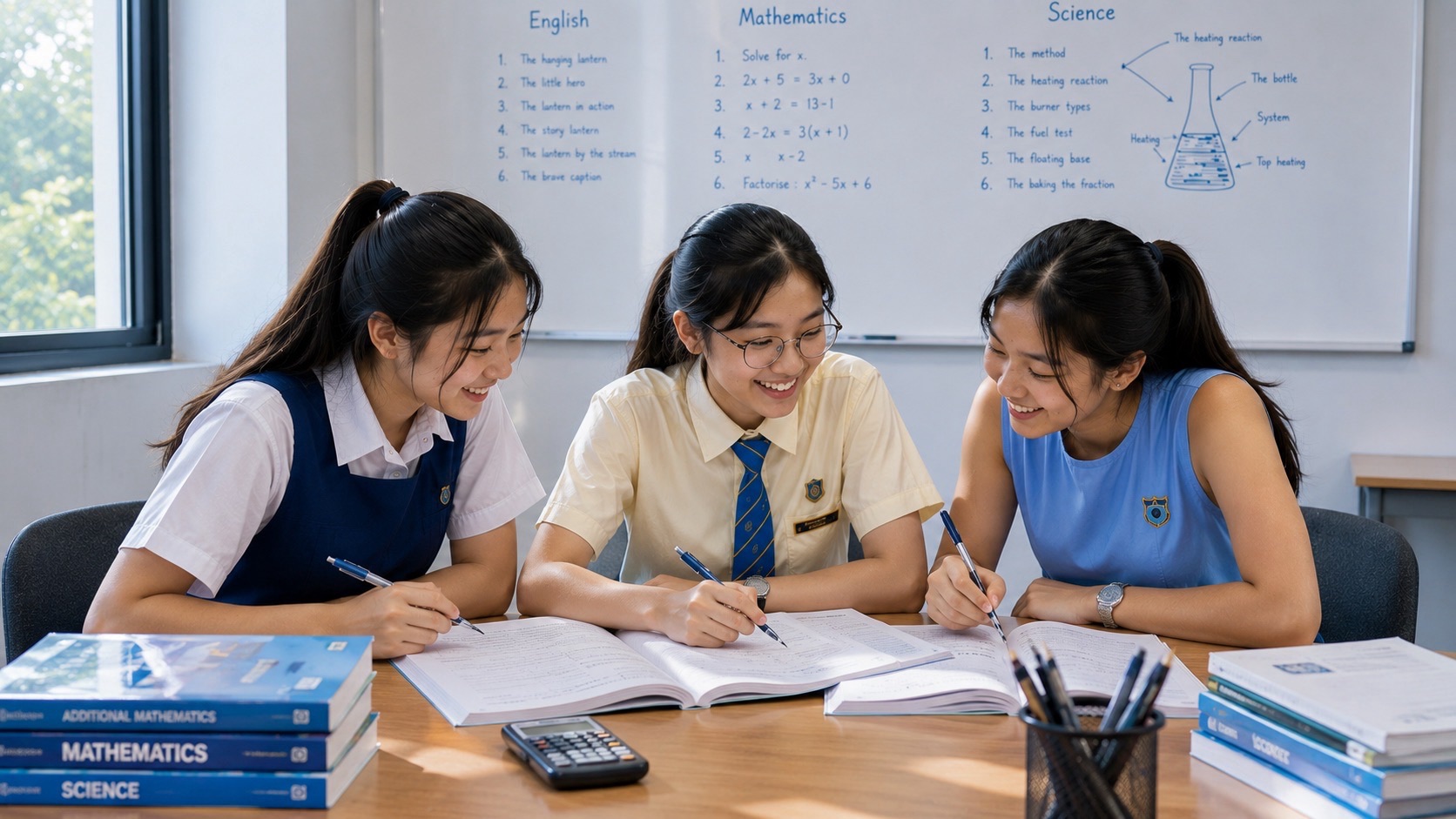
At eduKate Punggol, tuition is the wider service, the tutorial is the actual class session, and the tutor is the student-facing teacher in that session. Keeping those roles clear helps parents understand what a weekly lesson is supposed to accomplish.
The tutorial should convert time into stronger capability. Completing a worksheet is not enough if the student remains unable to explain, retrieve or apply the learning later.
1. Observe: Make the Learner Visible
The tutor first needs evidence. That may come from school work, a marked paper, a short diagnostic question, oral explanation, written working or a new problem attempted in class.
The important question is not simply “Did the student get it wrong?” but where did the reasoning first stop being reliable?
- Did the student misunderstand the instruction?
- Is prerequisite knowledge missing?
- Is the concept understood but the method unstable?
- Can the student solve familiar questions but not changed ones?
- Does performance collapse only under time pressure?
2. Teach: Repair the Smallest Useful Missing Piece
Once the weak point is visible, the tutor can decide how much teaching is actually needed. Sometimes the right response is a full concept rebuild. Sometimes one definition, one representation or one comparison unlocks the problem.
Teaching may involve an example, diagram, model, sentence comparison, worked solution, counterexample or guided question. The form changes by subject, but the purpose is the same: make the relationship clear enough that the student can use it.
3. Attempt: The Student Must Do the Thinking
Explanation is not yet learning. After teaching, the student needs to attempt the task. The tutor should reduce prompting enough to see whether the learner can begin, choose and continue independently.
This is where a small tutorial becomes useful. A tutor can watch the actual attempt rather than infer understanding from silence or from a copied model answer.
4. Correct: Use Errors as Information
Correction should identify the cause, not merely replace the answer. A useful correction distinguishes between a concept error, a method error, a reading error, an accuracy error, a language-control error and an examination-execution error.
The student should then attempt again. The second attempt matters because it shows whether the correction changed the next decision.
5. Vary: Test Transfer
A learner can look successful when the new question is almost identical to the example. Transfer begins when the surface changes but the underlying idea remains.
- Change the numbers.
- Change the wording.
- Change the representation.
- Mix the idea with another topic.
- Remove the obvious cue that tells the student what method to use.
If the learning survives variation, understanding is becoming more portable.
6. Retrieve: Check What Remains Later
Performance immediately after explanation can be misleading. A later retrieval attempt shows whether the student still owns the knowledge once the example and tutor prompt are gone.
For this reason, useful tutorials connect across weeks. An old weakness should reappear in later mixed work so retention can be checked rather than assumed.
7. Independence: Reduce Tutor Control
The long-term aim is not a student who performs only when a tutor is present. It is a student who increasingly knows how to begin, check, recover from error, retrieve prior learning and decide what to do next.
Good tuition therefore contains a deliberate transfer of responsibility from tutor to learner.
How the Loop Looks in Different Subjects
| Subject | What may be observed | What transfer looks like |
|---|---|---|
| English | Vocabulary, sentence control, reading, comprehension, writing organisation, oral response | Using language accurately in a new text, topic or communicative situation |
| Mathematics | Concept, representation, method, working, accuracy, strategy selection | Recognising the same structure in an unfamiliar problem |
| Science | Concept, observation, evidence, causal explanation, scientific vocabulary | Applying a scientific relationship to a changed context or experiment |
Why Maximum Three Students Matters
eduKate Punggol keeps tutorials to a maximum of three students. The value is not the number by itself. The value is that each student’s thinking can remain visible enough for the tutor to observe attempts, compare approaches, correct early and still allow useful peer explanation.
A three-student tutorial can also expose students to another way of thinking without turning the lesson into a large-group lecture.
A 1.5-Hour Lesson Should Have a Clear Job
Current eduKate Punggol tutorials are 1.5 hours. That time can include retrieval, explicit teaching, guided practice, independent attempt, feedback and mixed review. The balance changes with the learner’s state and proximity to school assessments.
The lesson should finish with more information than it started with: what improved, what remains unstable, and what the student should be able to do next.
What Parents Can Look For
- Can the child explain what was learned?
- Are repeated errors decreasing?
- Can the child handle a changed version?
- Is the tutor able to explain the current weak point specifically?
- Is prompting gradually reducing?
- Does improvement appear in school work, not only tuition worksheets?
Continue
Privacy: this page explains the visible teaching loop. Private student records and confidential learning records remain private.





